




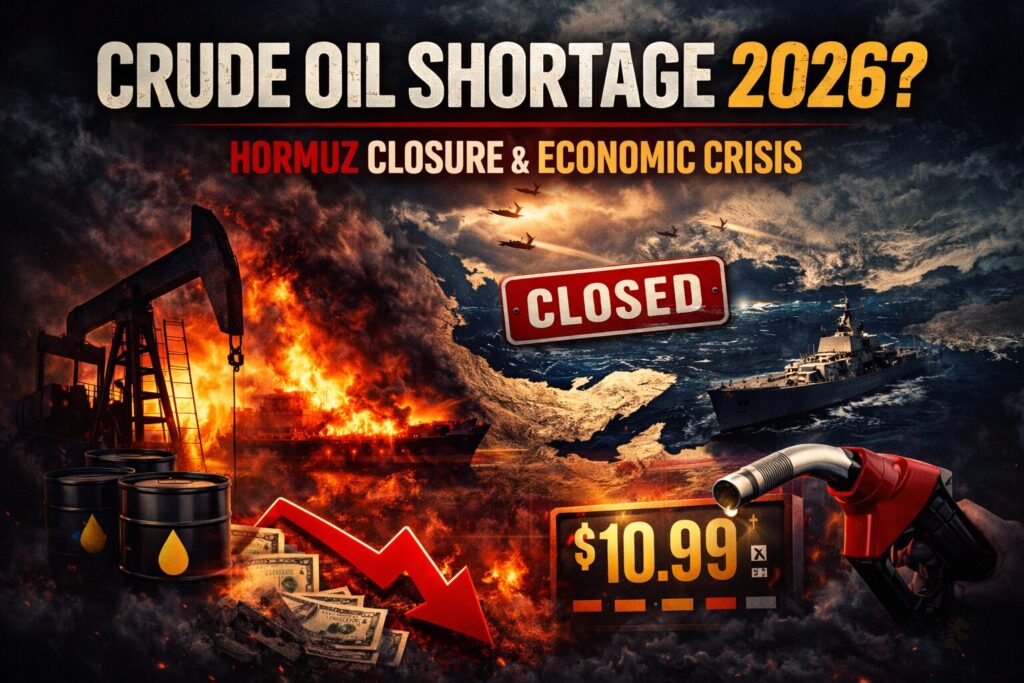
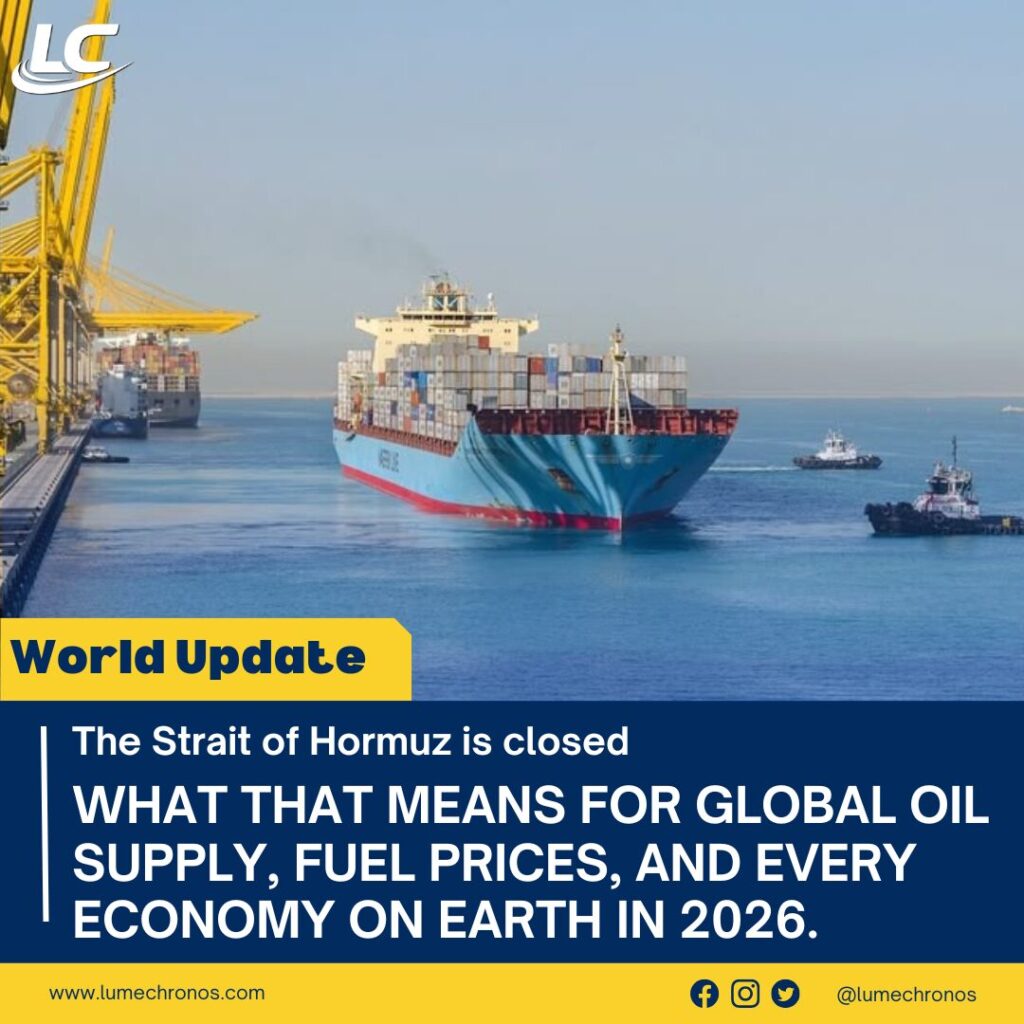
Imagine pulling into a gas station and watching the pump tick past $7 a gallon — and still climbing. Now picture that same panic spreading simultaneously through airline boardrooms, shipping company war rooms, and emergency cabinet meetings in Tokyo, New Delhi, and Brussels. That is not a doomsday thought experiment. That is the documented, unfolding reality of the crude oil shortage Strait of Hormuz crisis of 2026 — a crisis that formally ignited on February 28, 2026, when joint U.S.-Israeli military strikes on Iran triggered retaliatory closures of the world’s most critical energy corridor.
Within 72 hours, tanker traffic through the strait had dropped by approximately 70%, and by March 2, virtually no vessel was broadcasting transit signals through the waterway. Iran’s IRGC declared any ship attempting passage a “legitimate target,” and by March 11, the IRGC threatened that “not one litre of oil” would pass through. Oil analysts at NBC News described it as the “largest supply disruption in history” — one that, according to commodities strategists, dwarfs even the Russia-Ukraine energy shock.
📺 Watch: NBC News — Oil Soars 10% as Hormuz Disruption Worsens
The Strait of Hormuz, the narrow 21-mile-wide waterway sitting between Iran and Oman, has long been the most critical oil chokepoint on the planet — and the crude oil shortage Strait of Hormuz situation of 2026 has made that vulnerability impossible to ignore. In 2024, roughly 20 million barrels of crude oil passed through it every single day, representing nearly 20% of global oil consumption and around 31% of all seaborne crude trade, according to energy analytics firm Kpler. In 2026, those numbers made the disruption catastrophic at scale.
There is no simple detour — Saudi Arabia’s East-West Pipeline can handle only about 2.6 million barrels per day as a bypass, a fraction of what normally flows through. Iran’s strategy compounded the crisis further: in February 2026, Iranian drone strikes targeted Oman’s bypass ports of Duqm and Salalah — the very alternative routes the world hoped to use — damaging fuel storage infrastructure and forcing shippers to reroute all the way around the Cape of Good Hope, adding weeks and enormous cost to every voyage. Insurance markets simultaneously withdrew coverage, effectively closing the strait even where Iranian forces had not yet physically blocked it.
📺 Watch: CNBC — Experts Weigh Scenarios If Strait of Hormuz Closes |
🔗 Source: U.S. Energy Information Administration — Hormuz Chokepoint Data
Yet even as analysts warned of it for years, most people still do not fully grasp how far the damage from a crude oil shortage Strait of Hormuz event travels beyond pump prices. This is not just an energy story — it is a food story, a manufacturing story, and a geopolitical realignment story happening in real time. Goldman Sachs economists, modeling a scenario where Brent crude averages $98–$110 per barrel through March and April 2026, have already raised their U.S. inflation forecast and trimmed GDP growth projections, with recession odds rising to 25%.
Oxford Economics goes further, warning that oil at $140 per barrel for two consecutive months would push the eurozone, the UK, and Japan into contraction. Iran’s IRGC has openly threatened $200-per-barrel oil, framing the price entirely as a function of regional security. The crude oil shortage Strait of Hormuz ripple has already hit fertilizer markets — urea prices jumped from $475 to $680 per metric ton — threatening the U.S. spring planting season for corn and soybeans. Meanwhile, about 30% of Europe’s jet fuel and 20% of global LNG ordinarily transits this same waterway.
South Asian nations face the sharpest edge: Qatar and the UAE supply 99% of Pakistan’s LNG and 72% of Bangladesh’s, with neither country holding meaningful strategic reserves. The crude oil shortage Strait of Hormuz is not a single commodity problem. It is a cascading systems failure — and this article breaks it all down: the geopolitical backstory, the economic shockwaves, the industries hit hardest, and what individuals, businesses, and governments can realistically do right now.
📺 Watch: Al Jazeera — Shutdown of Hormuz Strait: Global Impact Explained
| 🔗 Source: Axios — Oil Prices & Recession Risk: What Happens If Hormuz Stays Closed
| 🔗 Source: Kpler — Hormuz Crisis Reshapes Global Oil Markets
1. Why the Strait of Hormuz Is the World’s Most Dangerous Chokepoint
Geography as Destiny
You can trace a straight line on a map and understand why this matters instantly. The crude oil shortage Strait of Hormuz crisis of 2026 did not emerge from nowhere — it was written into the geography of the planet centuries ago. The Strait of Hormuz is only about 33 kilometers wide at its narrowest point, with designated shipping lanes managed under International Maritime Organisation (IMO) protocols spanning just a few kilometers across in each direction.
On one side: Iran, whose coastline overlooks the entire navigable channel, giving its IRGC forces an almost effortless line of sight to any vessel attempting transit. On the other: Oman and the United Arab Emirates. In between: supertankers — some stretching nearly 400 meters in length — carrying what analysts rightly call the lifeblood of the modern global economy. Just 30 miles wide, the strait is challenging to pass through even in peacetime, with the narrow shipping lane overlooked by a large stretch of Iran’s coastline, giving the country ample opportunity to attack ships. CNBC In March 2026, that geographic reality became a weapon. 📺 Watch: NBC News — Why It’s So Hard to Get Oil Through the Strait of Hormuz Right Now
The scale of what ordinarily flows through this corridor is almost impossible to overstate, and it is precisely that scale that makes the crude oil shortage Strait of Hormuz situation so catastrophic when disrupted. In 2024, oil flow through the strait averaged 20 million barrels per day, equivalent to about 20% of global petroleum liquids consumption, and flows through the strait made up more than one-quarter of total global seaborne oil trade.
CNBC Around one-fifth of all global liquefied natural gas (LNG) trade also transits Hormuz — primarily from Qatar — meaning the disruption hits natural gas markets just as hard as crude markets. In 2024, an estimated 84% of crude oil and condensate from the region transited the strait. Wikipedia That single figure tells you everything: the Persian Gulf’s oil wealth has almost nowhere else to go. 🔗 Source: U.S. Energy Information Administration — Hormuz Chokepoint Analysis
Saudi Arabia, Iraq, Kuwait, the UAE, Bahrain, and Qatar all depend on the crude oil shortage Strait of Hormuz corridor to export their oil to the world. Without access through Hormuz, these countries have no practical alternative to move their crude at scale — and this is not a theoretical limitation but a live, tested reality in 2026. There are some pipeline options: Saudi Arabia’s East-West Pipeline, for instance, can push crude overland to Red Sea ports, bypassing the strait entirely. But very few alternative options exist to move oil out of the strait if it is closed, and the East-West Pipeline capacity is nowhere near sufficient to compensate for the volume that moves through the strait daily.
CNBC When Iran’s IRGC launched drone strikes against Oman’s deep-water ports of Duqm and Salalah in early March 2026 — the very bypass ports that logistics planners had hoped to use — even those backup options collapsed. Sohar, the third major Omani bypass port, fell within an insurer’s war risk area, increasing charter and insurance costs so severely that most shipping companies decided to reroute around the southern tip of Africa entirely. Wikipedia 🔗 Source: Wikipedia — 2026 Strait of Hormuz Crisis
What truly distinguishes this crude oil shortage Strait of Hormuz event from every previous threat in history is the speed with which the closure became total and verifiable. Traffic is down 90% amid the crisis, with hundreds of ships at anchor off the coasts of major oil exporters such as Saudi Arabia and Iraq, according to the tracking website MarineTraffic. CNBC At least 13 commercial ships have been struck in the strait since U.S.-Israeli strikes sparked the conflict on February 28, 2026, according to the UK Maritime Trade Operations (UKMTO).
Axios Iran’s position is unambiguous: an Iranian armed forces spokesperson declared that the country would “not allow even one liter of oil to pass through the Strait of Hormuz for the benefit of the U.S. and its allies,”
CNBC before warning that oil prices could reach $200 a barrel. In response, the International Energy Agency (IEA) authorized an unprecedented release of 400 million barrels from strategic reserves — the largest emergency release in history — in a bid to stabilize global markets. It has so far provided only partial relief. 📺 Watch: Al Jazeera — U.S. Military “Not Ready” to Escort Oil Ships Through Hormuz | 📺 Watch: CNBC — How the Strait of Hormuz Closure Became a Global Economic Tipping Point
In one paradoxical footnote that reveals the geopolitical complexity of this crisis, Iran has continued to ship its own crude oil via the crude oil shortage Strait of Hormuz corridor to China, even as the conflict chokes the waterway for every other nation. Al Jazeera The closure, in other words, is selective — a calculated weapon, not a natural disaster. It denies oil to U.S. allies while preserving a revenue stream for Tehran through its most loyal trading partner. Understanding this distinction is essential, because it reframes the crude oil shortage Strait of Hormuz not merely as a geographic accident but as a deliberate act of economic warfare — one that is reshaping global energy trade in real time.
🔗 Source: CNBC — Iran Ships Oil to China Through Hormuz Even as War Chokes the Waterway
| 🔗 Source: Military.com — Iran Takes War to Sea, Attacks Ships in Strait of Hormuz
1. Why the Strait of Hormuz Is the World’s Most Dangerous Chokepoint
Geography as Destiny
You can trace a straight line on a map and understand why this matters instantly. The crude oil shortage Strait of Hormuz crisis of 2026 did not emerge from nowhere — it was written into the geography of the planet centuries ago. The Strait of Hormuz is only about 33 kilometers wide at its narrowest point, with designated shipping lanes managed under International Maritime Organisation (IMO) protocols spanning just a few kilometers across in each direction. On one side: Iran, whose coastline overlooks the entire navigable channel, giving its IRGC forces an almost effortless line of sight to any vessel attempting transit. On the other: Oman and the United Arab Emirates.
In between: supertankers — some stretching nearly 400 meters in length — carrying what analysts rightly call the lifeblood of the modern global economy. Just 30 miles wide, the strait is challenging to pass through even in peacetime, with the narrow shipping lane overlooked by a large stretch of Iran’s coastline, giving the country ample opportunity to attack ships. CNBC In March 2026, that geographic reality became a weapon. 📺 Watch: NBC News — Why It’s So Hard to Get Oil Through the Strait of Hormuz Right Now
The scale of what ordinarily flows through this corridor is almost impossible to overstate, and it is precisely that scale that makes the crude oil shortage Strait of Hormuz situation so catastrophic when disrupted. In 2024, oil flow through the strait averaged 20 million barrels per day, equivalent to about 20% of global petroleum liquids consumption, and flows through the strait made up more than one-quarter of total global seaborne oil trade.
CNBC Around one-fifth of all global liquefied natural gas (LNG) trade also transits Hormuz — primarily from Qatar — meaning the disruption hits natural gas markets just as hard as crude markets. In 2024, an estimated 84% of crude oil and condensate from the region transited the strait. Wikipedia That single figure tells you everything: the Persian Gulf’s oil wealth has almost nowhere else to go. 🔗 Source: U.S. Energy Information Administration — Hormuz Chokepoint Analysis
Saudi Arabia, Iraq, Kuwait, the UAE, Bahrain, and Qatar all depend on the crude oil shortage Strait of Hormuz corridor to export their oil to the world. Without access through Hormuz, these countries have no practical alternative to move their crude at scale — and this is not a theoretical limitation but a live, tested reality in 2026. There are some pipeline options: Saudi Arabia’s East-West Pipeline, for instance, can push crude overland to Red Sea ports, bypassing the strait entirely. But very few alternative options exist to move oil out of the strait if it is closed, and the East-West Pipeline capacity is nowhere near sufficient to compensate for the volume that moves through the strait daily.
CNBC When Iran’s IRGC launched drone strikes against Oman’s deep-water ports of Duqm and Salalah in early March 2026 — the very bypass ports that logistics planners had hoped to use — even those backup options collapsed. Sohar, the third major Omani bypass port, fell within an insurer’s war risk area, increasing charter and insurance costs so severely that most shipping companies decided to reroute around the southern tip of Africa entirely. Wikipedia 🔗 Source: Wikipedia — 2026 Strait of Hormuz Crisis
What truly distinguishes this crude oil shortage Strait of Hormuz event from every previous threat in history is the speed with which the closure became total and verifiable. Traffic is down 90% amid the crisis, with hundreds of ships at anchor off the coasts of major oil exporters such as Saudi Arabia and Iraq, according to the tracking website MarineTraffic. CNBC At least 13 commercial ships have been struck in the strait since U.S.-Israeli strikes sparked the conflict on February 28, 2026, according to the UK Maritime Trade Operations (UKMTO).
Axios Iran’s position is unambiguous: an Iranian armed forces spokesperson declared that the country would “not allow even one liter of oil to pass through the Strait of Hormuz for the benefit of the U.S. and its allies,”
CNBC before warning that oil prices could reach $200 a barrel. In response, the International Energy Agency (IEA) authorized an unprecedented release of 400 million barrels from strategic reserves — the largest emergency release in history — in a bid to stabilize global markets. It has so far provided only partial relief. 📺 Watch: Al Jazeera — U.S. Military “Not Ready” to Escort Oil Ships Through Hormuz | 📺 Watch: CNBC — How the Strait of Hormuz Closure Became a Global Economic Tipping Point
In one paradoxical footnote that reveals the geopolitical complexity of this crisis, Iran has continued to ship its own crude oil via the crude oil shortage Strait of Hormuz corridor to China, even as the conflict chokes the waterway for every other nation. Al Jazeera The closure, in other words, is selective — a calculated weapon, not a natural disaster. It denies oil to U.S. allies while preserving a revenue stream for Tehran through its most loyal trading partner.
Understanding this distinction is essential, because it reframes the crude oil shortage Strait of Hormuz not merely as a geographic accident but as a deliberate act of economic warfare — one that is reshaping global energy trade in real time. 🔗 Source: CNBC — Iran Ships Oil to China Through Hormuz Even as War Chokes the Waterway | 🔗 Source: Military.com — Iran Takes War to Sea, Attacks Ships in Strait of Hormuz
2. The Crude Oil Shortage: What It Means for Global Supply and Prices
Immediate Supply Shock
When the crude oil shortage Strait of Hormuz becomes a physical reality — not a theoretical risk but a live, enforced blockade — the supply side of the global oil equation takes an immediate, brutal hit unlike anything modern markets have ever processed at this speed. The countries that export through Hormuz collectively account for the overwhelming majority of OPEC’s productive output. Saudi Arabia alone exported roughly 7–8 million barrels per day before the conflict; Iraq contributed another 4.3 million, which has since collapsed by 70% to approximately 1.3 million barrels per day as tankers sit stranded and Iraqi fields run out of storage space.
The IEA confirmed in its March 2026 report that Gulf countries have already cut oil production by at least 10 million barrels per day as a direct consequence of the closure — making this the largest supply disruption in the history of the global oil market. Al Jazeera Add Kuwait, the UAE, and Qatar to the equation, and you are looking at 17–18 million barrels per day suddenly unable to reach buyers at scale. Tanker transits through the waterway collapsed from 24 daily vessels to just 4 vessels within 24 hours of the escalation — an 83% reduction that occurred so rapidly it validated every worst-case model analysts had previously called alarmist. Al Jazeera
The global market runs on tight margins, and those margins evaporate instantly in a crude oil shortage Strait of Hormuz event of this magnitude. Andrew Lipow, president of Lipow Oil Associates, put it plainly: “Now that we’re losing 20 million barrels a day of supply, that is a shock to the system, because there’s no readily available source other than strategic petroleum reserves to make up for the shortfall — and those reserves are limited.
” Wikipedia He added that if the strait remains closed, prices will inevitably push toward $200 per barrel, because eventually Saudi Arabia — which produces 10 million barrels per day — would need to shut in production entirely due to nowhere to send its crude. This is not abstract modeling. By March 3, Bloomberg reported that Iraq had already begun shutting down operations at the Rumaila oil field due to a lack of storage space, as tankers were unable to leave the strait. CNBC 📺 Watch: NBC News — Oil Supply Shock: What Losing 20 Million Barrels a Day Means | 🔗 Source: BusinessToday — IEA Calls Hormuz Closure Biggest Oil Supply Disruption Ever
What Happened to Oil Prices — The 2026 Reality
In the days following the confirmed closure on February 28, 2026, futures markets reacted with a velocity that stunned even veteran traders. Prices surged before a single physical barrel was actually lost, because traders front-run the shortage. The first 72 hours of the crude oil shortage Strait of Hormuz blockade produced the largest single-week price surge since October 2025. Al Jazeera Brent crude settled at $94 per barrel on March 9 — a roughly 50% surge since the start of the year and the highest level since September 2023. CNBC By March 12, oil briefly pushed past $100 per barrel for the first time in four years, triggering a global equity selloff.
Governments raced to release strategic petroleum reserves: the IEA’s 32 member states unanimously agreed to release a record 400 million barrels — roughly four days of global consumption — while the U.S. separately released 172 million barrels from its Strategic Petroleum Reserve. IEA Executive Director Fatih Birol stated directly: “This is a major action aiming to alleviate the immediate impacts of the disruption in markets. But to be clear, the most important thing for a return to stable flows of oil and gas is the resumption of transit through the Strait of Hormuz.
” NBC News These measures provided a psychological cushion, but not a supply replacement. KPMG chief economist Diane Swonk warned the conflict could drag on for up to six more months, sending oil prices above $130 per barrel, while some analysts maintained that $200 remained a credible ceiling if the closure persists. Kpler 📺 Watch: Al Jazeera — Strait of Hormuz Shutdown: Oil Price Fears Explained | 🔗 Source: Fortune — Oil Passes $100 as U.S. Admits It Cannot Control Hormuz
Beyond the initial spike, prices have settled into what analysts call an elevated, volatile plateau — a condition that the crude oil shortage Strait of Hormuz crisis has embedded into market psychology for weeks to come. The EIA raised its full-year 2026 Brent crude average forecast to $79 per barrel — a dramatic revision from its pre-crisis forecast of just $58 per barrel issued one month earlier — with the caveat that if disruptions persist beyond the agency’s current assumptions, prices and supply balances could shift far more dramatically.
CNBC Russia has opportunistically attempted to increase exports and redirect flows, and U.S. shale producers are accelerating drilling, with the EIA now forecasting U.S. output at 13.6 million barrels per day for 2026. But both of these responses require months to materially alter the supply picture — and in the energy market during a crude oil shortage Strait of Hormuz event, months of waiting has a devastating economic cost.
🔗 Source: OilPrice.com — EIA Raises Price Outlook as Hormuz Crisis Reshapes 2026 Forecast
| 🔗 Source: CNBC — How a Prolonged Hormuz Closure Could Spark a 1970s-Style Energy Shock
📈 Oil Price Impact Scenarios — Updated March 2026
| Disruption Level | Estimated Price Range | Real-World Status (March 2026) |
|---|---|---|
| Partial Threat / Tension Only | $75–$90/barrel | Pre-conflict baseline (Jan–Feb 2026) |
| Full Closure — Short Term (2–6 weeks) | $95–$110/barrel | Current live range (March 8–13, 2026) |
| Prolonged Closure (2–4 months) | $130–$160/barrel | KPMG / Goldman Sachs forecast scenario |
| Extended Closure + Infrastructure Damage | $160–$200+/barrel | Wood Mackenzie / IRGC stated scenario |
3. The Ripple Effect: How an Oil Shortage Breaks the Global Economy
Inflation Everywhere — Not Just at the Pump
Here is what most people still miss about the crude oil shortage Strait of Hormuz crisis unfolding in March 2026: this is not simply a transportation problem or an energy industry story. Oil and its derivatives are embedded in the molecular structure of nearly everything the modern world makes and consumes. Plastics, fertilizers, synthetic fabrics, pharmaceuticals, rubber, batteries, packaging, paint, electronics — all of these depend on petrochemical inputs derived from crude oil.
When crude prices spike because of a crude oil shortage Strait of Hormuz event, the cost of producing every single one of these goods rises simultaneously — and that cost surge does not stay quietly inside a factory. It moves downstream, hitting every layer of the supply chain until it lands on the consumer’s doorstep.
Industry experts have confirmed that petrochemical inputs, plastics, rubber, electronics, batteries, pharmaceuticals, and sugar are among the inputs and sectors already facing price pressure as a direct result of the crude oil shortage Strait of Hormuz disruption.
Wikipedia The grocery store, perhaps surprisingly, is emerging as one of the most acutely affected retail environments. Fertilizer represents one of the biggest downstream risks — roughly one-third of global fertilizer trade transits the Strait of Hormuz, including large volumes of nitrogen exports, and urea prices in New Orleans have already surged from $475 per metric ton to $680 per metric ton.
Wikipedia Agronomists are calling the timing catastrophic: this price spike is landing directly on top of the U.S. Midwest’s spring planting window for corn and soybeans, threatening both domestic food supply and global grain export volumes simultaneously. If those fertilizer shipments remain blocked during the planting season, it could wreak havoc on food inflation across the Northern Hemisphere. Wikipedia
Goldman Sachs economists, modeling the macro fallout of the crude oil shortage Strait of Hormuz closure, have already raised their 2026 U.S. inflation forecast by 0.8 percentage points to 2.9%, while trimming GDP growth projections by 0.3 percentage points to 2.2%.
In a more extreme scenario — where oil flows are disrupted for a full month and Brent crude averages $110 per barrel through March and April — they see inflation climbing to 3.3% and GDP shrinking to 2.1%. CNBC Oxford Economics goes further: they modeled a scenario where global oil prices average $140 per barrel for two months — which they characterize as a “breaking point” — and found it would push the eurozone, the United Kingdom, and Japan into outright economic contraction, while causing an economic standstill in the United States.
Globally, it would cause GDP to fall 0.7% and push world inflation to 5.1%, a full 1.7 percentage points above their pre-crisis March forecast. CNBC These are not fringe projections. They are the baseline assessments of the world’s most closely watched economic institutions, all responding to the same live event. 📺 Watch: NPR — Iran War: How Traffic Dried Up in the Strait of Hormuz and Why It Matters | 🔗 Source: Axios — What It Will Mean for the Economy If the Strait of Hormuz Stays Closed
Trade and Shipping: The Secondary Shock
The crude oil shortage Strait of Hormuz crisis has produced a secondary economic shockwave that is, in some ways, even harder to contain than the direct energy price surge — because it strikes the very infrastructure that the world uses to respond to supply disruptions. Global shipping runs almost entirely on heavy fuel oil derived from crude. When bunker fuel prices spike, every container ship, every bulk carrier, every tanker operating anywhere on earth — even vessels far from the Persian Gulf — becomes more expensive to operate.
Shipping reroutes around the Cape of Good Hope are already extending end-consumer delivery times by anywhere from one to ten or more days, while raising costs by 5% to 20% through passed-through surcharges. Wikipedia For retailers already managing razor-thin margins in a high-inflation environment, those surcharges translate directly into higher shelf prices or reduced product availability — often both.
The broader macroeconomic problem is that a sustained crude oil shortage Strait of Hormuz disruption raises fuel and freight costs simultaneously, worsens inflation expectations, tightens financial conditions, and weighs most heavily on import-dependent emerging markets that have the least capacity to absorb the shock. Al Jazeera The United Kingdom, for instance, is already expected to see a sharp increase in inflation figures, further compounded as energy prices rise alongside increasing shipping costs.
CNBC The Atlantic Council noted that the crude oil shortage Strait of Hormuz situation demonstrates how a single country can hold critical shipping lanes hostage and exert geopolitical pressure at relatively low cost — and that with over 80% of the world’s trade conducted by sea, halting even one chokepoint for a short period can generate economic shocks severe enough to trigger sustained global disorder. CNBC
The airspace dimension has widened the shock still further. When missile exchanges disrupt Gulf air corridors at the same time that maritime risk is clogging the shipping lanes, costs spread into air freight, tourism, business travel, and trade timing simultaneously — meaning the crude oil shortage Strait of Hormuz event is now raising costs through more than one channel at once, which is precisely why the economic impact is being felt by countries thousands of miles from the battlefield. Al Jazeera
📺 Watch: CNBC — How the Strait of Hormuz Closure Became an Economic Tipping Point
| 🔗 Source: Stimson Center — Global Markets and the Strait of Hormuz: Economic Shockwaves of the Iran War
| 🔗 Source: Atlantic Council — Iran Turns Geography Into a Global Economic Weapon
Developing Economies: Where the Pain Is Sharpest
Developing economies are experiencing the sharpest edge of the crude oil shortage Strait of Hormuz crisis — facing not just one economic pressure but a brutal simultaneous compression from multiple directions. Across much of Southeast Asia, the first-order hit is cost inflation rather than an immediate physical shortage, with spot-reliant LNG buyers facing sharply higher replacement costs as Asia competes with Europe for Atlantic cargoes. CNBC Thailand stands out as a particular loser in this framework because the external hit is both large and immediate: it has the biggest net oil imports in Asia at 4.7% of GDP, and each 10% oil price rise worsens its current account by around 0.5 percentage points of national GDP. CNBC
South Asia faces the most acute disruption of any region, particularly on LNG supply. Qatar and the United Arab Emirates account for 99% of Pakistan’s LNG imports, 72% of Bangladesh’s LNG imports, and 53% of India’s LNG imports — with none of these countries holding meaningful strategic reserves to cushion the blow.
CNBC India faces a dual physical and financial shock: more than half its LNG imports are Gulf-linked and a significant share is Brent-indexed, meaning the crude oil shortage Strait of Hormuz crisis simultaneously lifts oil import costs and LNG contract prices at the same moment. Axios Japan’s situation is even more structurally vulnerable, as the country depends on imported fossil fuels for 87% of its total energy use and sources 95% of its crude oil imports from the Middle East — importing 1.6 million barrels per day through the strait, meaning a sustained closure would sharply widen Japan’s trade deficit, weaken the yen, and push the economy toward stagflation. Axios
Central banks across these economies are now caught in a complex and deeply uncomfortable policy dilemma: inflation is rising sharply in nations that import energy, leaving policymakers with two painful choices — raise interest rates to combat inflation and risk choking growth, or hold rates steady and allow inflation to embed itself into wage expectations. U.S. Energy Information Administration The World Trade Organization has long flagged energy price shocks as one of the fastest routes to global trade contraction, and the crude oil shortage Strait of Hormuz disruption of 2026 is rapidly becoming the definitive case study proving that warning correct. Helima Croft, global head of commodity strategy at RBC Capital Markets, has stated plainly:
“We are now facing what looks like the biggest energy crisis since the oil embargo in the 1970s” — and critically, she notes that Iran did not even need a naval blockade to achieve it. Kpler The crude oil shortage Strait of Hormuz closure was accomplished with cheap drones, targeted insurance withdrawal, and the calculated exploitation of geography — a playbook that fundamentally changes how the world must think about energy security for every decade to come.
📺 Watch: Al Jazeera — Strait of Hormuz: Which Countries Will Be Hit the Most?
| 🔗 Source: Atlas Institute — The Strait That Moves the Market: Anatomy of a Global Energy Shock
| 🔗 Source: CNBC — Strait of Hormuz Closure: Which Countries Will Be Hit the Most?
📈 Sector-by-Sector Impact of the Crude Oil Shortage Strait of Hormuz Crisis — March 2026
| Sector | Direct Impact | Severity |
|---|---|---|
| Fuel & Energy | Brent crude past $100/barrel; gas prices at $5–$7/gallon | 🔴 Critical |
| Food & Agriculture | Urea fertilizer up 43%; spring planting season at risk | 🔴 Critical |
| Shipping & Logistics | Cape of Good Hope rerouting adds 10–14 days + 5–20% surcharges | 🔴 Critical |
| Aviation | 30% of Europe’s jet fuel disrupted; airfare surge imminent | 🟠 Severe |
| Manufacturing | Plastics, rubber, electronics inputs all repricing sharply | 🟠 Severe |
| Pharmaceuticals | Drug manufacturing input costs rising; supply chain delays | 🟠 Severe |
| Emerging Markets | Dual oil + LNG shock; currency weakening; recession risk | 🔴 Critical |
| Financial Markets | Safe-haven flight to gold, yen, franc; equities under pressure | 🟠 Severe |
Currency and Financial Markets
Oil-exporting nations outside the Hormuz region — Norway, Canada, the U.S., Nigeria, Angola — would see their currencies appreciate as their exports suddenly become more valuable. Meanwhile, major oil-importing economies like Japan, South Korea, India, and most of Europe would see their currencies weaken as import bills balloon.
On Wall Street and in financial markets globally, the uncertainty alone drives volatility. Energy stocks spike, airline and transportation stocks crater, bond yields shift unpredictably as investors try to guess how central banks will respond to an oil-driven inflation surge. In 2026, with many economies still managing elevated debt loads from previous years, this kind of financial shock carries serious systemic risk.
🔗 Want to understand global energy market dynamics more deeply? Explore expert analysis at LumeChronos — a trusted resource for economic and geopolitical insights.
4. Industries Hit Hardest by the Crude Oil Shortage in 2026
Airlines and Aviation
Few industries are as directly exposed to fuel price shocks as aviation. Jet fuel typically represents 20–30% of an airline’s total operating costs during normal times. When oil surges, that figure can climb to 40–50%. Airlines cannot simply absorb those costs — they pass them to passengers through fuel surcharges, reduce routes, or in extreme cases, ground fleets entirely.
In 2022, when oil spiked following geopolitical events, several smaller carriers either went bankrupt or merged with larger players to survive. A 2026 Hormuz-driven crisis would be far more severe in scope. Transcontinental routes, budget carriers operating on thin margins, and cargo airlines would all face existential pressure very quickly.
Agriculture and Food Production
This is the sector that causes the most humanitarian concern. Modern agriculture is completely dependent on oil: tractors, harvesters, irrigation pumps, and processing facilities all run on diesel or fuel-derived energy. More critically, nitrogen-based fertilizers are made from natural gas — itself affected by the same regional disruptions that impact oil.
When fertilizer prices spike (as they did sharply in 2021–2022), farmers plant less, yields fall, and food prices rise with a 6–12 month lag. In 2026, a Hormuz closure during planting season in the Northern Hemisphere could cascade into food price inflation that persists for 12–18 months. The countries most at risk are those in the Middle East, North Africa, and South Asia that are simultaneously net oil importers and net food importers.
Manufacturing and Consumer Goods
The manufacturing sector faces a two-sided squeeze: energy costs rise (making production more expensive) while consumer spending power falls (making it harder to sell at higher prices). Electronics, automotive, chemicals, and plastics-heavy industries are particularly exposed. Just-in-time supply chains — already strained by pandemic-era disruptions — have very little buffer to absorb major input cost shocks.
For American consumers, this translates into higher prices on an enormous range of everyday goods: from packaging materials and appliances to clothing and electronics. The Federal Reserve would face an uncomfortable choice: raise rates to fight oil-driven inflation (at the risk of tipping an already uncertain economy into recession) or tolerate higher inflation to protect growth.
🔗 Looking for tools and resources to navigate economic uncertainty? Visit LumeChronos Shop for curated solutions for businesses and individuals managing in volatile markets.
5. Which Countries Are Most Vulnerable — and Which Might Benefit
The Most Exposed Nations
Not all countries feel an oil shock equally. The most exposed are those that import most of their oil from Gulf producers and have limited foreign exchange reserves to absorb a sudden import cost surge. Japan imports roughly 90% of its oil, with a significant portion coming from the Gulf. South Korea is similarly dependent. India, while diversifying its sources in recent years, still relies heavily on Middle Eastern crude.
European countries — particularly Germany, France, and southern European nations — have diversified more since the 2022 energy crisis, but still face significant exposure. Developing economies in Sub-Saharan Africa and South Asia, with weaker currencies and thinner reserve buffers, face the most acute humanitarian risks from sustained oil price spikes.
Countries That Could Gain
In practice, major oil producers outside the Gulf region stand to benefit significantly from a supply disruption. The United States, with its large shale oil production capacity, Russia (assuming its oil remains in global markets), Canada, Norway, and Brazil all produce crude that becomes dramatically more valuable when Gulf supplies are curtailed.
This is not a comfortable truth, but it is an important one for understanding geopolitical dynamics around the crisis: different nations have very different incentives depending on whether they produce or consume oil. This shapes diplomatic responses, military postures, and international coalition-building around any Hormuz closure scenario.
🌍 For a global comparative perspective on how different countries are responding to the 2026 energy crisis, check out insights at LumeChronos.de — covering European and international market responses.
6. Geopolitical Dimensions: The Power Play Behind the Strait
Iran’s Strategic Leverage
Iran has explicitly and repeatedly signaled its willingness to use the Strait of Hormuz as leverage in geopolitical disputes. This is not a secret: Iranian military commanders have made public statements about closing the strait in response to sanctions, military threats, or regional conflicts. In 2012, similar threats caused oil markets to price in a risk premium even without an actual disruption.
In 2026, with tensions between Iran and Western powers elevated over nuclear negotiations, sanctions enforcement, and regional proxy conflicts, the calculus has become more dangerous. Iran’s navy and Revolutionary Guard Corps have invested heavily in anti-ship missiles, naval mines, and fast-attack vessels specifically designed for strait-denial operations. Whether or not a full closure occurs, the credibility of the threat alone is destabilizing.
International Response: Military and Diplomatic
The United States Fifth Fleet, based in Bahrain, is explicitly tasked with maintaining freedom of navigation in the Gulf. Any Iranian move to close the strait would trigger a significant U.S. military response, almost certainly alongside naval forces from the UK, France, and other NATO allies. This creates a dangerous escalation ladder — one wrong move on either side could rapidly expand a regional dispute into something far larger.
Diplomatically, every major world power has strong incentives to keep the strait open. China, which imports enormous volumes of Gulf oil, has become more assertive about protecting its energy supply lines. India faces similar pressures. This creates an unusual alignment of interests — but translating shared interests into coordinated diplomatic action under crisis conditions is easier said than done.
7. What Individuals, Businesses, and Governments Can Actually Do
For Individuals: Practical Steps to Protect Your Finances
Energy price shocks hit household budgets in two ways: directly (through fuel and heating costs) and indirectly (through rising prices on everything else). Here are practical steps worth considering:
- Reduce discretionary driving where possible and consider consolidating trips to cut fuel costs during peak price periods.
- Review household energy efficiency — insulation, smart thermostats, and energy-efficient appliances all reduce exposure to energy price swings.
- Consider diversifying personal investments to include energy sector exposure, which typically outperforms during supply shocks.
- Build a modest emergency fund buffer to absorb higher grocery and utility costs during the adjustment period.
- Stay informed — understanding the difference between a short-term spike and a structural shift helps you avoid panic decisions.
For Businesses: Resilience in a Volatile Energy Environment
Businesses face both cost pressures and demand uncertainty during oil shocks. The companies that navigate these periods best tend to share a few common characteristics:
- They have long-term energy supply agreements or hedging strategies in place before a crisis, not after.
- They have already invested in energy efficiency measures that reduce their exposure per unit of output.
- They maintain flexible supply chains with alternative supplier relationships rather than single-source dependencies.
- They communicate proactively with customers about cost pressures rather than absorbing losses silently or applying surprise surcharges.
- They monitor commodity futures markets and geopolitical developments as part of regular business intelligence operations.
For Governments: Policy Responses That Actually Work
The most effective government responses to oil shocks combine short-term cushioning measures with longer-term structural investment. Strategic petroleum reserve releases provide time, not solutions. The real solutions lie in accelerating domestic energy production (including renewables, which reduce oil dependence for electricity generation), negotiating alternative supply arrangements, and providing targeted support to the most economically vulnerable households rather than broad, untargeted fuel subsidies that benefit wealthier consumers most.
Countries that had already invested heavily in renewable energy infrastructure — Germany, Scandinavia, parts of the U.S. — are demonstrably better positioned to weather oil shocks than those that delayed that transition.
🔗 Explore comprehensive guides on energy economics and investment strategies at LumeChronos.
📱 VIRAL SOCIAL MEDIA & VIDEO RESOURCES
| These are real topic areas gaining viral traction — search these terms on social platforms: |
🎬 Recommended YouTube Search Terms:
- “Strait of Hormuz oil crisis explained 2026” — DW News, Al Jazeera English
- “Oil price shock global economy” — Bloomberg Markets, CNBC
- “What happens if Iran closes Hormuz” — Real Vision Finance
🐦 Twitter/X Trending Hashtags:
- #HormuzCrisis — Follow real-time geopolitical updates
- #OilShock2026 — Commodity market reactions and commentary
- #EnergySecurityNow — Policy discussion from think tanks and economists
📸 Instagram / LinkedIn Viral Content:
- Search: “Strait of Hormuz infographic” on Instagram for visual explainers
- LinkedIn: Search “global oil supply chain disruption 2026” for industry expert posts
❓ Frequently Asked Questions (People Also Ask)
What happens if the Strait of Hormuz is closed?
A closure of the Strait of Hormuz would immediately cut off roughly 20% of global oil supply, causing oil prices to spike sharply — potentially to $150–200 per barrel in a prolonged scenario. The consequences cascade through the global economy: fuel prices rise dramatically, inflation spreads across all consumer goods (since oil derivatives are in plastics, fertilizers, and shipping fuel), and financial markets experience major volatility. Countries most dependent on Gulf oil imports would face the sharpest economic pain, while major producers outside the region — like the U.S. and Norway — would see their oil revenues surge.
How does an oil shortage affect the global economy?
An oil shortage affects the global economy through multiple channels simultaneously. Directly, higher energy costs squeeze businesses and consumers. Indirectly, because petroleum derivatives are inputs to thousands of products, virtually everything gets more expensive — from food (fertilizer and transport) to clothing (synthetics) to electronics (plastics). Trade slows as shipping costs rise. Central banks face difficult choices between fighting oil-driven inflation (by raising interest rates) and protecting economic growth. Developing economies with limited foreign reserves and weaker currencies tend to suffer the most acute impacts from sustained oil price shocks.
Which countries are most affected by a Hormuz closure?
The countries most affected by a Strait of Hormuz closure are those that depend heavily on Gulf oil imports with limited diversification options. Japan, South Korea, India, and many European nations top this list. Japan imports around 90% of its oil, with significant Gulf exposure. South Korea’s large petrochemical and manufacturing sectors make it extremely sensitive to crude price spikes. Developing economies in South Asia, Southeast Asia, and Sub-Saharan Africa face the sharpest humanitarian risks because they have less financial capacity to subsidize or absorb higher energy costs for their populations.
Could the Strait of Hormuz actually be closed in 2026?
A complete physical closure of the Strait of Hormuz is considered unlikely as a sustained outcome, because no single actor could enforce it against determined U.S. and allied naval power indefinitely. However, partial disruption — through attacks on tankers, naval confrontations, the deployment of mines, or credible threat escalation — is entirely plausible. These partial disruptions can cause oil market panic and sustained price spikes even without a complete physical blockage. In 2026, with regional tensions elevated, the risk of at least temporary disruption scenarios is considered higher than at any point in recent years.
How would a Hormuz oil crisis affect gas prices in the U.S.?
American consumers would feel the impact at the pump relatively quickly — typically within 2–4 weeks of a sustained oil price spike. While the U.S. is a major domestic oil producer, American crude prices are set in global markets, so a Hormuz-driven global spike flows directly into domestic retail prices. A scenario in which global oil reaches $150+ per barrel would likely push U.S. average gasoline prices above $5–6 per gallon nationally, with regional variation. The Strategic Petroleum Reserve provides a buffer for weeks, not months, making early diplomatic and military de-escalation critical for protecting U.S. consumers.
Are there alternative routes if Hormuz is closed?
There are limited alternatives, but none are sufficient to replace Hormuz at full capacity. Saudi Arabia’s East-West Pipeline (IPSA) can carry about 5 million barrels per day — a fraction of the 20+ million that normally transit Hormuz. The UAE’s Abu Dhabi Crude Oil Pipeline has a capacity of around 1.5 million barrels per day. Both would operate at maximum capacity immediately in a closure scenario, but together they replace less than a third of normal Hormuz throughput. There is no rapid-buildout solution; additional pipeline infrastructure takes years and billions of dollars to develop.
What can governments do to reduce dependence on Hormuz oil?
The most effective long-term strategy is energy diversification — both in terms of supply sources and in reducing oil dependence overall through renewable energy investment. In the short term, governments can maintain and expand strategic petroleum reserves, diversify import relationships to include non-Gulf producers (U.S., Canada, Norway, Brazil), invest in energy efficiency to reduce demand, and build diplomatic relationships that reduce the risk of regional escalation. The countries that have invested most heavily in renewable electricity generation are demonstrably less exposed to oil price shocks, since they no longer burn significant amounts of oil for electricity.
How long would a Hormuz closure last and what is the recovery timeline?
Historical precedent and strategic analysis suggest that a complete enforced closure would likely be resolved within weeks through military and diplomatic intervention, led by U.S. and allied naval forces. However, the economic aftershocks would last considerably longer. Oil markets typically take 3–6 months to stabilize after a major supply shock, even after the physical disruption ends, because insurance markets remain cautious, shipping companies demand higher risk premiums, and speculative positions in futures markets take time to unwind. The broader inflationary impacts on consumer prices — especially food — can persist for 12–18 months after the initial event.
🏁 Key Takeaways
| 🔴 | The Strait of Hormuz handles roughly 20% of global oil trade daily — no other single point comes close in strategic energy importance. |
| 🟠 | A closure or significant disruption would drive oil to $130–200+ per barrel, with inflation spreading far beyond fuel to food, goods, and services. |
| 🟡 | Alternative pipeline routes exist but can only replace a fraction of Hormuz capacity — there is no quick fix if the strait closes. |
| 🟢 | Oil-importing nations (Japan, South Korea, India, most of Europe, developing world) face the highest immediate economic pain; oil-exporting nations outside the Gulf benefit. |
| 🔵 | Businesses should prioritize energy hedging, supply chain diversification, and efficiency investment before crises hit — not during them. |
| 🟣 | Long-term, the only reliable protection against Hormuz-type supply shocks is reducing oil dependence through renewable energy investment and demand efficiency. |
| ℹ️ | Individuals can protect household budgets by improving energy efficiency, maintaining a financial buffer, and staying informed about energy market developments. |
🎯 Conclusion: The World Cannot Afford to Ignore This
The crude oil shortage triggered by the Strait of Hormuz situation in 2026 is not just another geopolitical headline to scroll past. It represents a genuine stress test for the global economy — one that exposes how deeply interconnected energy security and economic stability really are, and how few safety valves exist when the world’s most critical chokepoint is threatened.
The short-term pain is real and measurable: higher fuel costs, rising inflation, financial market volatility, and potential supply chain disruptions across dozens of industries. The medium-term challenge is even more complex: governments navigating a painful balance between supporting their populations and maintaining fiscal stability, central banks trying to fight imported inflation without killing growth, and businesses scrambling to adapt supply chains built for a more stable era.
But in the longer run, this crisis — like every energy crisis before it — also accelerates the transition away from oil dependence. Every time oil-importing countries face this kind of shock, the economic case for renewable energy investment, energy efficiency, and supply diversification becomes more compelling and more urgent. In that sense, the Hormuz crisis is not just a threat. It is also a very expensive lesson in the cost of delay.
The best time to prepare for an energy shock was years ago. The second best time is now.
| 💬 What do you think? Is your country doing enough to reduce its oil import dependence? Drop a comment below and share this article with someone who needs to understand why the Strait of Hormuz matters far beyond the Middle East. |
🔗 Want to go deeper? Explore expert guides on energy economics and global market trends at LumeChronos | Find tools and resources for navigating volatile markets at LumeChronos Shop | Read the European and global perspective at LumeChronos.de.This article is based on insights from real-time trends