




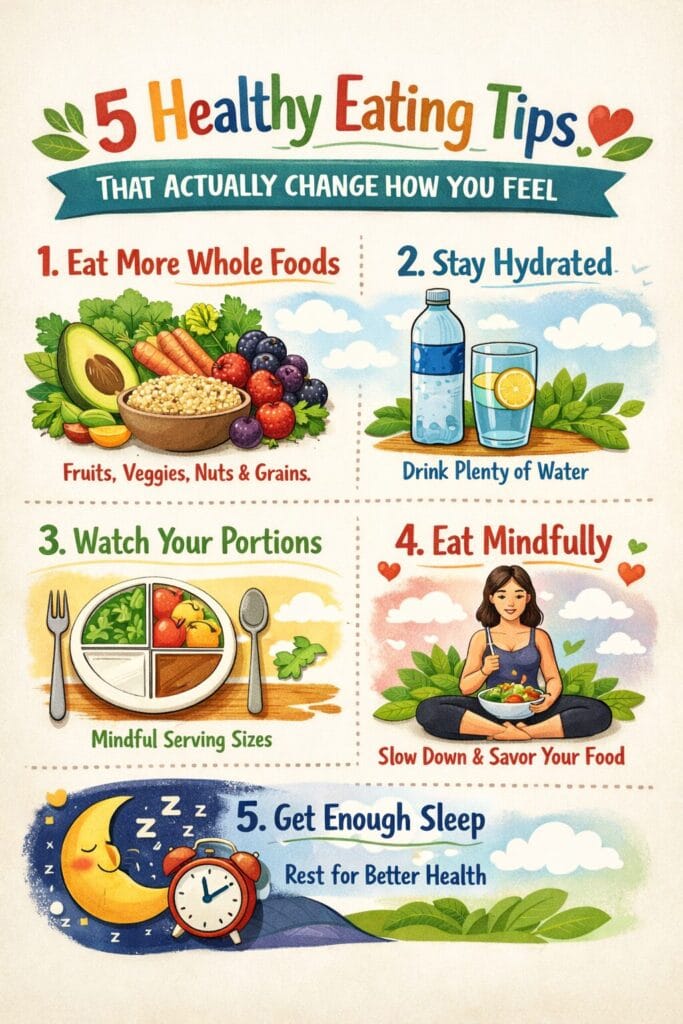
Here is a fact that might surprise you: most people who want to eat healthy already know the basics. Eat more vegetables. Cut the sugar. Drink water. And yet, according to data from the CDC, fewer than one in ten American adults eats enough fruits and vegetables daily. So the problem is not a lack of information. The problem is that most healthy eating advice is either too vague, too extreme, or just not built for real life. Here we discuss healthy eating tips for beginners.
You are probably here because you have tried before. Maybe you went all-in on a plan for two weeks and burned out. Maybe you eat well Monday through Thursday and fall apart on the weekend. Or maybe you genuinely do not know where to start and are tired of conflicting advice telling you one thing on Monday and the opposite on Friday.
That is exactly why this article exists. These 5 healthy eating tips are not about perfection. They are about building a way of eating that works in the real world — that fits your schedule, your budget, and your actual life. Whether you are just starting out or trying to get back on track, these are the fundamentals that registered dietitians, sports nutritionists, and public health researchers keep coming back to — for good reason.
And if you want a deeper foundation, Lumechronos.com has a full library of nutrition guides designed to help you understand not just what to eat, but why it works.
1. Build Your Plate Around Whole, Minimally Processed Foods
If there is one principle that every credible nutrition expert agrees on, it is this: the closer your food is to its natural state, the better it tends to be for you. This does not mean you need to cook everything from scratch or avoid anything that comes in a package. It means making whole foods the foundation of what you eat most of the time.
What Whole Foods Actually Are
Whole foods are ingredients that have not been significantly altered from their original form. Think fruits, vegetables, legumes, whole grains, eggs, nuts, seeds, and plain animal proteins. Minimally processed foods — like frozen vegetables, canned beans, plain Greek yogurt, or rolled oats — also fall into this category and are perfectly fine to use.
On the other end of the spectrum are ultra-processed foods: packaged snacks, fast food, sugary cereals, flavored drinks, and ready-to-eat meals loaded with additives and artificial ingredients. Research consistently links heavy consumption of ultra-processed foods with higher rates of obesity, type 2 diabetes, cardiovascular disease, and even depression.
Whole Foods vs. Ultra-Processed: A Side-by-Side Look
| Category | Whole / Minimally Processed | Ultra-Processed |
| Energy Levels | Steady, sustained energy | Quick spike, then crash |
| Hunger Control | Keeps you full longer | Often leaves you hungrier |
| Nutrient Density | High vitamins & minerals | Mostly empty calories |
| Gut Health | Feeds good bacteria | Disrupts gut microbiome |
| Long-Term Risk | Lowers disease risk | Raises chronic disease risk |
| Cost Over Time | Often cheaper per nutrient | Expensive for what you get |
How to Make the Shift Without Overhauling Everything
You do not need to throw out everything in your pantry. Start with one swap per week. Replace a processed snack with a handful of nuts or a piece of fruit. Swap white bread for whole grain. Add one more vegetable to dinner. These small shifts add up quickly, and over time they become automatic.
In practice, most people find it easiest to start with breakfast. It is the one meal where a simple, whole-food option — oatmeal, eggs, Greek yogurt with fruit — sets a positive tone for the rest of the day. For more structured meal guidance, Lumechronos.shop offers practical meal planning tools and downloadable resources to make this easier.
One honest mistake people make here: they assume “organic” and “natural” labels automatically mean healthy. That is not always the case. A cookie labeled organic is still a cookie. Focus on the ingredient list, not the marketing on the front of the package.
2. Eat Enough Protein at Every Meal
Protein is probably the most underrated nutrient when it comes to healthy eating — especially for people trying to manage their weight, energy, or hunger. Most people eat plenty of protein at dinner but not nearly enough at breakfast or lunch, which leads to energy crashes, cravings, and overeating later in the day.
Why Protein Is a Game-Changer
Protein does three things that matter enormously for your health. First, it keeps you full. Protein triggers satiety hormones more effectively than carbohydrates or fat, which means a protein-rich meal keeps you satisfied longer. Second, it helps maintain and build lean muscle, which supports your metabolism even as you age. Third, it stabilizes blood sugar by slowing the absorption of carbohydrates when eaten together.
The general recommendation for healthy adults is roughly 0.7 to 1 gram of protein per pound of body weight per day. For someone who is active, older, or trying to lose weight, the higher end of that range is often more beneficial.
Best Protein Sources for Everyday Eating
- Eggs (whole, not just whites) — versatile, affordable, nutrient-dense
- Chicken breast and thighs — lean, easy to cook in bulk
- Canned fish (tuna, salmon, sardines) — quick, shelf-stable, rich in omega-3s
- Greek yogurt and cottage cheese — great for snacks and breakfast
- Legumes (lentils, black beans, chickpeas) — plant-based protein with added fiber
- Tofu and tempeh — solid plant-based options that absorb flavor well
A Simple Rule: Protein at Every Meal
Do not save protein for dinner. Aim to include a meaningful protein source at breakfast, lunch, and dinner. Even something as simple as two eggs in the morning instead of cereal can significantly reduce how much you eat over the course of the day. Most people are surprised by how quickly their hunger and cravings improve once they fix this one thing.
For a more detailed breakdown of protein-rich food choices and how to combine them with other nutrients, visit Lumechronos.com — there are in-depth guides on macronutrient balance that go well beyond the basics.
3. Make Vegetables and Fiber Non-Negotiable
Vegetables are not a punishment. They are arguably the single most powerful food group for long-term health — and most people do not eat nearly enough of them. The average American gets about half the fiber they need daily, which has real consequences for gut health, heart health, blood sugar, and even mental clarity.
The Case for Fiber
Dietary fiber — found in vegetables, fruits, whole grains, and legumes — feeds the beneficial bacteria in your gut, helps regulate blood sugar, lowers cholesterol, and supports healthy bowel function. Beyond that, research increasingly connects gut microbiome health to mood, immunity, and cognitive function. In other words, what you eat does not just affect your waist — it affects your brain.
There are two types of fiber worth understanding. Soluble fiber (found in oats, beans, apples, flaxseeds) dissolves in water and forms a gel-like substance that slows digestion and blunts blood sugar spikes. Insoluble fiber (found in vegetables, whole grains, nuts) adds bulk and keeps things moving through your digestive system efficiently. You need both.
How to Eat More Vegetables Without Hating Your Life
The key is making vegetables convenient and tasty — not treating them as a side note. A few approaches that genuinely work in practice:
- Roast a large batch of mixed vegetables (zucchini, bell peppers, broccoli, sweet potato) at the start of the week and use them in everything.
- Add spinach or kale to smoothies — you will not taste it, but your gut bacteria will thank you.
- Use cauliflower rice or zucchini noodles as a base occasionally, not to restrict carbs, but to sneak in more nutrients.
- Eat a large salad before your main meal — studies show this simple habit reduces total calorie intake at that meal.
- Keep raw vegetables (baby carrots, cucumber slices, celery) at eye level in the fridge so they are the first thing you reach for.
Expert Tip: Eat the Rainbow
Different colored vegetables contain different phytonutrients and antioxidants. Dark leafy greens (spinach, kale, arugula), orange and yellow vegetables (carrots, bell peppers, sweet potato), red produce (tomatoes, red cabbage), and purple options (beets, eggplant) each offer a distinct nutritional profile. Variety is not just more interesting — it is more nutritious.
Curious how different countries approach vegetable consumption and what global eating patterns reveal about longevity? Lumechronos.de covers comparative nutrition research and global healthy eating trends worth exploring.
4. Treat Hydration as a Core Part of Your Nutrition Plan
Most people think of hydration as separate from eating well. It is not. Water is involved in nearly every metabolic process in your body — from digesting food and absorbing nutrients to flushing waste and regulating body temperature. Even mild dehydration — as little as one to two percent of body weight — measurably impairs concentration, mood, and physical performance.
How Much Water Do You Actually Need?
The old “eight glasses a day” rule is an oversimplification. Your actual needs depend on your body size, activity level, climate, and what you eat. A practical benchmark: aim for about half your body weight in ounces of water daily. If you weigh 160 pounds, that is roughly 80 ounces, or about 10 cups. If you exercise regularly or live in a hot climate, you need more.
Pay attention to the color of your urine as a simple gauge. Pale yellow means you are well-hydrated. Dark yellow or amber is a sign you need more water. Clear urine consistently could mean you are overdoing it, which dilutes important electrolytes.
What Counts Toward Hydration
Plain water is best, but it is not the only source. Herbal teas, sparkling water, and the water content of fruits and vegetables (cucumbers, watermelon, oranges) all contribute. Beverages with high caffeine content — coffee, black tea, energy drinks — have a mild diuretic effect but still count toward overall hydration in moderate amounts.
What does not help: sugary drinks, sodas, and fruit juices add calories and sugar without meaningfully improving your hydration status. They are not the same as water.
Simple Habits That Actually Help
- Start every morning with a glass of water before coffee or breakfast.
- Keep a water bottle on your desk or with you throughout the day.
- Drink a glass of water before each meal — it helps with digestion and can naturally reduce how much you eat.
- Add a slice of lemon, cucumber, or mint if plain water feels boring.
Hydration tools, water tracking apps, and curated wellness resources are available at Lumechronos.shop — worth checking if you want practical support for building better daily habits.
5. Practice Mindful Eating — Not Just What You Eat, But How
This one tends to get dismissed as too soft or too abstract. But the research on mindful eating is surprisingly strong — and in practice, it often makes a bigger difference than any specific diet rule. The way you eat matters just as much as what you eat.
What Mindful Eating Actually Means
Mindful eating is not about meditating over every bite. It is about paying attention to what you are eating and how your body responds. It means eating without major distractions (yes, that means putting the phone down), slowing down enough to notice when you are actually full, and learning to distinguish between physical hunger and emotional or habitual eating.
Most people eat significantly faster than their satiety signals can keep up with. It takes roughly 15 to 20 minutes for fullness hormones to register in your brain after you start eating. If you eat a meal in 8 minutes — which many Americans do — you can easily consume far more than your body actually needs before that signal arrives.
Practical Steps to Eat More Mindfully
- Sit down at a table for meals whenever possible — not in the car, not at your desk.
- Chew your food more slowly. This is not about counting chews; it is about slowing down the pace.
- Put your fork down between bites. It sounds small, but it genuinely works.
- Check in with your hunger before eating: are you physically hungry, bored, stressed, or just eating out of habit?
- Stop eating at about 80% full — this is a habit practiced in the longest-living populations in the world.
The Emotional Eating Factor
Many people use food to manage stress, boredom, loneliness, or anxiety. This is incredibly common and nothing to be ashamed of — but being aware of it is the first step toward addressing it. Keeping a simple food journal for a week, noting not just what you eat but how you felt at the time, can be genuinely eye-opening.
If emotional eating is a significant issue for you, that is worth addressing directly — not through stricter dieting, but through building other coping strategies and possibly working with a professional.
For a global perspective on how different cultures approach the relationship between food, lifestyle, and mental health, Lumechronos.de provides valuable comparative content worth reading.
Recommended Reads, Videos & Social Posts on Healthy Eating
These are some of the most shared and trusted resources on this topic. Explore them to deepen your understanding and stay inspired:
Videos
- YouTube – How to Eat Healthy for Beginners (Doctor Explains) — Short, science-backed intro from medical professionals.
- YouTube – What I Eat in a Day: Nutritionist Edition — Real-world examples of balanced eating that is sustainable, not extreme.
- TED Talk – What’s wrong with what we eat | Mark Bittman — A compelling big-picture perspective on food culture and health.
Social Media Posts Worth Following
- Instagram – @nutritionbykylie — Registered dietitian sharing practical, non-diet nutrition advice.
- TikTok – Search: #HealthyEatingTips — A constantly updated stream of quick, actionable nutrition content.
- Twitter/X – #CleanEating trending discussions — See what the global health community is talking about right now.
Lumechronos Guides
- Lumechronos.com — In-depth educational guides on nutrition, wellness habits, and science-backed eating strategies.
- Lumechronos.shop — Practical tools, meal planners, and health resources to support your daily routine.
- Lumechronos.de — Global health comparisons, international eating research, and cross-cultural wellness insights.
Frequently Asked Questions (People Also Ask)
What are the most important healthy eating habits to build first?
If you are just starting out, the single most impactful habit is eating whole or minimally processed foods as the foundation of your diet. From there, prioritize eating enough protein at every meal, adding more vegetables and fiber, staying consistently hydrated, and learning to slow down when you eat. You do not need to do all five at once. Pick the one that feels most doable and build from there. Consistency over a few weeks beats perfection for a few days every time. Small, sustainable changes compound into real, lasting results.
How do I start eating healthy with a busy schedule?
The most practical answer is to reduce the number of decisions you have to make in the moment. Batch-cook a few simple proteins and vegetables on the weekend. Keep easy, whole-food snacks stocked — nuts, fruit, Greek yogurt, hard-boiled eggs. Plan your meals loosely for the week so you are not starting from scratch every evening. Convenience is not the enemy of healthy eating; it is actually essential to it. The goal is to make the healthy choice the easier choice as often as possible.
Does healthy eating really improve energy levels?
Yes, consistently and measurably. The main drivers of fatigue related to diet are blood sugar instability (caused by relying heavily on refined carbohydrates and sugar), dehydration, inadequate protein, and micronutrient deficiencies — particularly iron, B12, and vitamin D. When you shift to a diet built around whole foods, adequate protein, and regular hydration, most people report noticeable improvements in sustained energy within one to three weeks. It is not instant, but it is reliable.
Is it okay to eat carbohydrates if I am trying to eat healthier?
Absolutely. Carbohydrates are not the enemy — the type and quality of carbohydrates matter far more than the quantity. Whole grain sources like oats, brown rice, quinoa, sweet potato, and legumes provide sustained energy, fiber, and important micronutrients. They are very different from the refined carbohydrates in white bread, pastries, and sugary snacks. A balanced healthy diet includes carbohydrates. The goal is not elimination; it is choosing better-quality sources most of the time.
How do I stop overeating without feeling deprived?
Overeating is almost always driven by one of three things: eating too fast, not eating enough protein and fiber (which leaves you physically unsatisfied), or eating in response to emotions rather than hunger. Address the root cause rather than just restricting more. Slow down at meals, build meals around protein and fiber, and get honest with yourself about whether you are eating out of hunger or habit. You will find that eating less stops feeling like deprivation when you are actually satisfied by what you do eat.
What are the best healthy snacks to eat between meals?
The best snacks are those that combine protein with fiber or fat, which keeps blood sugar stable and hunger at bay longer than carbohydrates alone. Great options include a handful of nuts with a piece of fruit, Greek yogurt, a hard-boiled egg, cottage cheese with cucumber, apple slices with almond butter, or raw vegetables with hummus. Avoid snacks that are mostly refined carbohydrates or sugar — they tend to spike energy briefly and then leave you feeling worse than before you ate.
Do I need to count calories to eat healthily?
Most people do not need to count calories if they focus on food quality and learn to pay attention to hunger and fullness cues. That said, having a general awareness of portion sizes and caloric density can be useful, especially early on or if you have a specific health goal. For most people, prioritizing whole foods, eating adequate protein, managing portion sizes of calorie-dense foods, and eating mindfully produces better long-term results than meticulous calorie counting, which is easy to sustain short-term but difficult to maintain.
How long does it take to see results from healthy eating?
Some effects are nearly immediate — better hydration improves energy and concentration within a day or two; reducing heavy processed food intake often reduces bloating within a week. For changes in body composition, energy levels, and markers like blood sugar and cholesterol, most people notice meaningful improvements within four to eight weeks of consistent, sustained changes. The key word is consistent. Brief, intense efforts rarely produce lasting results. Building habits that you can maintain long-term is what creates real, durable health outcomes.
Key Takeaways
- Healthy eating does not require perfection or extreme restriction — it requires building sustainable habits around whole, nourishing foods.
- Eating enough protein at every meal is one of the most effective ways to manage hunger, stabilize energy, and support your metabolism.
- Vegetables and fiber are foundational — most people are getting far less than they need, and fixing this has wide-ranging benefits for gut, heart, and brain health.
- Hydration is nutrition: even mild dehydration affects your mood, focus, and physical performance in measurable ways.
- How you eat matters as much as what you eat — slowing down, reducing distractions, and learning to recognize true hunger are skills worth developing.
- Avoid the common mistake of overhauling everything at once. One meaningful change at a time, sustained consistently, produces better results than dramatic short-term efforts.
- Quality, not just quantity, is the lens through which to evaluate food choices — whole foods deliver more nutrition per calorie than their ultra-processed counterparts.
Final Thoughts: Healthy Eating Is a Practice, Not a Destination
If there is one thing worth taking away from this article, it is that healthy eating is not a fixed endpoint you arrive at. It is an ongoing practice — one that will look different depending on your season of life, your goals, your budget, and a hundred other variables.
You do not need a perfect diet to have a healthy one. You need a mostly-good one, maintained consistently, with enough flexibility to enjoy your life. Start with whichever of these five tips feels most relevant to where you are right now. Build from there. Give it a few weeks before you judge whether it is working.
And when you are ready to go deeper — whether you want structured meal guides, evidence-based nutrition resources, or a global perspective on how different cultures eat and thrive — Lumechronos.com, Lumechronos.shop, and Lumechronos.de are built for exactly that.
Have a tip that has made a real difference in how you eat? Drop it in the comments below. And if this article helped you, share it with someone who is trying to build better habits. The best health advice is the kind that actually gets passed on.
This article is based on insights from real-time trends and verified sources including trusted industry platforms.