




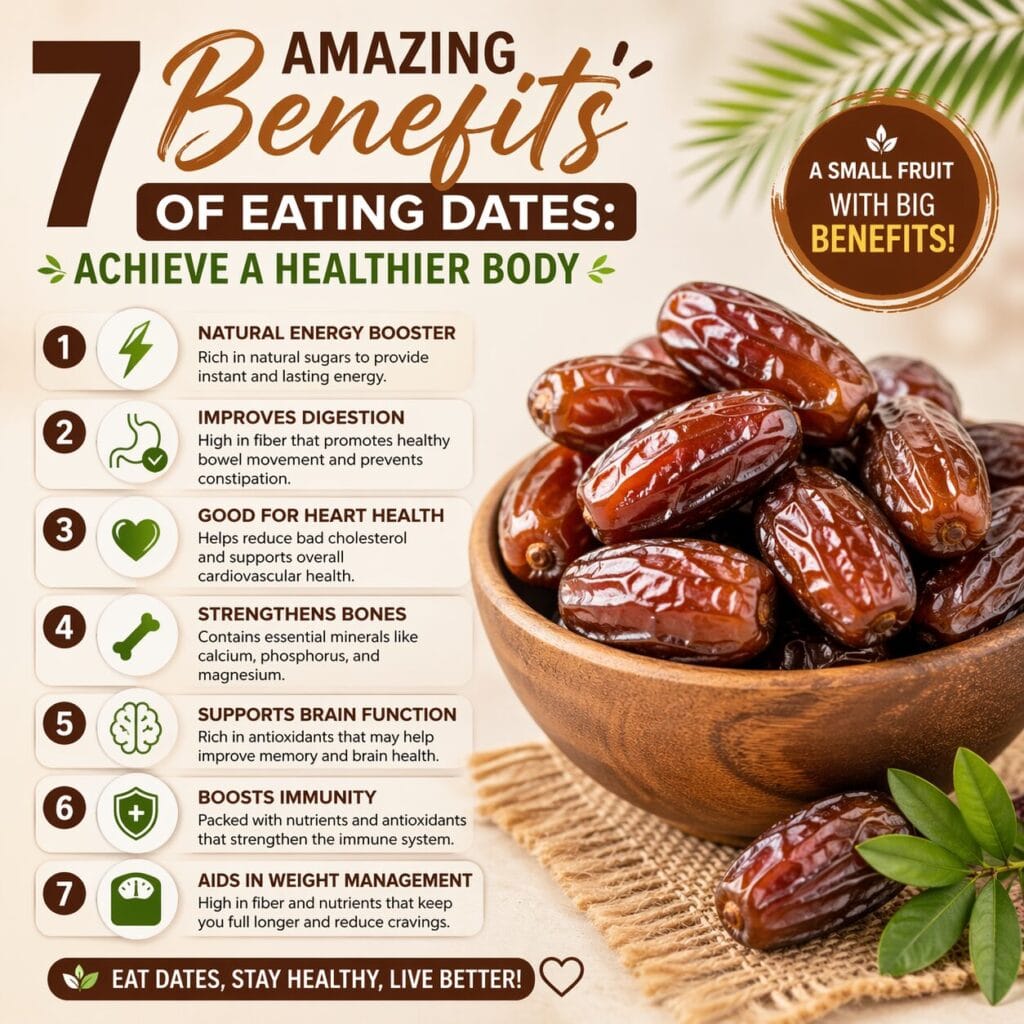
There’s a fruit that ancient civilizations called ‘the bread of the desert.’ Warriors packed it for long journeys. Traders carried it across the Silk Road. And today, millions of people in the Middle East, South Asia, and North Africa eat it as a daily staple — not as a treat, not as a rare indulgence, but as food they genuinely rely on.
That fruit is the date.
Here in the US, dates tend to live in the ‘exotic snack’ corner of Whole Foods or get buried in a recipe for a fancy energy ball. Most people have no idea what they’re actually missing. And that’s a shame — because the benefits of eating dates go far deeper than most wellness blogs ever bother to explain.
The confusion is understandable. Dates are sweet — sometimes intensely so — and a lot of people assume that sweetness means sugar overload, empty calories, something to avoid. But that assumption misses the entire picture. The sugar in dates comes packaged with fiber, minerals, antioxidants, and compounds that your body processes very differently from a soda or a candy bar.
Whether you’re trying to fix your digestion, boost your energy without the caffeine crash, support your heart, or just find a smarter snack, dates deserve a serious look. This guide breaks it all down — the real science, the practical advice, and the honest caveats.
What Are Dates, Exactly? (And Why Medjool vs. Deglet Noor Matters)
Before diving into benefits, it helps to understand what you’re actually eating. Dates are the fruit of the date palm tree (Phoenix dactylifera), one of the oldest cultivated trees on earth — with a history stretching back over 5,000 years in Mesopotamia and the Arabian Peninsula.
In the US, you’ll most commonly encounter two varieties:
Medjool Dates
These are the large, soft, caramel-like dates you find at most grocery stores. They’re moist, rich in flavor, and tend to be higher in natural sugars. They’re also the ones most studied in nutrition research. If you’re buying dates to eat as a snack or to add to smoothies and recipes, Medjool is usually the go-to.
Deglet Noor Dates
Smaller, drier, and less sweet. These are often used in baking or cooking. They have a slightly longer shelf life and a firmer texture. Nutritionally, they’re quite similar — just a bit lower in sugar and calories per date.
Basic Nutrition per 3–4 Medjool Dates (about 100g)
| Nutrient | Amount | Why It Matters |
| Calories | ~277 kcal | Energy-dense but nutrient-packed |
| Fiber | ~7g (25% DV) | Gut health, blood sugar regulation |
| Potassium | ~696mg (20% DV) | Heart health, blood pressure |
| Magnesium | ~54mg (13% DV) | Muscle, nerve, bone support |
| Iron | ~0.9mg | Red blood cell production |
| Antioxidants | Flavonoids, carotenoids, phenolic acid | Cell protection, inflammation |
| Natural Sugars | ~75g per 100g | Glucose + fructose + sucrose mix |
In practice, most people eat 2–5 dates at a time, which is a much smaller amount. Context matters enormously here.
Want a deeper dive into fruit nutrition and how to build a balanced diet? Check out the educational guides at Lumechronos for evidence-based wellness resources.
The Real Benefits of Eating Dates Daily (What the Research Actually Shows)
Let’s go through the benefits that have solid evidence behind them — no exaggeration, no miracle claims.
1. Digestive Health That Actually Works
Dates are one of the richest sources of dietary fiber among commonly eaten fruits. A single serving delivers both soluble and insoluble fiber, which work together to keep your digestive system running smoothly.
Soluble fiber feeds the beneficial bacteria in your gut — what researchers call the microbiome. Insoluble fiber adds bulk to stool and keeps things moving. Together, they help reduce the risk of constipation, bloating, and irregular bowel movements.
Several studies have looked at date consumption and gut health specifically. Regular date eaters show higher levels of beneficial bacteria (like Bifidobacterium) and lower levels of inflammatory gut markers. This isn’t just about comfort — gut health is increasingly linked to immune function, mood, and even cognitive health.
Most people miss this: dates also contain natural compounds called tannins, which have mild anti-diarrheal properties. So they work in both directions — preventing constipation and soothing irritation.
2. Sustained Energy Without the Crash
Here’s where a lot of the ‘dates are too sugary’ argument falls apart. Yes, dates are high in natural sugars. But because those sugars are bound up with fiber, your body absorbs them more slowly. The glycemic load of dates — the real-world impact on your blood sugar — is actually moderate, not high.
Athletes in the Middle East have used dates as pre-workout fuel for centuries. Modern sports nutrition research has validated this. One study found that consuming dates before endurance exercise produced energy performance comparable to commercially processed sports gels — with the bonus of added fiber and micronutrients.
If you’ve ever felt the mid-afternoon energy slump after a sugary snack, dates are a smarter alternative. The energy comes steadily, without the spike-and-crash cycle.
3. Heart Health Support
Potassium is one of the most important minerals for cardiovascular health — it helps counteract the effects of sodium on blood pressure. Dates are an excellent source of potassium, with a single serving delivering around 20% of your daily needs.
Beyond potassium, dates contain magnesium (which supports healthy heart rhythm), antioxidants that reduce LDL oxidation (a key step in arterial plaque formation), and fiber that binds to cholesterol in the digestive tract and removes it from the body.
The antioxidant flavonoids in dates — particularly quercetin and luteolin — have shown anti-inflammatory effects in cell studies, which is relevant because chronic inflammation is a major driver of heart disease.
4. Bone Strength and Mineral Density
Dates contain a useful mix of bone-supporting minerals: calcium, magnesium, phosphorus, and manganese. None of these amounts are enormous in a single serving, but if you’re eating dates regularly alongside a balanced diet, they contribute meaningfully to your total intake.
This matters especially for older adults and postmenopausal women, where bone density becomes a pressing concern. Dates won’t replace calcium supplements if you’re deficient, but they’re a practical, food-first way to add bone-supporting nutrients to your daily intake.
5. Brain Health and Cognitive Function
Emerging research is looking at dates and neurological health with genuine interest. Several animal studies have shown that date extract can reduce the accumulation of amyloid plaques in the brain — the same plaques associated with Alzheimer’s disease. Human research is still early, but the mechanisms are biologically plausible.
The anti-inflammatory and antioxidant compounds in dates may also help protect neurons from oxidative stress, which is one of the factors in age-related cognitive decline. Again, dates won’t prevent Alzheimer’s on their own — but as part of an anti-inflammatory dietary pattern, they fit the profile of foods that support long-term brain health.
6. Natural Labor Support (For Pregnant Women)
This one tends to surprise people. There’s actually a decent body of clinical research showing that consuming dates in the final weeks of pregnancy can support cervical ripening, reduce the need for labor induction, and shorten the first stage of labor.
Several randomized controlled trials have found these effects. The proposed mechanism involves compounds in dates that mimic oxytocin receptors and stimulate uterine contractions in a controlled way. This doesn’t mean every pregnant person should eat dates — always consult your OB or midwife — but it’s a well-documented traditional practice with modern research support.
Explore more health and wellness content backed by expert research at Lumechronos.com — your go-to destination for practical nutritional guides.
How Many Dates Should You Eat Per Day? (Getting the Dose Right)
This is the question most people search for and most articles gloss over. So let’s be direct.
The General Guideline
For most healthy adults, 3–6 dates per day is a reasonable target. This gives you a meaningful dose of fiber, minerals, and antioxidants without going overboard on calories or sugars.
Context-Specific Adjustments
- If you’re managing blood sugar (diabetes or prediabetes): Limit to 2–3 dates and pair them with protein or healthy fat to slow sugar absorption. Monitor your response individually.
- If you’re using dates as pre-workout fuel: 2–4 dates about 30–60 minutes before exercise works well.
- If you’re trying to improve digestion: Start with 2–3 dates daily and give your gut 1–2 weeks to adjust. Too much fiber too fast can cause temporary bloating.
- If you’re pregnant (third trimester): Some clinical protocols used 70–75g of dates daily (about 6 Medjool dates). Discuss with your healthcare provider first.
- If you’re in a calorie-conscious phase: Treat dates as a snack replacement, not an addition. Swap your afternoon cookie or granola bar for 2–3 dates.
The Mistake Most People Make
They either eat too many (treating dates like unlimited health food) or they avoid them entirely based on the sugar fear. Neither extreme makes sense. Dates are calorie-dense — about 20–25 calories each — so portion awareness matters, but there’s no reason to be afraid of them.
Looking for smart nutrition tools and trackers to help you build healthy habits? Browse resources at Lumechronos Shop — practical tools for your wellness journey.
Dates vs. Processed Sugar: Why the Comparison Isn’t Even Close
One of the biggest misconceptions about dates is that eating them is basically the same as eating refined sugar. It isn’t. Here’s why the comparison doesn’t hold up.
| Factor | Dates (Medjool) | Refined White Sugar |
| Fiber Content | ~7g per 100g | 0g |
| Minerals | Potassium, Magnesium, Iron, Calcium | None |
| Antioxidants | Flavonoids, Phenolic acids, Carotenoids | None |
| Blood Sugar Impact | Moderate glycemic load | High glycemic load |
| Satiety Effect | High (fiber slows digestion) | Low (no fiber or protein) |
| Gut Microbiome | Prebiotic — feeds beneficial bacteria | Can feed harmful bacteria |
| Processing Level | Whole food | Ultra-processed |
When you eat refined sugar, your body gets a rapid glucose spike and nothing else. When you eat dates, the fiber physically slows the absorption of sugar, the minerals and antioxidants are delivered alongside it, and your gut bacteria get a prebiotic feeding. It’s a fundamentally different experience for your metabolism.
This doesn’t mean diabetics should eat unlimited dates — individual blood sugar responses vary. But the fear that ‘dates are just sugar’ is nutritionally uninformed.
Practical Ways to Add Dates to Your Daily Routine
The health benefits of dates only matter if you actually eat them. Here are real, practical ways to incorporate them — not Pinterest-perfect ideas you’ll never actually try.
The Easiest Option: Just Eat Them
Sounds obvious, but the simplest approach is often the best. Keep a small container of 3–4 Medjool dates at your desk or in your bag. When you feel the afternoon energy dip coming, eat a couple instead of reaching for a sugary snack or another coffee.
Dates + Nut Butter
Slice a date open, remove the pit, and fill it with almond butter, peanut butter, or tahini. The fat and protein from the nut butter further slows the sugar absorption and makes for a much more satisfying snack. This is a genuinely delicious combination — not a compromise.
Smoothies and Breakfast
Two or three dates blended into a morning smoothie add natural sweetness, fiber, and minerals without needing any added sugar. They work especially well with banana, oat milk, and a scoop of protein powder.
Cooking and Baking
Dates are excellent in savory cooking too. Moroccan tagines, North African stews, and many traditional rice dishes use dates to add depth and slight sweetness. Chopped dates also work well in homemade granola, energy bars, and oatmeal.
Date Paste as a Sugar Substitute
Blend dates with water until smooth. The resulting paste can replace sugar or maple syrup in most baking recipes at a 1:1 ratio. You get the sweetness with a fraction of the processed sugar — and all the fiber intact.
For global food traditions and how different cultures incorporate dates into everyday eating, check out Lumechronos.de — a global lens on health and lifestyle.
Are There Any Downsides to Eating Dates? (Honest Caveats)
A good health article tells you the full picture. Dates are genuinely beneficial, but there are situations where you should approach them with more care.
High in Calories
Dates are calorie-dense. 100g delivers around 277 calories. If you’re in a weight-loss phase and not being mindful of portions, eating dates on top of your normal food intake could slow progress. They work best as a replacement for less nutritious snacks, not as an addition to everything else.
Blood Sugar Considerations
While the glycemic load of dates is moderate, people with Type 2 diabetes or insulin resistance should monitor their individual response. Pairing dates with protein or fat helps, but portion control matters more for this group than for the general population.
Fructose Sensitivity
Some people with irritable bowel syndrome (IBS) or fructose malabsorption find that high-fructose foods — including dates — trigger symptoms. If you already know you’re sensitive to FODMAPs, dates fall in the moderate-to-high FODMAP category and may need to be limited.
Dried vs. Fresh Dates
Most dates sold in the US are dried or semi-dried, which concentrates the sugars. Fresh dates (when you can find them) have a higher water content and lower sugar density. Both are healthy — just understand that dried dates are more calorie-concentrated by weight.
Allergies
True date allergies are rare but exist. Some people also react to the mold that can occasionally develop on improperly stored dates. Buy from reputable sources and store them in an airtight container in the refrigerator.
The Global Perspective on Dates: Why Different Cultures Have Always Known This
It’s worth stepping back for a moment to appreciate that dates aren’t a wellness trend. They’re one of humanity’s oldest foods — and the cultures that have eaten them for generations tend to have some of the lowest rates of certain chronic diseases.
In the Arabian Peninsula and North Africa, dates are eaten daily — at breakfast, as snacks, during Ramadan to break the fast. In South Asia, dates feature prominently in traditional Ayurvedic medicine as a food for vitality, digestion, and reproductive health. In the Mediterranean, dates appear in ancient records as medicine as much as food.
None of this is proof of cause and effect. But when a food has been central to human nutrition across thousands of years and dozens of cultures, it’s worth taking seriously.
Modern nutrition science is largely catching up to what traditional diets have always suggested: whole foods, eaten in reasonable amounts, provide benefits that isolated nutrients in supplements rarely replicate.
Explore comparative health traditions and global wellness perspectives at Lumechronos.de — where ancient wisdom meets modern research.
Explore More: Viral Resources & Social Discussions on Dates
The global conversation about dates and nutrition is active across multiple platforms. Here are some genuinely useful resources:
YouTube — ‘Benefits of Eating Dates Every Day (Doctor Explains)’: Search on YouTube
Instagram — #MedjoolDates health content: Explore #medjool on Instagram
Reddit r/nutrition — Community discussion on dates: Read the thread on Reddit
X (Twitter) — Trending: #DatesNutrition #HealthySnacks: Search on X/Twitter
Pinterest — Date recipe ideas and health infographics: Browse on Pinterest
Frequently Asked Questions (People Also Ask)
Q1: What happens to your body when you eat dates every day?
When you eat dates consistently — say, 3–5 per day — most people notice improvements in digestive regularity within the first week or two, thanks to the fiber content. Over a few weeks, you may also experience more stable energy levels throughout the day, as the slow-release natural sugars replace the spike-and-crash of processed snacks. The potassium and magnesium contribute to better cardiovascular function and reduced muscle cramping over time. Antioxidant compounds work gradually to reduce oxidative stress. In short: dates are not a fast fix. They’re a foundation food — their benefits compound with consistent, long-term consumption.
Q2: How many dates should I eat daily for health benefits?
For most healthy adults, 3–6 dates per day is the sweet spot. This amount gives you a meaningful fiber dose (roughly 2–5g), a useful hit of potassium and magnesium, and a solid load of antioxidants — without pushing calories unnecessarily high. If you’re managing blood sugar, start with 2–3 and pair them with protein or fat. If you’re using dates to replace processed sugar or snacks, even 1–2 per day is beneficial. There’s no magic number — the right dose depends on your goals, your overall diet, and your individual metabolic response.
Q3: Are dates good for weight loss or do they cause weight gain?
Dates can support weight management or work against it — depending entirely on how you use them. On their own, dates are calorie-dense (about 20–25 calories each), so eating 10 of them on top of your regular diet adds meaningful calories. But used smartly — as a replacement for processed snacks, cookies, or candy — they deliver more fiber and nutrients for similar or fewer calories, and the fiber keeps you fuller longer. Several studies show that high-fiber diets support weight loss by reducing overall calorie intake and improving satiety. Dates fit that pattern, but portion awareness is essential.
Q4: Do dates spike blood sugar?
Dates have a moderate glycemic load — not the high load many people assume. The fiber in dates physically slows the absorption of their natural sugars, which blunts the blood sugar response compared to equivalent amounts of refined sugar or white bread. Research comparing dates to other foods shows their glycemic index ranges from about 42 to 62 depending on variety — moderate by most classifications. That said, individuals with diabetes or insulin resistance should monitor their personal response. Pairing dates with protein, fat, or fiber from other sources (like nuts or yogurt) lowers the glycemic impact further.
Q5: Are dates safe to eat during pregnancy?
Yes — and the research on this is surprisingly robust. Multiple clinical trials have found that consuming dates in the final 4 weeks of pregnancy is associated with greater cervical ripening, a higher rate of spontaneous labor, and shorter first-stage labor compared to women who didn’t eat dates. The proposed mechanism involves compounds in dates that interact with oxytocin receptors. Dates are also a useful source of iron, folate, and potassium — all important during pregnancy. As always, discuss your specific situation with your OB-GYN or midwife before making significant dietary changes.
Q6: What’s the best time of day to eat dates?
There’s no single ‘best’ time — it depends on your goal. For energy: eat 2–3 dates about 30–45 minutes before a workout, or in the mid-afternoon to combat the energy slump. For digestion: consuming dates in the morning or with breakfast can kickstart your gut for the day. For sleep support: dates contain small amounts of magnesium and tryptophan, which may support relaxation — so a date or two in the evening isn’t a bad idea. For weight management: eat them when you’d otherwise reach for something less nutritious. The timing matters less than the consistency.
Q7: Can I eat dates if I have IBS or a sensitive gut?
This one depends on your specific situation. Dates contain fructose and sorbitol — both of which fall into the FODMAP category of fermentable carbohydrates that can trigger symptoms in people with IBS. If you know you’re sensitive to FODMAPs, dates may cause bloating, gas, or cramping — especially in larger amounts. However, some people with IBS tolerate small amounts of dates fine. The best approach is to start with one date and see how your gut responds over 24 hours. If you’re following a low-FODMAP elimination diet, dates are typically restricted in the elimination phase but may be reintroduced in small amounts.
Q8: Fresh dates or dried dates — which is healthier?
Both are nutritionally valuable, but they differ in important ways. Fresh dates have higher water content, lower sugar concentration per bite, and a lighter flavor. Dried or semi-dried dates (what you find in most US stores) have concentrated sugars and calories — but the same mineral and fiber profile per gram. Fresh dates are harder to find outside specialty or Middle Eastern grocery stores in the US. If you can access them, they’re a great option. If not, dried Medjool dates are perfectly nutritious — just eat them with portion awareness. Storage matters too: refrigerate dried dates and use them within a few weeks for best quality.
Key Takeaways
- The benefits of eating dates daily are real and research-backed — including improved digestion, sustained energy, heart health support, and anti-inflammatory effects.
- Dates are not the same as refined sugar. Their fiber, minerals, and antioxidants make them a fundamentally different food for your body.
- 3–6 dates per day is a reasonable daily amount for most healthy adults. Adjust based on your goals and individual response.
- People with diabetes, IBS, or fructose sensitivity should approach dates more carefully — but don’t need to avoid them entirely.
- The best way to use dates is as a replacement for less nutritious snacks, not as an addition on top of everything else.
- Fresh or dried, Medjool or Deglet Noor — all varieties offer real nutritional value. The key is consistency.
- Globally, dates have been a daily staple for thousands of years — a track record that modern nutrition science increasingly validates.
Final Thoughts: Small Habit, Real Results
Here’s the honest truth about dates: they’re not a superfood in the Instagram sense of the word. They won’t reverse disease on their own or transform your health overnight. But they are a genuinely excellent food — one of the most nutrient-dense, naturally sweet, fiber-rich whole foods available at any grocery store, at a price that’s reasonable and accessible.
Adding 3–4 dates to your daily routine is one of the simplest, least disruptive dietary upgrades you can make. You’re not overhauling your diet. You’re replacing a processed snack with something that’s been sustaining human health for 5,000 years.
That’s not a small thing.
If you’re new to dates, start with Medjool — they’re the most forgiving in terms of flavor and texture. Try the date + almond butter combination. Give it a few weeks before you judge whether you ‘feel’ the difference. Health benefits from whole foods accumulate quietly, not dramatically.
Got a question about dates or want to share how you’ve added them to your routine? Drop a comment below — we read every one.
For more evidence-based nutrition guides and wellness resources, visit Lumechronos.com.
Explore smart wellness tools and curated health resources at Lumechronos Shop.
For a global perspective on traditional foods and comparative health insights, explore Lumechronos.de.
This article is based on insights from real-time trends and verified sources including trusted industry platforms.