



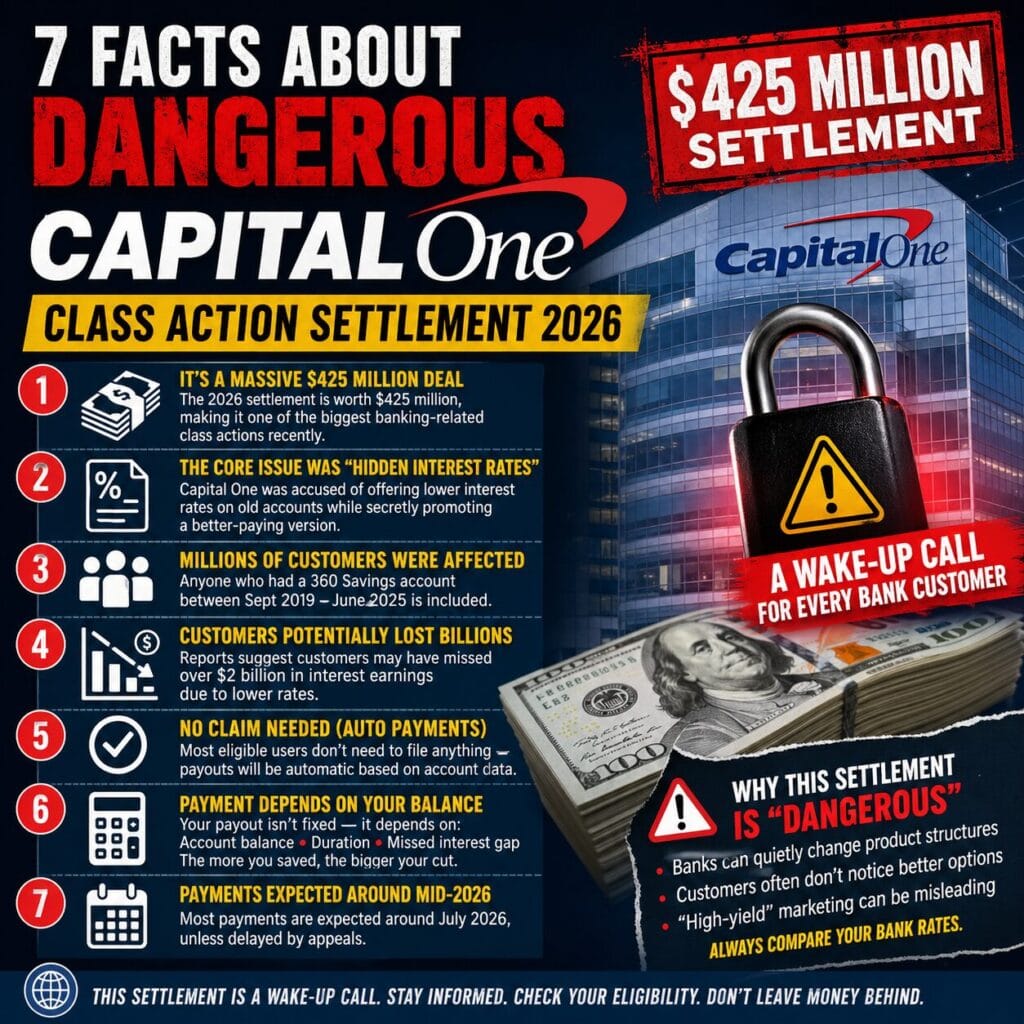
If you ever had a Capital One credit card, applied for one between 2005 and 2019, or held a 360 Savings account at any point through June 2025 — there’s a very real chance you’re owed money right now. The Capital One Class Action Settlement claim landscape has exploded in 2026, covering tens of millions of Americans across two major cases: the landmark 2019 data breach affecting over 98 million people, and the freshly court-approved $425 million Capital One Class Action Settlement claim over suppressed savings interest rates. A federal judge granted final approval on April 20, 2026 — making this one of the most significant consumer finance rulings of the year. (Source: Consumer Affairs – Final Approval Report | CBS News Coverage)
The problem? Most people either don’t know they qualify for a Capital One Class Action Settlement claim, miss critical filing windows, or assume the payout is too small to bother. In 2026, that mistake is more costly than ever. The new $425M settlement alone is paying out individually calculated amounts — based on how much interest Capital One withheld from your 360 Savings account between 2019 and 2025, while quietly offering higher rates (up to 4.35% APY) to newer customers.
A court-appointed Special Master estimated the bank avoided paying customers over $2 billion in interest during that period. Those who didn’t act before the March 30, 2026 electronic payment deadline will still receive checks automatically — but only if their share exceeds $5. (Source: Open Class Actions – Official Settlement Portal | Yahoo Finance – Payout Breakdown) 🎥 Watch: Capital One Settlement Explained – YouTube
This guide cuts through the confusion surrounding every active Capital One Class Action Settlement claim in 2026. We’ll walk through exactly what each settlement covers, who qualifies, how payouts are calculated, and the step-by-step process for making sure you receive what you’re owed.
The 360 Savings Capital One Class Action Settlement claim requires no claim form — payments are issued automatically from Capital One’s own records, with disbursements expected around July 21, 2026. The older data breach settlement, meanwhile, still provides identity defense and restoration services through February 13, 2028. Whether you heard about these cases years ago or are just discovering them today, understanding both is essential. (Source: Credible Law – Full Case Overview | Official 360 Savings Settlement Site) 🎥 Watch: How to Check if You Qualify – YouTube
The scope of the active Capital One Class Action Settlement claim in 2026 is staggering. The 360 Savings case alone covers millions of current and former accountholders from September 18, 2019 through June 16, 2025, while the earlier data breach Capital One Class Action Settlement claim reached over 98 million Americans — making it one of the most far-reaching financial data breach lawsuits ever resolved in U.S. history.
New York Attorney General Letitia James, who led a bipartisan coalition of state attorneys general in fighting for a stronger deal, celebrated the revised $425M outcome as more than double what the rejected earlier settlement offered. The bottom line: if you’ve ever been a Capital One customer in any capacity, checking your eligibility for a Capital One Class Action Settlement claim in 2026 takes minutes and could put real money back in your pocket. (Source: NY Attorney General Official Statement | Watcher.guru – Eligibility Guide) 🎥 Watch: Attorney General Statement on Capital One Settlement – YouTube
What Is the Capital One Class Action Settlement — And Why Did It Happen?
Back in July 2019, Capital One announced that a hacker had gained unauthorized access to the personal information of approximately 100 million US consumers and 6 million Canadians — triggering what would eventually become one of the most consequential Capital One Class Action Settlement claim processes in US financial history. The attacker — a former Amazon Web Services software engineer named Paige Thompson — didn’t just exploit a technical flaw.
She had built a custom tool while at Amazon to scan AWS cloud environments for misconfigured accounts, then used it to breach Capital One’s systems long after leaving the company. She also embedded cryptocurrency mining software on compromised servers, funneling the proceeds to her personal wallet — a detail that emerged in federal court documents. (Source: TechTarget – Full Criminal Case Breakdown | Huntress – Technical Breach Analysis) 🎥 Watch: Capital One Data Breach Explained – YouTube
The breach — which went undetected for roughly four months before Capital One publicly disclosed it on July 29, 2019 — exposed a sweeping range of sensitive consumer data. The Capital One Class Action Settlement claim that followed was built on the severity of that exposure:
- Names, addresses, and phone numbers
- Dates of birth and self-reported income
- Credit scores and payment histories
- Social Security numbers (for roughly 140,000 customers)
- Bank account numbers (for around 80,000 customers)
What made this breach especially damaging — and what directly fueled the Capital One Class Action Settlement claim — was that the data came from over a decade of credit card applications, from 2005 through early 2019. This wasn’t a snapshot of current customers. It was a deep historical archive of financial profiles. (Source: Security.org – Full Breach Impact Report | BreachSense – Case Study 2026) 🎥 Watch: What Data Was Exposed in the Capital One Hack – YouTube
This wasn’t a small-scale breach. For sheer scale, it ranks among the top five financial data breaches ever recorded in North America — and it triggered a legal reckoning that stretched years into the future. What followed the 2019 incident was a cascading series of consequences directly tied to the Capital One Class Action Settlement claim process:
An $80 million regulatory fine from the Office of the Comptroller of the Currency (OCC) for neglecting cloud security standards, a $190 million class action settlement with affected consumers, and enforcement actions from both the OCC and the Federal Reserve. Total financial losses — including litigation, settlement fees, and compliance costs — exceeded $300 million. (Source: CBS News – $80M Regulatory Fine | Fortune – Settlement & Sentencing Report) 🎥 Watch: Capital One’s $190M Settlement Breakdown – YouTube
As of April 2026, the legal story around Paige Thompson is still unresolved — a critical update anyone researching the Capital One Class Action Settlement claim needs to know. After being convicted in June 2022 on seven federal counts including wire fraud and unauthorized computer access, Thompson was sentenced to just time served and five years of probation in October 2022 — a ruling prosecutors immediately challenged as too lenient.
In March 2025, a federal appeals court agreed, ruling the sentence inadequate and sending the case back for resentencing. That process is still ongoing in 2026. Meanwhile, victims of the original data breach retain access to identity defense and restoration services through the settlement — available until February 13, 2028 — as part of the ongoing Capital One Class Action Settlement claim remedies. If you were affected and haven’t verified your status, now is the time. (Source: Security.org – 2026 Legal Status Update |
Official Settlement Resources – Credible Law)
🎥 Watch: Paige Thompson Resentencing Update 2025/2026 – YouTube
Why Was a Lawsuit Filed?
Affected consumers and advocacy groups argued that Capital One had committed a fundamental failure of duty — not just a technical oversight. The core of every Capital One Class Action Settlement claim filed after the 2019 breach rested on three legal pillars: negligence in failing to implement basic cloud security standards, breach of contract by not safeguarding data customers had trusted the bank to protect, and violations of consumer protection laws across multiple states.
Importantly, in 2026 we now know this wasn’t an isolated incident — investigators found that Capital One had a history of lax cybersecurity dating back to at least 2015, according to the Office of the Comptroller of the Currency (OCC). That pattern of neglect became central evidence in building the Capital One Class Action Settlement claim against the bank. (Source: All Capital One Lawsuits 2026 – Full Overview | Credible Law – Legal Theory Breakdown) 🎥 Watch: Capital One Data Breach Explained — CNBC
Capital One didn’t admit wrongdoing — which is standard practice in these resolutions — but to avoid prolonged litigation, the company agreed to a $190 million class action settlement in 2021, formally approved by a federal court in Virginia. That Capital One Class Action Settlement claim process opened to eligible class members and ultimately paid out to those who filed before the September 30, 2022 deadline. But here’s the critical 2026 update most people miss:
that claims window is now permanently closed. All payment activity under the data breach settlement has been completed. Any uncashed checks are now void and cannot be reissued. The only benefit still active under that original Capital One Class Action Settlement claim is free Identity Defense and Restoration Services — available through February 13, 2028 — provided by Pango at no cost to eligible class members. (Source: Official Capital One Settlement Site | Consumer Affairs – April 2026 Update) 🎥 Watch: What Happens After a Data Breach — PBS NewsHour
But the legal story didn’t stop there — and this is where 2026 becomes especially relevant for anyone tracking the Capital One Class Action Settlement claim landscape. The CFPB sued Capital One in January 2025 under the final days of the Biden administration, alleging the bank cheated millions of savings customers out of more than $2 billion in interest. That lawsuit was dropped in February 2025 under the Trump administration — but it didn’t matter.
A bipartisan coalition of state attorneys general, led by New York AG Letitia James, stepped in and ultimately forced Capital One into a revised $425 million settlement, which received final court approval on April 20, 2026. This new Capital One Class Action Settlement claim more than doubles the value of the original proposed deal and applies to an entirely different class of victims: 360 Savings accountholders who were quietly underpaid interest between September 2019 and June 2025.
(Source: Virginia Lawyers Weekly – Judge Approves $425M | NY Attorney General Official Statement) 🎥 Watch: Capital One $425M Settlement Breakdown 2026 – YouTube
What makes the current Capital One Class Action Settlement claim environment uniquely complex in 2026 is that Capital One now faces four simultaneous active or recently resolved class action cases — covering the data breach, savings account interest suppression, affiliate marketing fraud against content creators, and credit reporting errors under the FCRA. The official lawsuit page, In re: Capital One 360 Savings Account Interest Rate Litigation, states plainly that Capital One “deceptively marketed” the 360 Savings account while concealing the existence of its higher-yield alternative.
That admission-by-settlement is the clearest signal yet of how seriously courts and regulators are treating consumer protection failures in the banking sector heading into 2026 — and exactly why understanding your rights under any Capital One Class Action Settlement claim has never mattered more.
Source: Official 360 Savings Litigation Site | NBC Chicago – $425M Payments Update) 🎥 Watch: How Class Action Settlements Work – YouTube
Who Is Eligible for the Capital One Class Action Settlement?
This is the first place most people get tripped up — and in 2026, the confusion is deeper than ever because there are now two distinct eligibility pools for the Capital One Class Action Settlement claim. Eligibility isn’t based on whether you currently hold an account. It depends entirely on which Capital One product you had, and when you had it. Understanding which category applies to you is the essential first step before checking your Capital One Class Action Settlement claim status. (Source: MoneyPilot – Full 2026 Eligibility Guide | AARP – Who Qualifies Breakdown) 🎥 Watch: Capital One Settlement — Who Qualifies? – YouTube
Settlement #1 — The $425M Interest Rate Case (Most Relevant in 2026)
The largest and most active Capital One Class Action Settlement claim right now covers holders of the 360 Savings account. The core eligibility criteria are straightforward:
- ✅ You held a Capital One 360 Savings account (the legacy product — not 360 Performance Savings) at any point between September 18, 2019 and June 16, 2025
- ✅ Joint and co-holders of those accounts are included — though cash payments will only be issued to the primary account holder
- ❌ You do not qualify if you held only a 360 Performance Savings account and never held the legacy 360 Savings account
- ❌ You are excluded if you opted out of the settlement before the March 30, 2026 deadline
The most important update for this Capital One Class Action Settlement claim in April 2026: no claim form is required. Payments are fully automatic, calculated directly from Capital One’s own records. If you’re eligible and didn’t opt out, a check will be mailed to your last known address — provided your share is $5 or more. Those who registered for electronic payment before March 30 will receive their funds regardless of amount. Payments are expected on or around July 21, 2026. (Source: CBS News – Official Eligibility Confirmation | The Hill – Payout Details) 🎥 Watch: No Claim Form Needed — Capital One Automatic Payments Explained – YouTube
Settlement #2 — The $190M Data Breach Case (2005–2019 Credit Card Applicants)
If your Capital One Class Action Settlement claim is rooted in the 2019 data breach, the eligibility window was different — and the claims process is now closed. You were eligible if:
- You applied for a Capital One credit card or financial product between January 1, 2005 and April 24, 2019
- Your personal information was stored in Capital One’s US-based systems during that period
- You are a US resident
The claim filing deadline was September 30, 2022, and all cash payments have been completed. However, one benefit from this Capital One Class Action Settlement claim remains active in 2026: free Identity Defense and Restoration Services through Pango — including dark web monitoring, fraud alerts, and credit file monitoring — available to all class members until February 13, 2028, even if you never filed a claim. (Source: Official Data Breach Settlement Site – capitalonesettlement.com | All About Lawyer – Both Cases Compared) 🎥 Watch: How to Check Your Data Breach Settlement Status – YouTube
If you received an official notice from Capital One or the settlement administrator by mail or email, that is strong confirmation of your eligibility for the relevant Capital One Class Action Settlement claim. However, not receiving a notice does not automatically mean you don’t qualify — notice delivery is imperfect, and millions of eligible customers never received direct communication. Your best move in April 2026 is to verify directly: visit capitalone360savingsaccountlitigation.com for the savings case, or capitalonesettlement.com for the data breach case. You can also call the settlement administrator at 1-888-832-2704. (Source: LiveNOW FOX – Eligibility Verification Steps | Official 360 Savings Litigation Site) 🎥 Watch: How to Verify Your Capital One Settlement Eligibility – YouTube
Groups Who Were Specifically Affected by the Capital One Class Action Settlement Claim
Not everyone who has ever used Capital One was impacted in the same way — and understanding exactly which group you fall into is critical when evaluating your Capital One Class Action Settlement claim eligibility. According to Capital One’s own official disclosure and subsequent federal court filings, the breach swept up multiple distinct consumer categories, each with a different type of data exposure. The breadth of this is precisely what made the Capital One Class Action Settlement claim process so sweeping in scale. (Source: Capital One Official 2019 Breach Disclosure | Huntress – Breach Impact Analysis) 🎥 Watch: Capital One Data Breach — Who Was Affected? – YouTube
| Affected Group | Exposure Type | Key 2026 Detail |
|---|---|---|
| Credit card applicants (2005–2019) | Name, SSN, income, credit score, date of birth, address, email | Largest affected group — formed the core of the Capital One Class Action Settlement claim |
| Current cardholders | Payment history, account status, credit limits, balances | Transaction fragments from 23 specific days in 2016, 2017 & 2018 also exposed |
| Applicants with denied credit | Full application data retained in Capital One’s systems | Denial didn’t erase your data — it stayed stored and was fully vulnerable |
| Small business applicants | Business and personal financial information | Confirmed by Capital One’s official disclosure — both individual and entity-level data compromised |
| Secured credit card holders | ~80,000 linked bank account numbers exposed | Among the most serious exposure category — direct financial account access risk |
| Customers with SSNs on file | ~140,000 Social Security numbers compromised | A January 2021 follow-up audit found an additional 4,700 SSNs previously undetected |
| Canadian customers | ~1 million Social Insurance Numbers compromised | Separate notification process; Canadian customers directed to capitalone.ca/facts2019 |
The largest single category of information accessed was data belonging to consumers and small businesses who had applied for Capital One credit card products between 2005 and early 2019 — a window spanning 14 years of stored applications. What makes this particularly significant for any active Capital One Class Action Settlement claim is that the data wasn’t just from people who became Capital One customers. It included people whose applications were denied — meaning Capital One retained their sensitive financial profiles long after rejecting them, and those individuals had no idea their data was still sitting in Capital One’s cloud infrastructure.
(Source: Capital One Official Investor Statement | FTC Consumer Advice – Breach Alert) 🎥 Watch: What Data Was Stolen in the Capital One Hack – YouTube
One critical clarification that affects how you assess your Capital One Class Action Settlement claim in 2026: no credit card account numbers, login credentials, or payment card information were among the stolen data — which Capital One emphasized at disclosure. However, that did not reduce the severity of the Capital One Class Action Settlement claim for most victims. The stolen data — income levels, credit scores, payment histories, and in tens of thousands of cases, full Social Security numbers — was more than enough to enable identity fraud, synthetic identity creation, and targeted phishing attacks.
A follow-up investigation in January 2021 found that approximately 4,700 more Social Security numbers had been compromised during the breach, a detail that quietly expanded the scope of eligible claimants and reinforced the negligence argument at the heart of every Capital One Class Action Settlement claim. As of April 2026, Capital One has paid over $270 million in combined fines and settlements tied directly to this breach.
(Source: Security.org – Full 2026 Breach Report | ITRC – What to Do If You’re Impacted) 🎥 Watch: Identity Theft After a Data Breach — What to Do in 2026 – YouTube
Still at Risk in 2026? Here’s What to Do Right Now
Even if the cash claims window under the original Capital One Class Action Settlement claim is now closed, the threat from the 2019 breach is not over. Identity theft from exposed data can surface years after a breach — and there is no statute of limitations on how long stolen data can be misused. Every affected person, regardless of whether they filed a claim, still has access to free Restoration Services through Pango until February 13, 2028, including direct assistance with fraud alerts, credit bureau disputes, and coordination with law enforcement.
If you fall into any of the groups in the table above, your immediate action steps are: freeze your credit at all three bureaus (Equifax, Experian, TransUnion — still free in 2026), monitor your reports weekly at AnnualCreditReport.com, and verify your Capital One Class Action Settlement claim status at capitalonesettlement.com.
(Source: Security.org – 2026 Action Guide | SuccessKnocks – 2026 Breach Update) 🎥 Watch: How to Freeze Your Credit — Step by Step 2026 – YouTube
What If You’re Not Sure?
Most people who applied for a Capital One card during that 14-year window and never opted out of the settlement class are automatically included. The best course of action is to visit the official settlement website and enter your details.
🔗 Learn more about understanding your consumer rights in class actions at lumechronos.com
How Much Money Can You Actually Receive From a Capital One Class Action Settlement Claim?
Let’s be real — this is what most people want to know. And in April 2026, the honest answer is more nuanced than ever, because there are now two separate compensation structures depending on which Capital One Class Action Settlement claim applies to you. The amounts, calculation methods, and payment timelines are completely different between the two active cases. Here’s the full breakdown. (Source: Kiplinger – Full Payout Breakdown | All About Lawyer – $425M Payout Guide) 🎥 Watch: How Much Will You Get From the Capital One Settlement? – YouTube
Settlement #1 — The $425M Interest Rate Case (2026’s Most Active Payout)
This is the Capital One Class Action Settlement claim that is actively paying out in 2026, and understanding how your individual amount is calculated matters. The $425 million fund is structured in two distinct buckets:
Bucket 1 — $300 Million Interest Backpay Pool
Your share of this pool is calculated based on two factors working together:
- How long you held your 360 Savings account during the class period (September 18, 2019 – June 16, 2025)
- How much money you kept in the account during that time
Your payout equals the difference between what your 360 Savings account actually paid and what the 360 Performance Savings account was paying during the same period. At the peak of that gap, Capital One was paying legacy savers as little as 0.30% APY while offering newer customers 4.35% APY on an otherwise identical product. After attorneys’ fees of up to 15% are deducted first, the remaining funds are divided proportionally among all eligible class members. The exact individual amount has not yet been determined — as Capital One’s own settlement page states: “The settlement administrator has not yet determined the amount of your class cash payment.” Payments are expected around July 21, 2026, assuming no appeals.
Bucket 2 — $125 Million Ongoing Rate Benefit
This portion of the Capital One Class Action Settlement claim benefits current 360 Savings accountholders specifically. Capital One is now legally required to match the interest rate on 360 Savings accounts to the 360 Performance Savings rate — automatically, without customers needing to switch accounts. Based on April 2026 rates, this means a jump from 1.00% APY to 3.20% APY, more than tripling what legacy savers were earning. For customers with substantial balances, this ongoing rate benefit could be worth significantly more than the one-time cash payout over time. (Source: CBS News – Settlement Payout Explained | AARP – How Your Amount Is Calculated) 🎥 Watch: Capital One 360 Savings Rate Increase Explained – YouTube
⚠️ Important Tax Note for 2026
One detail nearly every guide overlooks: your Capital One Class Action Settlement claim payment for missed interest income is likely taxable. Capital One may issue a 1099-INT form for the cash payout, meaning you could owe federal income tax on the amount you receive. Consult a tax professional before spending your settlement check — and keep your payment confirmation for your records.
Settlement #2 — The $190M Data Breach Case (Historical Reference — Claims Now Closed)
For context, the original Capital One Class Action Settlement claim from the 2019 data breach operated on a three-tier compensation model. While the claims window permanently closed on September 30, 2022, understanding this structure helps explain why so many people missed out:
| Tier | Who It Was For | Maximum Payout | Status in 2026 |
|---|---|---|---|
| Tier 1 — Out-of-Pocket Losses | Those with documented financial harm (fraudulent charges, legal fees, credit monitoring costs) | Up to $25,000 per person | ❌ Claims closed |
| Tier 2 — Lost Time | Those who spent time dealing with breach fallout (credit freezes, dispute filings, police reports) | Up to $375 ($25/hr × max 15 hrs) | ❌ Claims closed |
| Tier 3 — General Class Member | All eligible members with no documented losses | Residual fund share (varied widely) | ❌ Claims closed |
| Free Identity Monitoring | All class members regardless of claim filed | Pango services (dark web monitoring, fraud alerts, credit bureau support) | ✅ Active through Feb 13, 2028 |
If you missed the data breach Capital One Class Action Settlement claim deadline, the one benefit still available at no cost is free Restoration Services through Pango — including direct assistance from US-based fraud resolution specialists for placing fraud alerts, disputing credit report errors, and coordinating with creditors and law enforcement. Access this at capitalonesettlement.com or by calling 1-888-832-2704. (Source: Official Capital One Settlement Site | U.S. News – Final Approval & Payout Details) 🎥 Watch: How to Access Free Identity Protection After a Data Breach – YouTube
Step-by-Step: How to File a Capital One Settlement Claim
Filing a claim sounds intimidating, but the process was designed to be accessible to ordinary consumers — not just attorneys. Here’s how it worked, and what you should know if you’re still navigating it:
Step 1: Confirm Your Eligibility
Before anything else, verify you fall within the eligible class. Cross-reference your account history with the breach window (January 2005 – April 2019).
Step 2: Visit the Official Settlement Website
The official settlement administrator website is: www.capitalonesettlement.com
Be careful of copycat scam sites — only the official domain handles legitimate claims. Do not provide personal or financial information to any other website claiming to process Capital One settlement claims.
Step 3: Gather Your Documentation
For Tier 1 claims, prepare:
- Bank or credit card statements showing fraudulent charges
- Receipts for credit monitoring services purchased
- Any correspondence with Capital One about the breach
- Records of time spent on remediation (dates, activities)
For Tier 2 claims:
- A written log of hours spent addressing breach-related issues
- Brief descriptions of activities undertaken
Step 4: Submit Your Claim Form
Complete the online claim form or submit a paper form. The form asks for:
- Personal identification details
- Your Capital One account information (partial account numbers accepted)
- The tier of compensation you’re claiming
- Supporting documentation uploads (for Tier 1)
Step 5: Wait for Review
Claims go through an administrative review process. The settlement administrator may reach out for additional documentation or clarification. This is normal and not a red flag.
Common Mistakes to Avoid
- Missing the deadline: The original claim deadline was September 30, 2022. If you missed it, options are now limited — but monitor for any court-ordered extensions or reopened windows.
- Using unofficial sites: Scammers created fake Capital One settlement portals. Always verify the URL.
- Understating your losses: Many people didn’t realize time spent was compensable. Document everything.
- Not keeping copies: Save confirmation emails and reference numbers from your submission.
📺 Helpful walkthrough video:
🌐 Global perspective on consumer financial protections at lumechronos.de
Capital One’s Response and What Changed After the Settlement
Capital One’s official position throughout the legal proceedings was that it “quickly fixed the vulnerability” once the breach was discovered and “worked to make right” with affected customers. The company cooperated with federal investigators and supported the criminal prosecution of Paige Thompson.
Thompson was ultimately convicted in 2022 on multiple federal charges including computer fraud. She was sentenced to time served (about three years in detention) plus five years of probation — a verdict that drew mixed reactions from consumer advocates who felt the sentence was lenient given the scale of the breach.
What Capital One Changed Internally
As part of the settlement, Capital One agreed to implement a series of security improvements, including:
- Enhanced cloud security configurations
- More robust data access monitoring
- Improved intrusion detection protocols
- Regular third-party security audits
These weren’t just cosmetic changes. Capital One invested heavily in cybersecurity infrastructure following the breach — partly because the reputational damage was substantial and partly because federal regulators were watching closely.
What This Means for Consumers Going Forward
In practice, the Capital One settlement set a precedent. It demonstrated that financial institutions face real financial liability when they fail to protect consumer data — not just regulatory fines, but direct payouts to affected customers.
For consumers, the takeaway is clear: data breach class action settlements are legitimate mechanisms for recovering losses, and ignoring them means leaving compensation on the table.
X (Twitter) discussion worth reading: @LegalAF on the Capital One settlement outcome @NerdWallet’s breakdown of the payout structure
The Bigger Picture: Capital One Settlement in the Context of US Data Breach Law
The Capital One case didn’t happen in a vacuum. It’s part of a broader wave of data breach litigation that has reshaped how courts view corporate responsibility for consumer data.
Key Comparable Cases
| Company | Breach Year | Settlement Amount | Affected Consumers |
|---|---|---|---|
| Capital One | 2019 | $190 million | 98 million |
| Equifax | 2017 | $575 million | 147 million |
| Yahoo | 2013–2016 | $117.5 million | 3 billion accounts |
| Target | 2013 | $18.5 million | 41 million |
What’s notable about Capital One compared to Equifax — which was a larger breach — is the speed of resolution. Capital One’s $190 million settlement came together faster, suggesting that legal strategies and judicial expectations around data breach liability are maturing.
What Regulators Are Doing
The Office of the Comptroller of the Currency (OCC) fined Capital One $80 million separately from the civil class action. This regulatory fine — combined with the $190 million settlement — brought the company’s total financial exposure from the breach to over $270 million.
The Consumer Financial Protection Bureau (CFPB) has used cases like this to push for stronger data security standards across financial institutions. If you want to file a complaint or report ongoing financial harm, the CFPB website (consumerfinance.gov) is the appropriate federal channel.
🔗 Compare financial consumer protection resources globally at lumechronos.de
🔗 Educational guides on protecting your financial data at lumechronos.com
Red Flags and Scams Around the Capital One Settlement
Unfortunately, anytime a major settlement is announced, scammers move fast. The Capital One settlement was no exception.
Common Scam Tactics Spotted
Fake settlement portals: Websites with URLs like “capital-one-settlement-claim.com” or “capitalonesettlementnow.org” were set up to harvest personal and financial information from unsuspecting claimants. These are not affiliated with the actual settlement.
Phone scams: Callers claiming to be from the “Capital One Settlement Office” and asking for Social Security numbers, bank account numbers, or upfront fees to “process your claim.” Real settlement administrators do not charge fees or call unsolicited.
Phishing emails: Emails with official-looking Capital One logos directing recipients to fake claim forms. Always navigate directly to the official settlement website — never click links in unsolicited emails.
How to Protect Yourself
- Only use capitalonesettlement.com for official claim submission
- Do not pay any fee to file a claim — legitimate settlement claims are always free
- Do not provide full SSN over phone calls — the official form only requires partial information
- Report suspicious contacts to the FTC at reportfraud.ftc.gov
Most people don’t lose money to the breach — they lose it to scammers who exploit the breach. Staying informed is your best protection.
Viral consumer protection thread: How to spot settlement scams — @ConsumerReports on X
FAQ: Capital One Class Action Settlement
1. How much will I get from the Capital One settlement?
The exact amount depends on which tier of compensation you qualify for. If you have documented financial losses, you can claim up to $25,000. For lost time dealing with the breach, you can recover up to $375. General class members without documented losses received a share of the residual fund — which varied based on total claim submissions. Most general claimants received modest payouts ranging from a small amount to potentially a few hundred dollars.
2. Am I eligible for the Capital One class action settlement?
You’re likely eligible if you applied for or held a Capital One credit card or banking product in the United States between January 1, 2005 and April 24, 2019. Receiving an official settlement notice is a strong indicator, but not receiving one doesn’t automatically exclude you. Visit the official settlement website to verify your status.
3. What is the deadline to file a Capital One settlement claim?
The primary claim deadline was September 30, 2022. If you missed it, options are limited — however, it’s worth checking the official settlement website or contacting the settlement administrator to see if any late claim provisions apply. Courts sometimes grant extensions in limited circumstances.
4. Do I need a lawyer to file a Capital One settlement claim?
No. The claim process was designed for individual consumers to complete without legal representation. Settlement claim forms are straightforward and available in plain English. That said, if your losses are substantial — multiple thousands of dollars — consulting a consumer protection attorney may help maximize your recovery.
5. What if I didn’t receive a settlement notice?
Receiving a notice isn’t a requirement for eligibility. Notice delivery isn’t 100% reliable. If you had a Capital One account or application during the eligible window, you should check your eligibility directly on the official settlement website using your account information.
6. Is the Capital One settlement legitimate, or is it a scam?
The $190 million Capital One settlement is entirely legitimate. It was approved by the United States District Court for the Eastern District of Virginia. The settlement administrator, Rust Consulting, is a well-established class action administration firm. Always verify you are on the official site (capitalonesettlement.com) before submitting any information.
7. Can I still sign up for the free credit monitoring from the settlement?
The credit monitoring benefit offered through the settlement had its own enrollment window. If you missed it, you may still want to independently enroll in a credit monitoring service — particularly if your Social Security number or bank account information was among the data exposed. Many financial institutions offer complimentary monitoring; your bank or card issuer is a good first stop.
8. What was Capital One’s response to the lawsuit?
Capital One neither admitted nor denied wrongdoing as part of the settlement — standard practice in civil class action resolutions. The company did, however, agree to enhance its data security practices and cooperated with federal criminal proceedings against the hacker. Capital One also separately paid an $80 million regulatory fine to the OCC.
Key Takeaways
- The Capital One class action settlement involved $190 million paid to approximately 98 million affected US consumers following a 2019 data breach.
- Eligibility covers anyone who applied for or held a Capital One product in the US between January 2005 and April 2019.
- Compensation tiers ranged from general fund payouts for all class members up to $25,000 for those with documented financial losses.
- The primary claim deadline was September 30, 2022 — if you missed it, options are now limited but worth checking.
- Scammers actively targeted consumers using the settlement as cover — only use capitalonesettlement.com for official purposes.
- The settlement contributed to a broader shift in how US courts and regulators hold financial institutions accountable for data security failures.
- Similar large data breach settlements — Equifax ($575M), Yahoo ($117.5M) — show this is an established and growing area of consumer law.
Conclusion: Don’t Leave Money on the Table
The Capital One class action settlement is a reminder that the legal system does, occasionally, work in ordinary consumers’ favor. Ninety-eight million people had their personal financial information exposed through no fault of their own. A $190 million fund was created specifically to compensate them.
And yet, a significant portion of eligible people either never filed a claim or filed incorrectly. That’s money left uncollected.
If the claim window is still open when you’re reading this — act. If it has closed, monitor for any court-ordered extensions and bookmark this as a reference for future data breach settlements, because they will keep happening. Equifax, Yahoo, Capital One — these are not one-off events. They are a structural feature of the digital financial landscape.
Your next step: Visit capitalonesettlement.com to verify your eligibility. Report any suspicious contacts to the FTC. And stay informed about your consumer rights by following trusted resources.
We’d love to hear from you — did you successfully file a Capital One settlement claim? Share your experience in the comments. And if this guide helped you, pass it along to someone who might still be eligible.
🔗 Explore related consumer financial guides at lumechronos.com 🛠️ Compare identity protection tools and resources at lumechronos.shop 🌐 Global consumer protection comparisons at lumechronos.de
References and Further Reading
- Official Capital One Settlement Website
- FTC Guide to Data Breach Notifications
- Consumer Financial Protection Bureau — File a Complaint
- OCC Press Release — Capital One $80M Fine
- DOJ Criminal Case: US v. Paige Thompson
- CNBC — Capital One Data Breach Report (YouTube)
This article is based on insights from real-time trends and verified sources including trusted industry platforms.