



Introduction
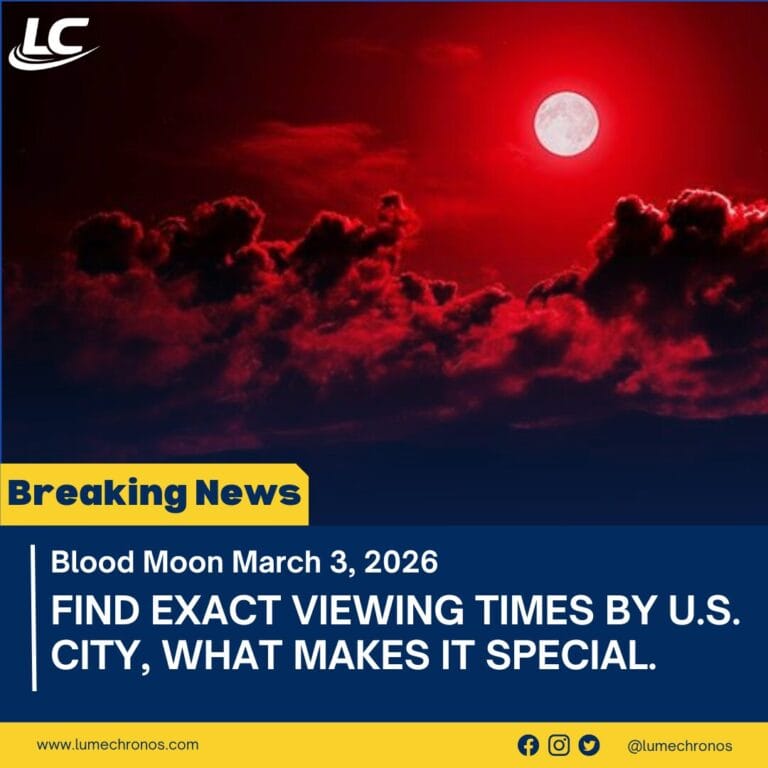
Picture this: it’s just past 3 a.m. on a Tuesday in early March. The sky is dark and cold. And the full moon — the same moon you’ve seen hundreds of times — has turned deep, glowing red.
That’s exactly what happened on March 3, 2026, when the blood moon made its dramatic appearance over North America, the Pacific, East Asia, and Australia. And for millions of Americans who were watching, it was the most striking thing they’d seen in the night sky in years.
But here’s the problem — a staggering number of people either missed it entirely, found out too late, or set an alarm for the wrong time. Others weren’t sure which direction to look, or didn’t realize that the moon was going to set right in the middle of totality for East Coast viewers. All very fixable problems if you had the right information ahead of time.
The blood moon March 3 event was no ordinary full moon. This was a total lunar eclipse — the third in a nearly back-to-back series that began in March 2025 — and it also happens to be the last total lunar eclipse visible from North America until New Year’s Eve 2028. That’s almost three years away.
Whether you saw it, missed it, or just want to understand what the world was watching this morning, this guide covers every detail: the science, the exact timing by U.S. time zone, the best viewing locations, the rare astronomical quirks that made this eclipse stand out, and everything you need to plan ahead for the next one.
Let’s get into it.
What Is a Blood Moon? The Real Science Behind the Red Glow
Most people hear “blood moon” and assume it’s an astrology term or tabloid hype. It’s actually pure physics — and once you understand what’s happening, it becomes one of the most beautiful phenomena in all of astronomy.
How Earth’s Atmosphere Paints the Moon Red
A blood moon occurs when the moon passes completely inside Earth’s umbra — the deepest, darkest zone of our planet’s shadow. You’d think the moon would just go dark, like a light switch flipped off. Instead, it turns red. Here’s why.
Earth’s atmosphere doesn’t simply block light — it bends and filters it. Short-wavelength blue light scatters away (the same reason our daytime sky is blue). But longer-wavelength red and orange light travels further through the atmosphere and curves around the edge of the planet, landing on the moon’s surface.
It’s as if all the world’s sunrises and sunsets are projected onto the moon simultaneously. Every dawn and dusk happening on Earth at that moment is casting its warm glow onto the lunar surface. The result is that deep copper-red color — sometimes rusty orange, sometimes vivid blood red — depending on how much dust, cloud, or volcanic ash is in Earth’s atmosphere at the time.
The Three Types of Lunar Eclipse (And Why Most Don’t Look Like This)
Not every lunar eclipse produces a blood moon. Most go largely unnoticed. Here’s the breakdown:
| Eclipse Type | What Happens | What You See |
|---|---|---|
| Penumbral | Moon grazes the outer shadow | Subtle dimming, easy to miss |
| Partial | Part of moon enters the umbra | A dark bite-shaped shadow |
| Total (Blood Moon) | Moon fully inside the umbra | Deep red or copper disk |
The March 3, 2026 event was a total lunar eclipse, with totality lasting 58 minutes and 19 seconds. That’s enough time to watch, photograph, and still text your friends to wake up.
Why March’s Full Moon Is Called the Worm Moon
March’s full moon carries a traditional name: the Worm Moon. This name comes from Native American and colonial American farming traditions, marking the season when earthworms begin to resurface in thawing ground — a signal that spring is arriving. This year, the Worm Moon and a total lunar eclipse coincided in a poetic pairing of two entirely natural cycles, one above the soil and one deep in space.
📺 Video: What Is a Blood Moon? — NASA Science 📺 Video: Total Lunar Eclipse Science in 3 Minutes — National Geographic 🐦 X Trend: #BloodMoon trending on X March 3, 2026 🐦 X Thread: NASA’s official blood moon explainer thread
Blood Moon March 3, 2026: Exact Viewing Times by U.S. Time Zone
One of the biggest reasons people missed this eclipse — or only caught a sliver of it — was simple timing confusion. The blood moon didn’t happen all at once. It unfolded over several hours, and the truly red phase had a very specific window.
Full Eclipse Timeline in UTC
| Eclipse Phase | UTC Time | What to Watch |
|---|---|---|
| Penumbral begins | 08:44 UTC | Very subtle dimming begins |
| Partial begins | 09:50 UTC | Shadow creeps across the moon |
| Totality begins | 11:04 UTC | Moon turns red — the show starts |
| Maximum eclipse | 11:33 UTC | Deepest red — the peak moment |
| Totality ends | 12:03 UTC | Red begins to fade |
| Partial ends | 12:57 UTC | Moon returns to white |
| Penumbral ends | 14:04 UTC | Eclipse completely over |
Totality Times Across U.S. Time Zones
| U.S. Time Zone | Totality Window | Viewing Notes |
|---|---|---|
| Eastern (EST) | 6:04–7:02 AM | Moon sets mid-totality — look west immediately |
| Central (CST) | 5:04–6:02 AM | Partial totality before moonset |
| Mountain (MST) | 4:04–5:02 AM | Full totality, excellent conditions |
| Pacific (PST) | 3:04–4:02 AM | Best continental U.S. viewing window |
| Alaska (AKST) | 2:04–3:02 AM | Full totality, dark overnight skies |
| Hawaii (HST) | 1:04–2:02 AM | Full totality, warm overnight conditions |
In practice: the farther west you are, the better your view. California, Oregon, Washington, and Nevada had the moon high enough in the sky to see the full blood-red phase without it setting. East Coast viewers in New York, Boston, and Miami had to act fast — totality began at 6:04 a.m. EST just before the moon dipped toward the western horizon. Some East Coasters got a dramatic low-horizon view. Others with buildings or trees blocking the west missed it entirely.
Most people don’t realize that during a blood moon, “getting up early” isn’t enough — you also need a clear view in the right direction. On the East Coast, that’s straight west. In the western U.S., the moon was higher in the sky and much easier to find.
🌐 Check your exact city’s eclipse timing: TimeAndDate.com Eclipse Map 📺 Video: Space.com Live Blood Moon Coverage — March 3, 2026 🐦 X Live Blog: Space.com live updates on the eclipse
Where Was the Blood Moon Visible? Global Coverage Explained
This total lunar eclipse was visible from Asia, Australia, and North America — making it a genuinely worldwide event. And it’s the last total lunar eclipse until the December 31, 2028–January 1, 2029 New Year’s Blood Moon. That context matters.
Regional Breakdown
United States and Canada: The western half — California, Oregon, Washington, Nevada, Arizona, Hawaii, and Alaska — had premium views with the moon at a comfortable height during the full totality phase. The Midwest and East Coast saw early totality but had the moon set before the eclipse ended.
East Asia and Australia: Totality was visible in the evening from eastern Asia and Australia — a prime window when people were awake and outdoors. Sydney, Brisbane, Tokyo, and Seoul all had excellent evening views. It was, by timing alone, some of the best viewing conditions on Earth.
International Totality Windows (Local Times):
| Location | Local Totality Time |
|---|---|
| New Zealand (Auckland) | 12:04–1:02 a.m. NZDT, March 4 |
| Sydney, Australia | 10:04–11:02 p.m. AEDT, March 3 |
| Brisbane, Australia | 9:04–10:02 p.m. AEST |
| Tokyo / Seoul | Evening, March 3 |
| Los Angeles (PST) | 3:04–4:02 a.m., March 3 |
| New York (EST) | 6:04–7:02 a.m., March 3 (moonset during totality) |
Europe and Africa: Largely shut out. The eclipse was not visible from Europe and Africa. If you’re in those regions, your next total lunar eclipse is 2028.
The Selenelion — The “Impossible” Eclipse Effect
Here’s something most people don’t know about the East Coast’s view. Some observers in eastern U.S. cities may have experienced a selenelion — a rare atmospheric effect where the eclipsed red moon and the rising sun are both visible on opposite horizons at the same time. This atmospheric illusion is called a selenelion: an ‘impossible’ moment when the rising sun and eclipsed moon appear in the sky simultaneously.
Geometrically, this shouldn’t be possible. But Earth’s atmosphere bends light just enough — through atmospheric refraction — to push both above the visible horizon briefly. If you were in Washington D.C., Philadelphia, or New York and saw a red moon while dawn was breaking behind you, you watched something genuinely rare.
📺 Video: The Selenelion Explained — Sky & Telescope 🐦 X Post: Space.com thread on the selenelion during March 3 eclipse
Why This Blood Moon Was Astronomically Unusual
Not every blood moon gets written into the record books. The March 3, 2026 total lunar eclipse had multiple layers of significance that made it stand out even for professional astronomers.
Third of a Near-Tetrad Series
This lunar eclipse was the third of an almost tetrad, with the others being on March 14, 2025 (total); September 8, 2025 (total); and August 28, 2026 (partial). A tetrad — four consecutive total lunar eclipses six months apart — is genuinely rare. Long stretches of decades have passed with no tetrads at all. Three total eclipses in just over a year is remarkable by any measure.
The Moon Occulted a Galaxy
Here’s the detail that got astronomers most excited. During the eclipse, the Moon occulted NGC 3423 over North America. Deep-sky objects are rarely occulted during a total eclipse from any given spot on Earth.
In plain language: the blood-red moon passed directly in front of a distant galaxy, blocking it from view. Anyone with a telescope pointed at the right coordinates at the right moment watched the moon literally swallow a galaxy. That kind of alignment from any specific location is extraordinarily unusual.
It Fell on the Lantern Festival
The eclipse fell on the Lantern Festival — the first time this coincidence had occurred since February 11, 2017. The Lantern Festival closes Lunar New Year celebrations across China, Japan, Korea, and Southeast Asia. Hundreds of millions of people were already outdoors, already looking at the moon, already celebrating — and then the moon turned red. The convergence of a major cultural moon celebration and a total lunar eclipse is the kind of thing that gets remembered for generations.
Part of the Ancient Saros 133 Series
This eclipse is a member of Saros series 133, repeating every 18 years, 11 days, and containing 71 events. The series started with a penumbral lunar eclipse on May 13, 1557. The Saros cycle is how Babylonian astronomers predicted eclipses thousands of years before modern telescopes. It still works. Knowing this eclipse’s Saros membership lets astronomers trace its lineage back to the 16th century and project it forward to the 26th.
For readers who want to go deeper into eclipse cycles, the Saros series, and lunar astronomy history, lumechronos.com has detailed educational guides written for curious minds at every experience level.
📺 Video: Saros Cycle Explained — How We Predict Eclipses 🐦 X Thread: Wikipedia Astronomy editors on the Saros 133 series
How to Watch and Photograph the Blood Moon (Tips That Actually Work)
Whether you caught March 3 or are already preparing for December 31, 2028, these are the approaches that actually make a difference.
What You Don’t Need (Good News First)
You can observe a lunar eclipse without any special equipment — all you need is a line of sight to the Moon. Unlike a solar eclipse, there is no eye safety concern. No glasses, no filters, nothing. Just go outside and look up.
What Genuinely Helps
Binoculars or a small telescope: These reveal the color gradient across the lunar disk during totality — the center of the shadow is darkest, the edges are orange-yellow. A remarkably three-dimensional view compared to the naked eye.
A darker location: Even modest distance from city streetlights — a state park, a hilltop, an open field — dramatically improves contrast and color richness. State parks and official dark sky sites provide the best conditions.
Smartphone photography in manual mode:
- Switch to Pro or Manual mode
- Set ISO 800–1600 during totality
- Try shutter speeds between 1/60 and 1 second
- Use a tripod or stable surface
- Tap the moon on screen to lock focus — not to set exposure
- Take 10–15 shots and review
For East Coast viewers specifically: Know your western horizon. Buildings, trees, and hills will cut off a low-hanging moon right when totality is most dramatic. Getting to a rooftop, open parking lot, or park with a clear west-facing view was genuinely critical on March 3.
Mistakes Most People Made
Auto mode on smartphones. The phone sees a dark scene, overexposes to compensate, and turns the moon into a washed-out white blob. Five minutes in manual mode fixes this entirely.
Leaving after first totality contact. Many people saw the moon just begin to redden and assumed they’d seen the peak. Maximum eclipse — when the moon is deepest red — was at 11:33 UTC (6:33 AM EST, 3:33 AM PST). The moon is most red at the midpoint, not the beginning.
Not planning for the horizon. On the East Coast, horizon clearance was everything. A tree line that doesn’t bother you during a high full moon can completely block a moon that’s only 5–10 degrees above the horizon.
For quality stargazing tools, binocular recommendations, and optics for upcoming sky events, lumechronos.shop offers curated resources for observers at every level.
📺 Video: 7 Tips for Photographing the Blood Moon — Space.com 📺 Video: Best Binoculars for Lunar Eclipse Viewing 🐦 X Thread: Astrophotographers sharing March 3 blood moon shots
Blood Moon March 3 vs. Past and Future Eclipses: The Full Timeline
Context matters. One eclipse is fascinating. Understanding where it sits in the long-term pattern transforms it into something genuinely humbling.
The Near-Tetrad of 2025–2026
| Date | Type | Primary Visibility |
|---|---|---|
| March 14, 2025 | Total (Blood Moon) | Americas, Europe |
| September 8, 2025 | Total (Blood Moon) | Asia, Australia, Americas |
| March 3, 2026 | Total (Blood Moon) | Americas, Asia, Pacific |
| August 28, 2026 | Partial only | Limited global view |
Three total lunar eclipses in just over a year is unusual. Most multi-year periods have one total eclipse, or occasionally none. This has been a remarkable stretch for anyone paying attention to the sky.
What Comes Next
The March 3, 2026 total lunar eclipse is the final total lunar eclipse for a period of almost 3 years. After the partial eclipse in August 2026 and a completely eclipse-free 2027, the next blood moon is the December 31, 2028–January 1, 2029 New Year’s Blood Moon Eclipse — visible globally.
| Date | Type | Best Region |
|---|---|---|
| August 28, 2026 | Partial only | Limited |
| 2027 | No total eclipses | — |
| Dec 31, 2028 – Jan 1, 2029 | Total (Blood Moon) | Global — New Year’s Eve |
If you missed March 3, 2026, you have until New Year’s Eve 2028 to prepare. That’s actually a generous runway. Start planning now.
For a global eclipse calendar and astronomy event coverage from a European and international perspective, lumechronos.de provides in-depth multi-timezone planning guides for sky events worldwide.
🌐 Reference: EarthSky Eclipse Calendar 2026–2028
The Cultural and Historical Meaning of Blood Moons
Science explains the what. History explains the why it matters to people — and that story is every bit as fascinating.
Ancient Civilizations and the Red Moon
In ancient Mesopotamia, royal scribes recorded every lunar eclipse as a potential omen. Some rulers placed substitute kings on the throne during eclipse periods to absorb any bad fortune, while the real king waited it out in hiding. It sounds odd today, but it was taken completely seriously.
The Inca of South America believed a great jaguar was eating the moon during totality. Communities would make noise, shake weapons, and cry out to drive it away. The moon always came back — presumably proof the strategy worked.
Medieval European astronomers treated eclipse prediction as one of the highest intellectual achievements of the age. Being able to accurately forecast a blood moon was a demonstration of rare mathematical skill and observational power.
Blood Moons and Modern Culture
Today, blood moons exist at the intersection of science and public fascination. Social media lights up with photos, astronomy pages gain millions of followers overnight, and major news organizations run live blogs for hours. The term “blood moon” — not a formal scientific label, but popularized in the early 2000s — now generates extraordinary search traffic with every total eclipse.
That’s not a problem. Anything that gets three billion people looking at the same sky at the same time is doing something genuinely good for human curiosity.
The Lantern Festival Coincidence in 2026
As noted earlier, this eclipse fell on the Lantern Festival, the first time this coincidence had occurred since February 11, 2017. In China, Japan, Korea, Vietnam, and across Southeast Asia, the Lantern Festival is the final night of Lunar New Year celebrations — a night already filled with outdoor gatherings, paper lanterns, and moon-gazing. The blood moon appeared above hundreds of millions of people who were already outside, already looking up. That kind of convergence between sky event and human ceremony is genuinely rare.
📺 Video: Blood Moon History and Mythology — Smithsonian Channel 🐦 X Post: Lantern Festival + Blood Moon viral posts, March 3, 2026
FAQ: Blood Moon March 3, 2026 — Your Questions Answered
What time was the blood moon on March 3, 2026?
Totality — when the moon turned fully red — ran from 11:04 to 12:03 UTC on March 3, with maximum eclipse at 11:33 UTC. For American viewers, that was: Eastern 6:04–7:02 a.m. EST; Central 5:04–6:02 a.m. CST; Mountain 4:04–5:02 a.m. MST; Pacific 3:04–4:02 a.m. PST; Alaska 2:04–3:02 a.m. AKST; Hawaii 1:04–2:02 a.m. HST. Western states had the fullest, clearest views. East Coast viewers saw totality begin just before the moon set, making horizon access critical.
Why does the moon turn red during a blood moon?
Earth moves directly between the sun and moon, blocking direct sunlight from reaching the moon. Instead of going dark, the moon turns red because Earth’s atmosphere bends sunlight around the planet and filters out blue wavelengths. The red and orange light that remains spills onto the moon’s surface. It’s the same physics that gives us vivid red sunsets — just projected 239,000 miles away onto the lunar surface. The darker and cleaner Earth’s atmosphere is at the time, the more vivid the red color tends to be.
Was the March 3 blood moon visible across all 50 U.S. states?
Technically visible from all 50 states, weather permitting — but quality varied significantly. Western states (California, Hawaii, Alaska, Oregon, Washington) had the moon high in the sky during full totality. Mountain and Central zones had good views. East Coast viewers saw totality begin but the moon set before it ended. Weather was also a major factor: heavily overcast regions like the Carolinas had their view blocked entirely by cloud cover, regardless of timing.
Do I need special equipment to watch a blood moon?
No special equipment is required, and lunar eclipses are completely safe to watch with the naked eye. Unlike solar eclipses, there’s no eye safety risk. You can watch entirely unaided. That said, binoculars or a small telescope dramatically improve the experience — you can see the gradient of colors across the lunar disk and subtle surface textures that are invisible to the naked eye.
How long does a blood moon last?
The March 3, 2026 total lunar eclipse had 58 minutes of totality — from 11:04 to 12:03 UTC, with maximum eclipse at 11:33 UTC. The total eclipse event from first penumbral contact to last penumbral contact spanned over five hours. But most people focus on totality — the 58-minute window when the moon is fully red. Totality duration varies per eclipse depending on how centrally the moon passes through Earth’s umbra.
When is the next blood moon after March 3, 2026?
The March 3, 2026 eclipse is the last total lunar eclipse until the December 31, 2028–January 1, 2029 New Year’s Blood Moon Eclipse. There are no total lunar eclipses anywhere on Earth in 2027. A partial lunar eclipse occurs in August 2026 but won’t produce the blood moon effect. For North American viewers specifically, the next total lunar eclipse is also New Year’s Eve 2028 — nearly three years away.
What is the Saros cycle and how does it relate to this eclipse?
The Saros cycle is an 18-year, 11-day pattern in which eclipses repeat in a similar geometric arrangement. This eclipse is part of Saros series 133, which began with a penumbral eclipse on May 13, 1557, and contains 71 events. Babylonian astronomers used the Saros cycle thousands of years ago to predict future eclipses with remarkable accuracy — and the system still works perfectly today. Every eclipse in a Saros series is a kind of “sibling” to the one before it, shifted slightly westward in visibility.
What made the March 3, 2026 blood moon scientifically unique?
Several factors combined to make this one unusually notable. First, it was the third in a near-tetrad series of consecutive total eclipses. Second, during the eclipse the Moon occulted galaxy NGC 3423 over North America — a rare event where the moon physically blocked a deep-sky galaxy from view. Third, it fell on the Lantern Festival, the first time that coincidence had occurred since 2017. And fourth, some East Coast U.S. observers had a chance to witness the selenelion — the rare simultaneous appearance of the eclipsed moon and the rising sun on opposite horizons.
Key Takeaways
- 🌑 The blood moon March 3, 2026 was the only total lunar eclipse of the entire year — and the last one visible in North America until December 31, 2028. A nearly three-year gap follows.
- ⏰ Timing was everything. Totality ran 11:04–12:03 UTC (6:04–7:02 AM EST, 3:04–4:02 AM PST). Western U.S. viewers had the best window; East Coast viewers needed a clear western horizon and an early alarm.
- 🔭 No special equipment is required to watch a blood moon safely — but binoculars or a small telescope reveal dramatic color gradients across the lunar surface during totality.
- 🌍 Visibility was broad globally — East Asia, Australia, New Zealand, the Pacific, and North America. Europe and Africa were shut out until 2028.
- 🌌 This eclipse was astronomically unusual: it was the third in a near-tetrad, fell on the Lantern Festival, involved the moon occulting galaxy NGC 3423 over North America, and some viewers experienced the rare selenelion effect.
- ❌ Biggest viewing mistakes to avoid: auto mode on smartphones (overexposes the moon), leaving before maximum eclipse, and ignoring horizon clearance on the East Coast.
- 📅 Next total lunar eclipse: December 31, 2028 — New Year’s Eve. Three years to prepare. Start now.
Conclusion: What This Blood Moon Means — and What Comes Next
The blood moon on March 3, 2026 was one of those rare nights when billions of people looked up at the same sky and witnessed the same extraordinary thing. A moon that had spent all night looking completely ordinary suddenly turned deep, glowing red — the product of every sunrise and every sunset on Earth happening simultaneously, their warm light bending through our atmosphere and landing on the lunar surface 239,000 miles away.
That’s not mythology. It’s not clickbait. It’s real, predictable physics — and it’s been happening like clockwork since long before any human was around to see it.
If you watched it — even briefly, even through a gap in the clouds — that’s worth holding onto. If you missed it, don’t worry too much. The December 31, 2028 New Year’s Blood Moon is coming, and with nearly three years of lead time, there’s every reason to prepare properly: drive somewhere dark, set two alarms, try manual mode on your camera, and bring someone along who’s never seen one.
The universe runs on its own schedule. But it shares the show with anyone willing to step outside and look up.
📚 Explore more astronomy guides at lumechronos.com 🔭 Find stargazing tools and optics at lumechronos.shop 🌍 Get a global eclipse calendar and sky events coverage at lumechronos.de
Have a question about the March 3 blood moon — or did you catch it from somewhere memorable? Drop it in the comments below. Share this guide with anyone who set an alarm and still missed it. And subscribe for alerts when the next major sky event is approaching.
The next one is worth every bit of the wait.
Verified Reference Sources
- NASA — March 2026 Total Lunar Eclipse Guide
- TimeAndDate.com — Total Lunar Eclipse March 3, 2026
- Space.com — What Time Is the Blood Moon on March 3?
- Space.com — Where to See the Total Lunar Eclipse on March 3
- Space.com — Live Blood Moon Updates, March 3
- StarWalk — Blood Moon 2026 Times and Visibility
- Wikipedia — March 2026 Lunar Eclipse
- TheSkyLive — Lunar Eclipse March 3, 2026 Detail
- EarthSky — Lunar Eclipse Guide 2026
This article is based on insights from real-time trends and verified sources including trusted industry platforms.