





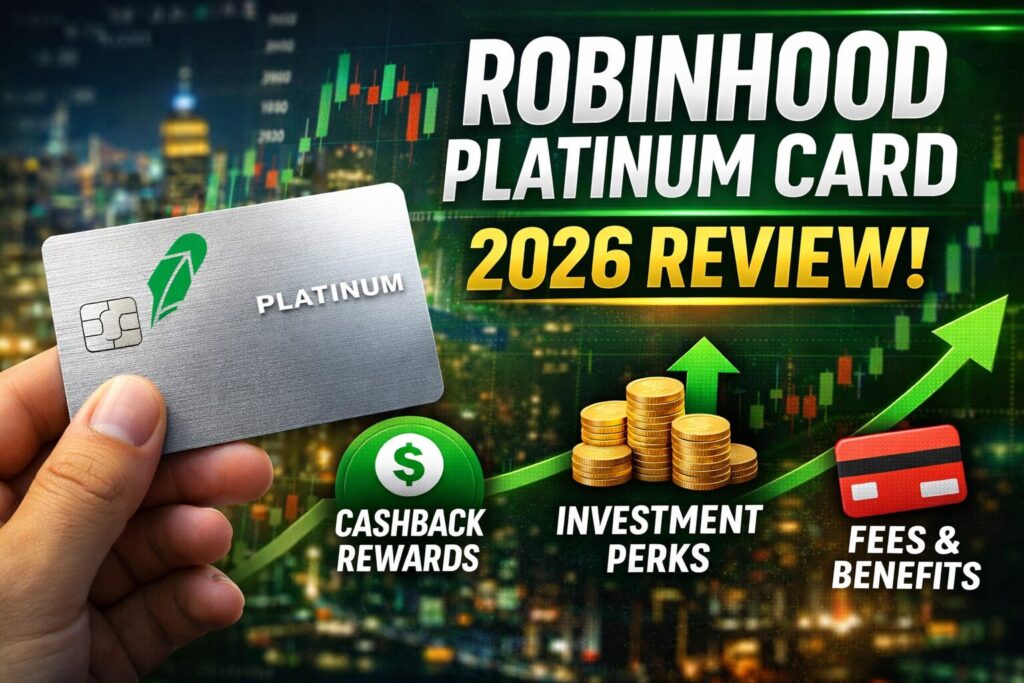
🚀 Robinhood Platinum Card Review 2026: The Fintech Disruptor That’s Rewriting the Rules of Premium Credit
The fintech world just got a serious new contender — and if you haven’t heard about it yet, you’re about to. Robinhood — the platform that democratized investing for over 24 million everyday Americans — has now set its sights on the premium credit card market with the launch of the Robinhood Platinum Card. Unveiled on March 4, 2026, at the company’s much-anticipated “Take Flight” keynote event in New York, the card is already turning heads across Wall Street and Silicon Valley alike. In an era where consumers increasingly expect their financial tools to do double duty — rewarding spending and building wealth simultaneously — this Robinhood Platinum Card Review 2026 arrives at exactly the right moment.
This isn’t just another rewards card dressed up in flashy packaging. With a physical card plated in 99.9% pure platinum, an aggressive cashback structure that feeds directly back into your investment portfolio, and a suite of lifestyle benefits conservatively valued at over $3,000 per year, the Robinhood Platinum Card 2026 is a direct, full-frontal challenge to legacy premium cards like the American Express Platinum and the Chase Sapphire Reserve.
In fact, Robinhood CEO Vlad Tenev took the stage holding the card and cheekily branded it the “actual” Platinum card — a not-so-subtle jab at rivals that the financial media immediately picked up on. At a time when premium card annual fees have been creeping past $700, this Robinhood Platinum Card Review 2026 will show you whether Robinhood has found a smarter value equation.
📺 Watch: Robinhood “Take Flight” Keynote — Full Event Recap (March 2026)
So who should seriously consider this card? If you’re already a Robinhood Gold member, a frequent traveler, a dining enthusiast, or simply someone who wants their everyday spending to work harder for their long-term investment portfolio, this card was built with you in mind. The timing is also significant: as Buy Now Pay Later usage surges in 2026 and younger investors increasingly demand integrated financial ecosystems, the Robinhood Platinum Card Review 2026 addresses a genuine gap in the market. No longer do you need to choose between a card that rewards you and a platform that grows your money — Robinhood is betting those two things can finally be the same product.
📺 Watch: Is the Robinhood Platinum Card Worth It? (Honest 2026 Breakdown)
In this comprehensive Robinhood Platinum Card Review 2026, we break down everything you need to make a smart decision — from the rewards structure and annual fee justification, to eligibility requirements, hidden perks, and whether this card can genuinely compete with the entrenched titans of the premium card space. Whether you’re a seasoned Robinhood investor curious about expanding your financial relationship with the platform, or a complete newcomer evaluating your first premium card, this Robinhood Platinum Card 2026 review gives you the full, unfiltered picture.
💳 What Is the Robinhood Platinum Card? — Robinhood Platinum Card Review 2026
To fully appreciate what Robinhood is attempting here, it helps to understand exactly what this product is at its core. The Robinhood Platinum Card is a premium Visa credit card issued by Coastal Community Bank and offered through Robinhood Credit, Inc. — a subsidiary of Robinhood Markets, the brokerage and fintech platform headquartered in Menlo Park, California. In this Robinhood Platinum Card Review 2026, that institutional detail matters more than it might seem: Coastal Community Bank has become one of the go-to banking partners for fintech companies looking to issue regulated credit products without holding a full banking charter themselves, a model that has proven increasingly common as the embedded finance trend accelerates through 2026.
To understand how the Platinum Card fits into Robinhood’s product evolution, a little history goes a long way. Robinhood launched its first credit card in 2024 — the Robinhood Gold Card — which quickly earned widespread attention for its straightforward 3% flat cash back on all purchases and sleek metal design at a time when most competitors were still offering tiered, category-restricted rewards. The Platinum Card is a significant leap beyond that.
It is positioned at the very top end of the premium rewards market, sitting alongside flagship products from American Express, Chase, and Capital One — three institutions that have dominated the premium card space for over a decade. As any thorough Robinhood Platinum Card Review 2026 must acknowledge, competing in that tier is not just about perks; it’s about trust, ecosystem depth, and long-term customer relationships — all areas where Robinhood is still proving itself.
📺 Watch: Robinhood Gold Card vs. Platinum Card — What’s the Difference? (2026)
The target user for this card is refreshingly specific, which is actually one of its strengths. Robinhood has designed the Platinum Card for active investors, high-income professionals, frequent travelers, and existing Robinhood Gold members who want a credit card that integrates seamlessly with their brokerage account, cash management account, and broader financial life — all within a single app. In the context of 2026, this makes strong strategic sense:
according to J.D. Power’s 2025 U.S. Credit Card Satisfaction Study, younger affluent consumers are increasingly gravitating toward financial “super-apps” that consolidate investing, spending, and saving in one place, rather than managing five separate accounts across five separate platforms. The Robinhood Platinum Card 2026 is clearly designed to be the spending layer of that super-app vision.
📺 Watch: Is Robinhood Building a Financial Super-App? Full 2026 Analysis
As of this Robinhood Platinum Card Review 2026, the card is currently invite-only at launch, though Robinhood has opened a public waitlist for customers to request early access. A broader rollout is expected to begin in the second quarter of 2026, meaning most applicants will need to join the queue before receiving an invitation.
This invite-only model isn’t simply an exclusivity tactic — it’s a deliberate strategy to manage underwriting risk and infrastructure scaling, a lesson likely learned from the Apple Card’s rocky 2019 launch and the overwhelming demand that followed the Chase Sapphire Reserve’s debut in 2016. For anyone seriously evaluating the Robinhood Platinum Card in 2026, getting on that waitlist early is the smartest first move you can make right now.
Key Features of the Robinhood Platinum Card
The Robinhood Platinum Card is built around three core pillars: strong cashback rewards, an ecosystem of lifestyle benefits, and deep integration with the Robinhood Banking app.
On the cashback side, the card offers 5% back on dining, 5% back on flights booked through the Robinhood Banking app, and a remarkable 10% back on hotels and rental cars — also booked through the app. All other purchases earn a solid 1% cash back. Critically, cash back must be redeemed into a Robinhood Financial brokerage account, which reinforces the card’s investment-lifestyle identity and turns everyday spending into long-term wealth building.
For security and features, the card comes with no foreign transaction fees, which makes it immediately competitive for international travelers. Credit limits can be up to 5x higher than those available on the Robinhood Gold Card, reflecting the premium nature of the product and its target demographic. The card is also physically distinctive: the primary cardholder receives a card plated with 99.9% pure platinum, while authorized users receive a stainless steel version by default (with an upgrade option available for a fee).
The Robinhood Banking app integration is central to the value proposition. Travel bookings, family card management, reward tracking, and spending limits are all managed within the app, making the entire experience feel native to Robinhood’s ecosystem rather than bolted on.
Robinhood Platinum Card Benefits
The Robinhood Platinum Card benefits package is one of the most compelling in the current premium card landscape, with Robinhood claiming over $3,000 in annual value across four main categories.
Dining Benefits are generous and easy to use. Cardholders receive a $250 annual DoorDash credit, a $250 annual dining credit usable at more than 15,000 eligible restaurants, and a complimentary DashPass membership worth $120 per year. Combined with the 5% cash back on dining purchases, this category alone can justify a significant portion of the annual fee for people who eat out regularly.
Travel Benefits are where the card truly competes with Amex and Chase. The card offers $500 in annual hotel credit, a $300 annual travel credit, and 5% cash back on flights plus 10% back on hotels and rental cars when booked through the Robinhood Banking app. Cardholders also get unlimited access to over 1,800 Priority Pass airport lounges worldwide, a Global Entry or TSA PreCheck fee credit, and no foreign transaction fees anywhere in the world. For frequent flyers, this combination is genuinely impressive.
Health & Wellness Benefits set the Robinhood Platinum Card apart from almost every other premium card on the market. Cardholders receive a complimentary Oura Ring membership for personalized sleep and activity insights, a complimentary Function Health membership (a $365 value) giving access to 160+ advanced lab tests, and a free Amazon One Medical membership worth $199. On top of that, there is a $200 annual credit toward wearable devices.
Lifestyle & Mobility perks include a $250 annual credit for autonomous vehicle rides — a forward-thinking benefit that signals where Robinhood sees its customer base heading. Family members can also be added as authorized users at no additional cost, with easy spending tracking and limit controls in the app.
Finally, every Platinum cardholder receives a complimentary Robinhood Gold membership, which provides access to premium investing tools, higher interest rates on uninvested cash, and other platform perks — essentially connecting the credit product to the investment platform in one seamless bundle.
Fees and Charges
The Robinhood Platinum Card annual fee is $695, placing it squarely in the same tier as the American Express Platinum ($695/year) and well above the Chase Sapphire Reserve ($550/year). This is the most important number to understand before applying, because whether the card makes financial sense depends entirely on how many of its bundled benefits you will actually use.
On the interest rate side, specific APR details are governed by the card’s full rates and fee disclosure (available on Robinhood’s website), which will vary based on your creditworthiness at the time of approval. As with all credit cards, carrying a balance will accrue interest charges that can quickly erode the value of any rewards earned.
There are no foreign transaction fees, which is a meaningful saving for international travelers who would otherwise pay 2–3% on every overseas purchase. Late payment fees and other standard charges apply as disclosed at the time of application. Robinhood has not publicly announced any hidden charges beyond the standard disclosures, though as with all credit products, reading the full cardholder agreement before signing up is strongly advised.
Authorized users can be added at no additional cost for the standard stainless steel card, though upgrading an authorized user to the platinum-plated version carries an additional fee.
Eligibility Requirements
Understanding the Robinhood Platinum Card eligibility criteria is essential before you request an invitation or submit an application.
First and foremost, the card is currently invite-only. Robinhood is sending a limited number of invitations to existing customers, while also allowing others to join a waitlist through the Robinhood app or the official Platinum Card page. Being an existing Robinhood Gold member or a high-activity Robinhood user likely improves your chances of receiving an early invitation.
Because this is a premium card with high credit limits, applicants should expect a strong credit score requirement — industry norms for cards in this tier typically start at 720 or higher, though Robinhood has not published a specific minimum. The application process is described as including a soft pull first (no impact to your credit score) before a hard inquiry is initiated if you choose to accept an offer.
In terms of geographic availability, the card is available to US residents only, consistent with Robinhood’s current US-focused operations. An existing or new Robinhood Financial brokerage account is required, since cash back rewards are redeemed directly into that account. Income requirements are not explicitly stated, but the premium nature of the card and its high credit limits suggest that underwriting will favor applicants with stable, higher incomes.
How to Apply for the Robinhood Platinum Card
Applying for the Robinhood Platinum Card is a straightforward process, though access is currently gated through Robinhood’s invite system. Here is how to get started.
Step 1: Open a Robinhood Account. If you don’t already have one, download the Robinhood app and create a free brokerage account. You’ll need this to be eligible for the card and to redeem cash back rewards.
Step 2: Upgrade to Robinhood Gold (Recommended). While not strictly required, holding a Robinhood Gold membership appears to improve your standing for an invitation. Gold costs $5 per month and provides a range of investing and banking perks.
Step 3: Check Eligibility and Request Access. Visit robinhood.com/us/en/creditcard/platinum/ and tap the “Request Access” button. This places you on the waitlist. You can also check your Robinhood app inbox, as existing customers may receive direct invites.
Step 4: Submit Your Application. Once invited, you’ll be prompted to complete a credit application. Robinhood first runs a soft credit check with no impact to your score. Review the offer and terms carefully before proceeding.
Step 5: Wait for Approval and Card Delivery. If approved, Robinhood will mail your 99.9% pure platinum-plated card. Given that the card is rolling out in Q2 2026, early applicants can expect their cards in the April–June 2026 window.
Robinhood Platinum Card vs Other Credit Cards
One of the most common questions is how the Robinhood Platinum Card stacks up against the competition. Here’s a clear-eyed comparison.
Robinhood Platinum Card vs American Express Platinum: Both cards carry a $695 annual fee and claim over $3,000 in annual benefits value. The Amex Platinum is a long-established leader with extensive travel protections, Centurion Lounge access, and a massive merchant network of benefits. The Robinhood card counters with higher cashback rates on specific categories (10% on hotels vs. no cashback on Amex), a genuinely distinctive wellness package, and an investment integration that Amex simply cannot match. The Amex card may suit those who want prestige and travel perks above all; the Robinhood card suits those who also want their spending to feed their portfolio.
Robinhood Platinum Card vs Chase Sapphire Reserve: The Sapphire Reserve ($550/year) is the favorite of frequent travelers who value points flexibility — Chase Ultimate Rewards points transfer to over a dozen airline and hotel partners. The Robinhood card doesn’t offer transferable points; it offers direct cash back into an investment account instead. For investors who prefer simplicity and wealth-building over points juggling, Robinhood’s model is appealing. For optimizers who love maximizing point transfers, Chase remains compelling.
Robinhood Platinum Card vs Other Fintech Cards: Cards like the Apple Card or the no-annual-fee Robinhood Gold Card offer simpler, lower-cost cash back structures. They are better suited to users who prefer minimal fees and straightforward rewards. The Platinum Card is in a different league entirely — its value only shows for high spenders who will utilize the bundled credits.
Pros and Cons
No financial product is perfect, and an honest Robinhood Platinum Card review has to address both sides of the equation.
Pros: The cashback structure is genuinely strong — 10% back on hotels and rental cars is hard to find anywhere else at this tier. The wellness benefits (Oura, Function Health, Amazon One Medical) are uniquely differentiated from every competitor. Redeeming cash back directly into a brokerage account creates a real wealth-building loop. The integration with the Robinhood Banking app makes the whole experience cohesive. Family card sharing at no extra cost is a thoughtful addition. The physical card is also genuinely premium, made with 99.9% pure platinum.
Cons: The $695 annual fee demands careful lifestyle alignment — if you don’t regularly use DoorDash, travel frequently, or care about wellness memberships, the math won’t work in your favor. The invite-only launch creates access friction. Cash back is tied to Robinhood’s ecosystem, meaning it’s less flexible than transferable points from Amex or Chase. Booking travel through the Robinhood Banking app is required to earn the elevated cashback rates, which is an added step compared to booking on your preferred travel platform. And the autonomous ride credit, while forward-thinking, is only valuable if you live in a city where that service is widely available.
Is the Robinhood Platinum Card Worth It in 2026?
Here’s the bottom line: the Robinhood Platinum Card is worth it for the right person, and it falls flat for the wrong one.
If you are an active Robinhood investor, spend meaningfully on dining and travel, would use the DoorDash credits and health memberships, and appreciate having your rewards feed directly into your investment portfolio — this card could easily deliver $1,500–$2,500 or more in net value annually (after the $695 fee), especially if you book hotels or rental cars regularly through the app.
If you are a casual credit card user, don’t travel frequently, already have an Amex Platinum, or prefer the flexibility of transferable points, the Robinhood Platinum Card is likely not your best choice.
What makes this card genuinely exciting from a fintech perspective is what it signals: Robinhood is no longer just a trading app. With a premium credit product that rivals American Express on price and ambition, the company is building a full-stack financial ecosystem — investing, banking, and now premium spending — all under one roof. For a certain generation of investors and high earners, that integrated vision is exactly what they’ve been waiting for.
Conclusion
The Robinhood Platinum Card arrives in 2026 as one of the boldest moves in fintech credit. From 10% cash back on hotels to complimentary health memberships and a physically stunning platinum-plated card, Robinhood has built a product that speaks directly to the investment-minded lifestyle. It’s not the right card for everyone, but for the active investor who lives, travels, and dines within Robinhood’s growing ecosystem, it may well be the most rewarding card in your wallet.
Whether you’re chasing returns in the market or at the dinner table, the Robinhood Platinum Card wants to be your partner in both.
This article is based on insights from real-time trends and verified sources including trusted financial platforms such as Bloomberg, Robinhood’s official product pages, and The Street. Card terms, benefits, and availability are subject to change. Always review the full cardholder agreement before applying.