




Disclaimer: This blog post contains historical analysis and opinions. All product names, logos, and brands are property of their respective owners.
“The Rise and Fall of Valve’s Steam Machine Dream”
Remember the buzzword from a few years ago? The phrase that was supposed to change PC gaming forever and bring it to your living room couch? That’s right, we’re talking about the Steam Machine console.
For a moment in the mid-2010s, it seemed like the gaming world was about to get a major shake-up. Valve, the legendary company behind Steam and hits like Half-Life and Counter-Strike, decided to take on Sony and Microsoft directly. The plan was ambitious: a line of pre-built, living-room-friendly PCs that ran a new, streamlined operating system called SteamOS.
But what exactly was a Steam Machine? And why did this promising concept fade into obscurity? Let’s take a nostalgic trip back to the rise and fall of this fascinating piece of gaming history.
What Was a Steam Machine Console?
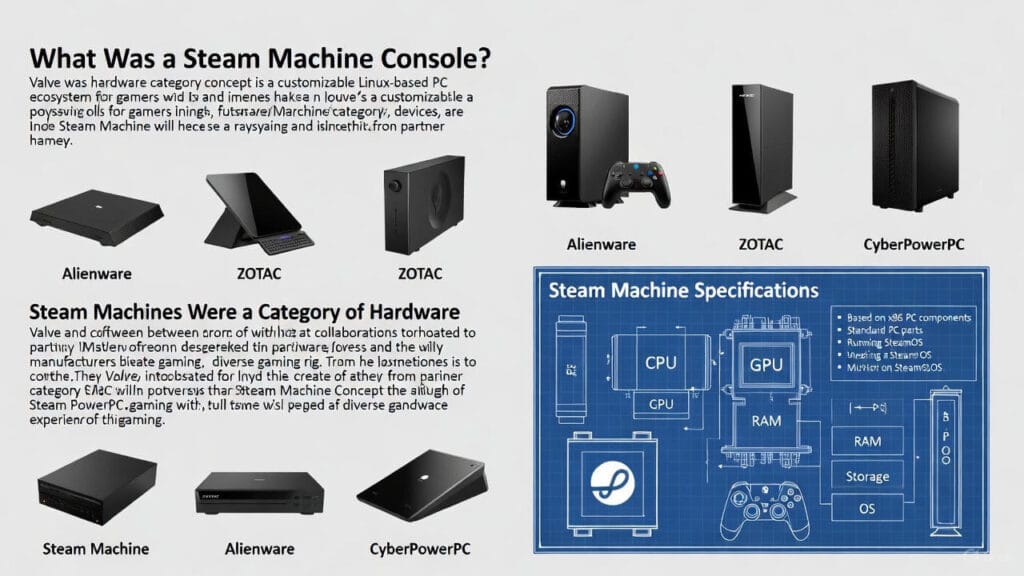
At its heart, a Steam Machine was not a single, standardized console like the PlayStation or Xbox. Instead, it was a category of hardware. Valve created a specification, and then partnered with various PC manufacturers like Alienware, ZOTAC, and CyberPowerPC to build the actual devices.
The core idea was brilliant:
- The Power of a PC, the Simplicity of a Console: A Steam Machine console would sit under your TV, connect to your big screen, and be controlled with a revolutionary new Steam Controller. You’d get access to the vast library of Steam games without the hassle of building a PC or dealing with Windows in the living room.
- SteamOS: The Beating Heart: The operating system was Linux-based, which promised better performance and was free from the licensing costs of Windows. This was meant to keep costs competitive.
- Variety and Choice: Unlike traditional consoles, you could buy a Steam Machine at various price points and performance levels, from affordable 1080p boxes to high-end powerhouses for 4K gaming.
The Grand Vision: Why It Was So Exciting
For PC gamers, the promise was intoxicating. Imagine having your entire Steam library seamlessly available on your big-screen TV. For console gamers, it offered a potential gateway into the PC ecosystem with its massive game sales, modding support, and incredible backwards compatibility.
Valve’s initiative was a direct challenge to the “walled gardens” of closed console platforms. It was an open platform, championing PC gaming’s strengths in a console-like form factor.
The VTI stock represents the Vanguard Total Stock Market ETF, one of the most popular index funds for long-term investors. It tracks the performance of the entire U.S. stock market, including large-, mid-, and small-cap companies. Whether you’re monitoring the VTI stock price today or analyzing its overall growth trend, this ETF remains a top choice for those seeking broad market exposure and consistent returns.
Read more here: VTI Stock | VTI Stock Index | VTI Stock Price Today
What Went Wrong? The Fall of the Steam Machine
Despite the hype, the Steam Machine console initiative never gained significant traction and quietly fizzled out. The reasons are a classic case study in good ideas meeting harsh reality.
- The Linux Problem (A Lack of Games): This was the biggest hurdle. The vast majority of games on Steam were (and still are) built for Windows. While Valve invested in tools like Proton (the precursor to the amazing Steam Deck compatibility layer), getting developers to port their games to Linux/SteamOS was a massive challenge. At launch, and for a long time after, the game library was a fraction of what was available on Windows.
- Confusing Messaging and Options: The very thing that made it cool—choice—also made it confusing for the average consumer. “Which Steam Machine should I buy?” was a difficult question, unlike “Should I get a PS4 or an Xbox One?” The pricing was also all over the place, with some models being prohibitively expensive.
- The Rise of a Simpler Alternative: Steam Link. Around the same time, Valve released the Steam Link, a cheap device that could stream games from your existing powerful gaming PC to your TV. For most gamers, this was a much cheaper and more effective solution.
- The Steam Controller Was Divisive: While innovative, the controller’s trackpads had a steep learning curve and never felt as intuitive for many genres as a traditional dual-stick gamepad.
The Legacy of the Steam Machine Console
So, was the Steam Machine a total failure? Not entirely. It was a bold experiment that laid the groundwork for Valve’s future success.
The lessons learned from the Steam Machine and SteamOS were directly applied to the creation of the Steam Deck. The Steam Deck is, in many ways, the spiritual successor and successful execution of the original vision. It’s a single, well-defined hardware spec that uses a highly refined SteamOS and Proton compatibility layer to run thousands of Windows games seamlessly.
The Steam Machine console was a revolution that arrived a few years too early. It challenged the status quo and, even in its failure, pushed the entire PC gaming industry forward. It remains a fascinating “what if” in gaming history.
Can I still buy a Steam Machine console today?
While some retailers may have old stock, no new Steam Machine models are being produced. The initiative has been discontinued by Valve and its partners.
What is the difference between a Steam Machine and a regular gaming PC?
A Steam Machine was a type of pre-built gaming PC designed specifically for the living room and originally shipped with SteamOS. A regular gaming PC typically runs Windows and is built for a desk setup, though it can also be connected to a TV.
Are Steam Machines and the Steam Deck the same thing?
No. The Steam Machine was a line of home consoles for the TV. The Steam Deck is a handheld gaming PC. However, the Steam Deck is the direct evolution of the technology and concepts pioneered by the Steam Machine.
Could I install Windows on a Steam Machine?
Yes, technically. Since a Steam Machine was essentially a standard PC, you could install Windows on it, which would solve the game compatibility issue but defeat the original purpose of the console-like experience.
What was the point of the Steam Machine if it didn’t have many games?
The point was to create a new, open gaming platform. Valve hoped that by creating the hardware and OS, game developers would be incentivized to port their games to Linux. Unfortunately, this “field of dreams” approach (if you build it, they will come) didn’t work at the scale needed.