




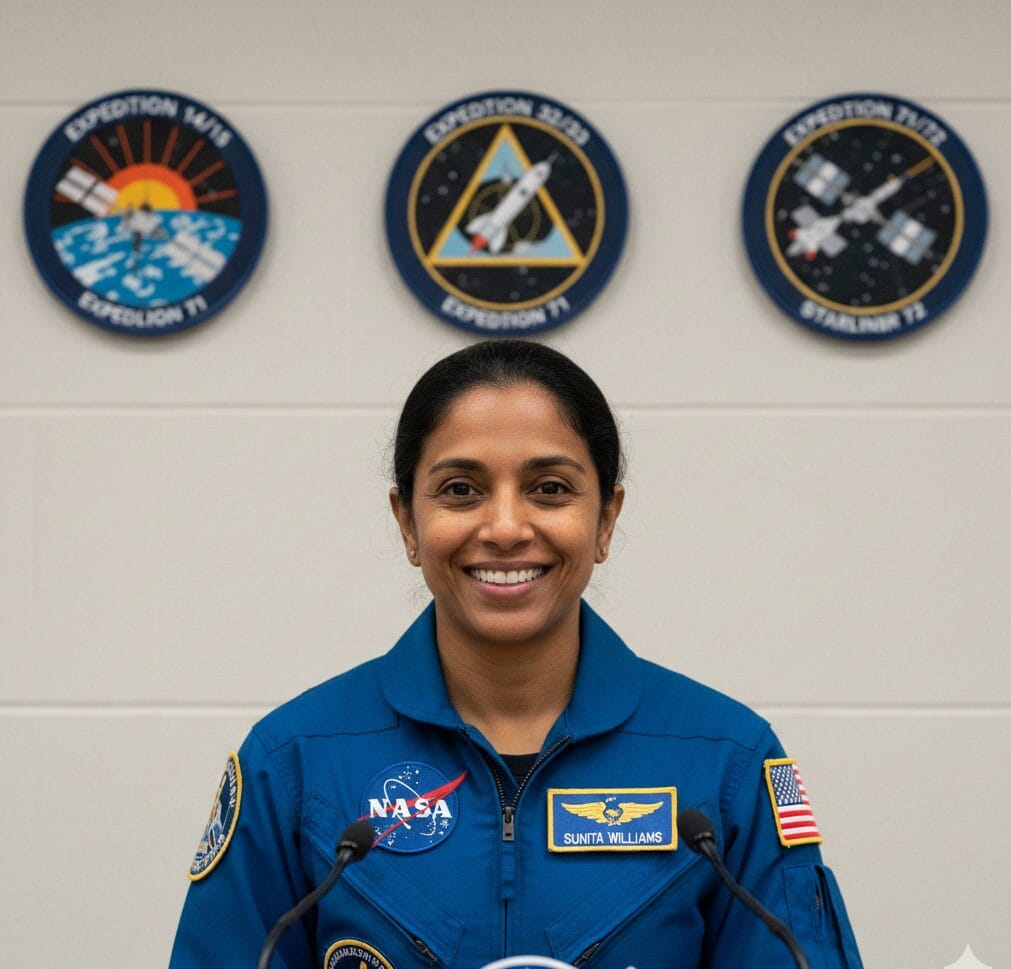
Record-Breaking Sunita Williams Astronaut Concludes Legendary Space Exploration Journey
NASA astronaut Sunita “Suni” Williams has officially retired from the agency after an extraordinary 27-year career marked by groundbreaking achievements, leadership in orbit, and an unwavering commitment to advancing human spaceflight. In an announcement made just days ago on January 20, 2026, NASA confirmed that Sunita Williams’ retirement became effective December 27, 2025, closing a chapter on one of the most distinguished careers in the history of space exploration.
Williams departs NASA having accumulated 608 cumulative days in space—the second-highest total among all NASA astronauts—and completing nine spacewalks totaling 62 hours and 6 minutes, the most spacewalk time by any woman and fourth-most in agency history. Her remarkable journey from Navy test pilot to International Space Station commander has inspired countless individuals worldwide and helped pave the way for the next generation of space explorers, including the legacy of Sunita Williams.
The announcement comes just months after Williams returned from an unexpectedly extended mission aboard the International Space Station, demonstrating the resilience and adaptability that defined her entire career. As the news reverberates through the space community this week, platforms like LumeChronos continue to provide comprehensive coverage of groundbreaking moments like this retirement that shape the future of human spaceflight.
Distinguished Career Spanning Three Decades
Sunita Williams joined NASA’s astronaut program in 1998, bringing exceptional credentials as a U.S. Navy test pilot with over 4,000 flight hours in more than 40 aircraft. According to NASA’s official announcement, her selection marked the beginning of a career redefining what was possible for women in space exploration.
Williams’ first spaceflight launched on December 9, 2006, aboard Space Shuttle Discovery as part of the STS-116 mission. She served as flight engineer for Expeditions 14 and 15, completing what was then a record-breaking four spacewalks. In 2012, Williams launched from Kazakhstan for a 127-day mission as part of Expeditions 32 and 33, achieving a historic milestone by serving as commander of the International Space Station for Expedition 33. The mission included three critical spacewalks to repair a radiator leak and replace essential power distribution components.
Boeing Starliner Mission: An Unexpected Challenge
Sunita Williams final mission became one of the most closely watched space endeavors in recent history. In June 2024, Sunita Williams and fellow astronaut Barry “Butch” Wilmore launched aboard Boeing’s Starliner spacecraft for what was planned as an eight-day test flight as part of NASA’s Commercial Crew Program. However, technical issues with the spacecraft—including thruster malfunctions and helium leaks—prevented the planned return timeline.
What began as a brief test mission evolved into a nine-month orbital deployment, with Sunita Williams and Wilmore remaining aboard the ISS through March 2025. During this extended stay, Sunita Williams once again assumed command of the space station for Expedition 72 and completed two additional spacewalks, demonstrating the professional excellence and adaptability that characterized her entire career. The duo eventually returned to Earth aboard a SpaceX Crew Dragon capsule as part of the Crew-9 mission.
NASA Administrator Jared Isaacman praised Sunita Williams’ contributions in the official retirement statement, noting that she has shaped the future of exploration through leadership aboard the station while advancing commercial missions to low Earth orbit. Her work, he emphasized, has laid crucial foundations for the Artemis program’s lunar missions and eventual Mars exploration.
Record-Breaking Achievements and Historic Milestones
Throughout her distinguished career, Sunita Williams established multiple records that highlighted her exceptional contributions to human spaceflight. Among her most notable achievements was becoming the first person to run a marathon in space, completing the 2007 Boston Marathon on a treadmill aboard the International Space Station.
Her nine spacewalks, accumulating 62 hours and 6 minutes of extravehicular activity, represent the highest total for any female astronaut and rank fourth overall in NASA history. These spacewalks involved critical maintenance operations, scientific equipment installations, and emergency repairs essential to maintaining the orbital laboratory’s operational capabilities.
Sunita Williams ranks sixth on the list of longest single spaceflights by an American astronaut, tied with Wilmore at 286 days during their extended Boeing Starliner and SpaceX Crew-9 missions. Her 608 cumulative days in space place her second only to astronaut Peggy Whitson among all NASA personnel, cementing her status as one of the agency’s most experienced space travelers.
The international space community, including partners and collaborators featured on platforms like LumeChronos Germany, has recognized Sunita Williams’ contributions to fostering international cooperation in space exploration and advancing scientific research in microgravity environments.
Leadership Beyond Spaceflight
Sunita Williams’ impact extended far beyond orbital missions. In 2002, she served as a NEEMO crew member, spending nine days in the Aquarius underwater habitat. She later held positions as deputy chief of NASA’s Astronaut Office and director of operations in Star City, Russia, facilitating crucial international partnerships. Most recently, she helped develop helicopter training platforms for future lunar landings under the Artemis program.
Vanessa Wyche, director of NASA’s Johnson Space Center in Houston, described Williams as a pioneering leader whose contributions from space station operations to the Starliner test flight program will inspire future generations of explorers.
Global Recognition and Cultural Impact
Born in Euclid, Ohio, to Deepak Pandya, a neuroanatomist of Gujarati-Indian descent, and Bonnie Pandya of Slovenian heritage, Williams holds a bachelor’s degree in physical science from the U.S. Naval Academy and a master’s degree in engineering management from Florida Institute of Technology. A retired U.S. Navy captain, she logged more than 4,000 flight hours in 40 different aircraft.
Williams’ Indian-American heritage made her a source of tremendous pride and inspiration, particularly in India where her achievements received extensive coverage. Her connection to Jhulasan village in Gujarat created a powerful symbolic link between rural India and the frontiers of space exploration.
Throughout her career, Williams served as an ambassador for STEM education, encouraging young people—especially women and minorities—to pursue careers in science and technology. For those interested in commemorating achievements of pioneering astronauts, LumeChronos Shop offers curated collections honoring space exploration legacy.
Reflections on a Remarkable Career
In her retirement statement, Williams expressed profound gratitude for her time with NASA while looking forward to the agency’s future achievements. She acknowledged that space is her “absolute favorite place to be” and called serving in the Astronaut Office an incredible honor.
Williams credited her colleagues for her successful 27-year career, describing the International Space Station, its people, engineering, and science as “truly awe-inspiring.” She expressed hope that the foundation established by current missions has facilitated the next steps of exploration toward the Moon and Mars, adding that she is excited to watch NASA and its partner agencies make history in the coming years.
Scott Tingle, chief of the Astronaut Office at NASA’s Johnson Space Center, offered a personal tribute to Williams, calling her “incredibly sharp” and describing her as an all-around great friend and colleague. He noted that she has inspired many people, including fellow astronauts in the corps, and that she will be greatly missed.
Impact on NASA’s Future and the Artemis Program
Williams’ retirement marks a significant transition as NASA shifts focus toward the Artemis program and deep space exploration. Her career bridged the Space Shuttle era, the ISS program, and the emerging Commercial Crew era, providing invaluable institutional knowledge during this transformative period.
The experience Williams developed over nearly three decades will continue influencing NASA’s operations through astronauts she mentored, procedures she helped establish, and training programs she contributed to developing. Her involvement in the Boeing Starliner test flight, despite its challenges, provided critical data that will inform future commercial crew missions.
As NASA advances the Artemis program to return humans to the Moon and eventually send astronauts to Mars, the foundations Williams helped build will prove essential. While she won’t participate in these future missions as an astronaut, her legacy will continue shaping NASA’s approach to human spaceflight for generations.
Frequently Asked Questions
How many days did Sunita Williams spend in space during her career?
Sunita Williams accumulated 608 cumulative days in space across three missions to the International Space Station, ranking second among all NASA astronauts for total time spent in orbit. Her longest single mission lasted 286 days during the Boeing Starliner and SpaceX Crew-9 missions from June 2024 to March 2025.
What records did Sunita Williams set during her NASA career?
Williams set multiple records including completing nine spacewalks totaling 62 hours and 6 minutes—the most spacewalk time by any female astronaut and fourth-most overall in NASA history. She was also the first person to run a marathon in space when she completed the 2007 Boston Marathon on a treadmill aboard the ISS. She served as commander of the International Space Station twice, during Expeditions 33 and 72.
What happened during Sunita Williams’ final mission aboard Boeing Starliner?
Williams and astronaut Butch Wilmore launched aboard Boeing’s Starliner spacecraft in June 2024 for what was planned as an eight-day test flight. However, technical issues including thruster malfunctions and helium leaks extended the mission to nine months. The astronauts remained aboard the ISS and eventually returned to Earth in March 2025 aboard a SpaceX Crew Dragon capsule as part of the Crew-9 mission.
A Legacy That Continues to Inspire
As Sunita Williams transitions to retirement, her impact on space exploration remains profound and enduring. Her technical excellence, leadership capabilities, and commitment to advancing human spaceflight have left an indelible mark on NASA and the international space community.
Williams demonstrated throughout her career that dedication, skill, and perseverance can overcome any challenge—from adapting to an unexpected nine-month mission to performing critical repairs during complex spacewalks. Her influence continues through the next generation of astronauts following in her footsteps, the commercial space industry she helped pioneer, and countless individuals she inspired to pursue careers in space exploration.
The foundation Williams helped build will support humanity’s journey to the Moon, Mars, and beyond. As she watches NASA make history from the ground, her contributions will remain woven into the fabric of every future mission that builds upon the work of pioneering astronauts who dared to reach for the stars.
This article is based on insights from real-time trends and verified sources including NASA.gov.