



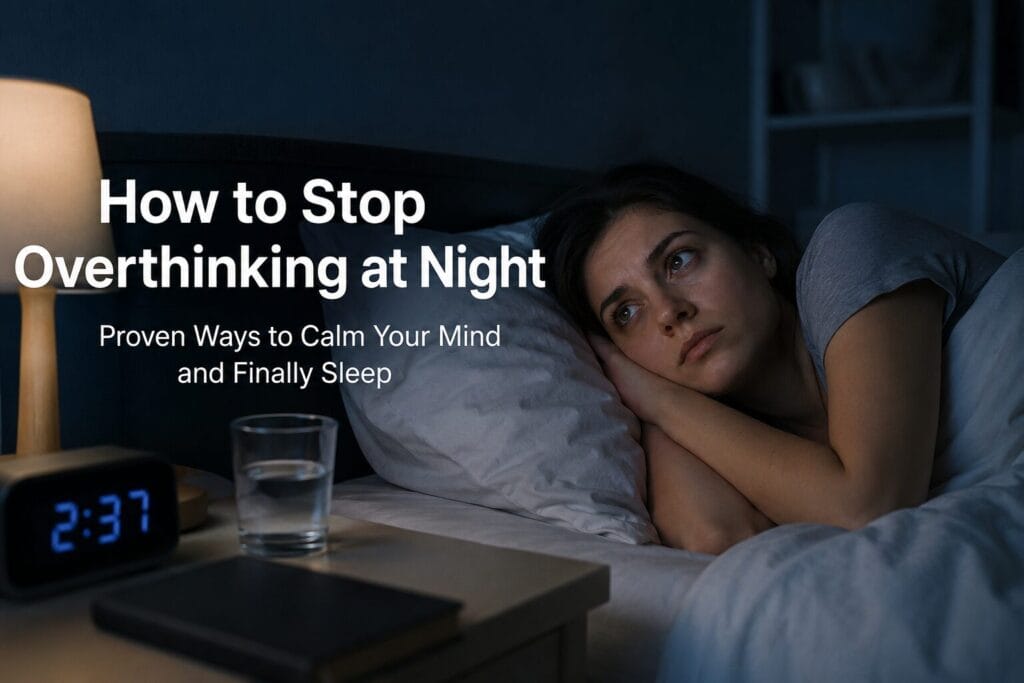
You climb into bed. The room is dark. Your body is tired. But the moment your head hits the pillow — your brain turns on.
Suddenly you’re replaying that awkward conversation from last Tuesday. You’re building tomorrow’s to-do list. You’re worrying about things you can’t fix at midnight. You just want to sleep, but your mind won’t stop.
If this sounds familiar, you are not alone. Millions of people deal with overthinking at night, and it’s one of the biggest reasons people struggle to fall asleep. The good news? There are real, science-backed ways to quiet your mind and actually get the rest you need.
This guide covers everything — why it happens, what makes it worse, and exactly how to stop overthinking before bed so you can finally sleep.
Why Do I Overthink at Night?
This is one of the most common questions people ask. And the answer makes a lot of sense once you understand how your brain works.
During the day, your mind is busy. Work, conversations, scrolling, errands — there is always something pulling your attention outward. Those distractions act like a wall that keeps your worries from flooding in.
But at night, the distractions disappear. The house gets quiet. The phone goes down. And suddenly your brain has open space — space it immediately fills with everything you pushed aside all day.
Here is what is actually happening inside your brain:
Your Default Mode Network kicks in. This is your brain’s “background mode” — it activates when you are resting and not focused on a task. It handles self-reflection, memory processing, and unfortunately, a lot of worry. When there is nothing else to focus on, this network takes over. Harvard Health research confirms that an overactive Default Mode Network contributes directly to sleeplessness by increasing anxious thoughts.
Your stress hormone gets confused. Cortisol, the hormone that keeps you alert, is naturally supposed to drop at night. But when you are stressed or anxious, your cortisol levels can stay high or even spike in the evening. This keeps your body in an alert state when it should be winding down. Chronic stress can also affect your energy, mood, digestion, and overall health in subtle ways. If you are experiencing ongoing stress, it may help to recognize the early warning signs. Learn more about the 10 silent signs your body is stressed and what they could reveal about your overall well-being.
Your emotional defenses are weak. By the end of the day, you are tired. And a tired brain is a less resilient brain. Thoughts that felt manageable at 2 PM can feel overwhelming at 2 AM. Your emotional armor is low, so every worry hits harder.
You treat bedtime like your first quiet moment. Many people never actually process their stress during the day. So the moment they lie down, their brain sees it as the first chance to work through everything — past regrets, future worries, unfinished problems. All at once.
What Makes Nighttime Anxiety Worse
Before we get to solutions, it helps to understand the habits that are quietly feeding your anxiety at night. You might be doing some of these without even realizing it.
Caffeine in the afternoon. Caffeine can stay in your system for 6 to 8 hours. An afternoon coffee at 3 PM can still be affecting your brain at 9 PM, making it much harder to wind down.
Scrolling before bed. Your phone is designed to keep you engaged. Social media, news, and notifications all stimulate your brain. Looking at your screen right before sleep is like throwing fuel on a fire you were trying to put out.
Lying in bed trying to “force” sleep. When you stay in bed frustrated and wide awake, your brain starts to associate your bed with stress. Over time, the bed itself becomes a trigger for anxiety — not rest.
Arguing with every anxious thought. Some people try to fight their overthinking by debating each worry. This turns bedtime into an exhausting mental argument, and it rarely works. Fighting thoughts at night almost always makes them come back harder.
No decompression time. Going straight from a stressful activity to your bed gives your brain no transition. Your nervous system needs time to shift from “alert” mode to “rest” mode.
How to Stop Overthinking at Night: What Actually Works

Anxiety and overthinking often go hand in hand, especially when your mind becomes trapped in a cycle of worries before sleep. Along with the techniques in this guide, simple daily habits such as mindfulness, regular movement, proper breathing, and relaxation practices can help calm your nervous system. You can explore these easy ways to reduce anxiety naturally to support better mental balance and more peaceful nights.
These strategies work best when you use them consistently. Try them for at least a week before deciding if they work for you.
1. Create a Wind-Down Window
About an hour before bed, stop doing anything that requires mental effort or emotional energy. No emails. No news. No stressful conversations. Give your brain a clear signal that the workday is over.
This window does not have to be boring. You can take a warm shower, make herbal tea, read a light novel, or do some gentle stretching. The point is to lower your brain’s activity level gradually, not all at once.
Think of it like landing a plane. You do not just drop from the sky — you descend slowly. Your brain needs the same thing.
2. Write It Down Before You Sleep
One of the most effective ways to stop overthinking before bed is surprisingly simple: grab a pen and paper.
Before you sleep, spend 5 to 10 minutes writing down everything on your mind. Your worries, your to-do list, your unfinished thoughts. Get it all out on paper. This works because your brain holds on to unfinished things — it is called the Zeigarnik Effect. When you write something down, your brain feels like it has been “filed” and it does not need to keep reminding you about it.
You can also try a simple gratitude list — three good things from your day. This gently shifts your brain’s focus from problems to positives before you try to sleep.
3. Set a “Worry Time” Earlier in the Day
This sounds strange, but it works. Instead of letting anxiety at night ambush you, schedule a specific 15-minute block during the day — say, 5 PM — where you intentionally think through your worries.
When a stressful thought comes at night, you tell yourself: “I already handled that at worry time. I will look at it again tomorrow at 5 PM.” Over time, your brain learns that nighttime is not the window for problem-solving. It has a time for that — just not now.
4. Try the 4-7-8 Breathing Method
When you feel anxiety building at night, your nervous system is in “fight or flight” mode. Breathing exercises are one of the fastest ways to bring it back down.
The 4-7-8 method works like this:
- Breathe in through your nose for 4 seconds
- Hold your breath for 7 seconds
- Breathe out slowly through your mouth for 8 seconds
Repeat this 3 to 4 times. The long exhale is what activates your parasympathetic nervous system — the part of your body that tells it to calm down and rest.
5. Use the Body Scan Technique
Instead of fighting your thoughts, redirect your attention to your body. This is a simple mindfulness exercise that pulls your brain out of “thinking mode” and into the present.
Start at the top of your head. Notice any tension there. Then slowly move your attention down — your forehead, your jaw, your shoulders, your chest — all the way to your feet. At each spot, just notice what you feel. Do not judge it. Just observe.
This gives your brain something neutral to focus on, and it is impossible to run a full anxiety spiral while you are paying close attention to how your left knee feels.
6. Get Out of Bed If You Cannot Sleep
If you have been lying awake for more than 20 to 25 minutes, get up. Go to a dim, quiet room. Sit down. Read something light. Do not check your phone.
Stay there until you feel genuinely sleepy — not just tired — and then go back to bed.
This might feel counterproductive, but it is actually one of the most evidence-backed strategies from Cognitive Behavioral Therapy for insomnia (CBT-I). The longer you lie in bed frustrated, the more your brain connects your bed with wakefulness and stress. Breaking that connection is key.
7. Keep a Consistent Sleep Schedule
Your body has an internal clock, and it runs best when you go to sleep and wake up at the same time every day — even on weekends. When your schedule is all over the place, your brain never knows when to start winding down, which makes nighttime anxiety worse.
Pick a bedtime. Stick to it. Within a few weeks, your body will naturally start preparing for sleep at that time, making the whole process easier.
8. Limit Stimulating Content Before Bed
News, social media, and even some television shows can leave your brain in a heightened, stimulated state. Try to stop consuming this kind of content at least 45 minutes before bed.
If you want screen time in the evening, choose something light and predictable — a show you have already seen, a calming YouTube video, or an audiobook. The key is to lower stimulation, not cut it out completely.
When Overthinking Becomes Anxiety Attacks at Night
Sometimes nighttime overthinking goes beyond racing thoughts. Some people experience full anxiety attacks at night — a sudden wave of intense fear, a pounding heart, chest tightness, and a feeling of dread that seems to come from nowhere.
Anxiety attacks at night are real and they are deeply uncomfortable. They can happen even when nothing obviously scary is going on. Here is why:
During sleep, your body goes through hormonal and physical changes. If you are already running high on stress, these shifts can sometimes trigger a panic response. Your brain interprets normal body sensations — like a change in breathing or heart rate during sleep — as a threat, and your fight-or-flight system fires.
If you experience anxiety attacks at night regularly, the strategies in this guide can help, but it is also worth speaking with a doctor or mental health professional. Frequent nighttime panic may point to an anxiety disorder or another underlying condition that responds well to treatment.
A Simple Routine to Stop Overthinking Before Sleep
Here is a basic evening routine you can start tonight. It does not require any special equipment — just some intention and 30 to 45 minutes.
8:30 PM — Start winding down. Put on something comfortable. Make a calming drink. Dim the lights. Step away from your phone.
9:00 PM — Journal for 10 minutes. Write your worries, your to-do list, and three things you are grateful for. Let the page hold it all.
9:15 PM — Light activity. Read a book, listen to calm music, or do some light stretching. Nothing stimulating.
9:45 PM — Prepare for bed. Brush your teeth, wash your face, keep the routine consistent.
10:00 PM — In bed, lights off. Try the 4-7-8 breathing technique. If thoughts come, acknowledge them without engaging. “I see you. We will deal with that tomorrow.”
What to Do When Your Mind Still Won’t Stop
Even with a great routine, some nights your brain just will not cooperate. That is normal. Here is what to do in those moments:
Do not fight it. Resisting your thoughts usually makes them stronger. Instead, imagine your thoughts as clouds passing across a sky. You see them, but you do not grab them.
Ground yourself in the present. Name five things you can feel right now — the weight of your blanket, the temperature of the air, the sound outside your window. This pulls your attention away from future worries and back to right now.
Repeat a calming phrase. Something simple like “I am safe. I am okay. I can rest now.” It sounds basic, but repeating a calm phrase gives your brain something to anchor to instead of the worry spiral.
Accept the discomfort. Sometimes the most powerful thing you can do is stop trying to fix it. Tell yourself: “It is okay if I am awake right now. I am resting even if I am not sleeping. My body is still recovering.” This removes the pressure, and often — paradoxically — that is when sleep finally comes.
When to Seek Help
If overthinking at night is a nightly problem that has lasted more than a few weeks, or if it is seriously affecting your daily life, it is worth speaking to a professional.
Chronic sleep problems combined with anxiety at night can sometimes indicate generalized anxiety disorder (GAD), depression, or a sleep disorder. All of these are very treatable — but they respond best to professional support, not just self-help.
You do not have to white-knuckle your way through sleepless nights. Help is available, and getting it is a sign of strength, not weakness.
Final Thoughts
Overthinking at night is not your fault. It is your brain doing what it was built to do — process, plan, and protect. The problem is, it picked the worst possible time to do it.
But you are not stuck with this pattern. With the right habits and a little patience, you can train your brain to calm down at night. Start with one or two strategies from this guide. Be consistent. Give it time.
Frequently Asked Questions
Why do I overthink at night but feel fine during the day?
Because during the day, your brain is busy. Work, people, your phone, errands — all of these pull your attention outward. That constant activity acts like a wall between you and your worries. At night, the distractions disappear. The house goes quiet. And suddenly your brain has empty space — which it immediately fills with everything you pushed aside all day. It is not that your anxiety got worse. It is that the wall came down.
Is overthinking at night a sign of anxiety?
It can be. Occasional overthinking before bed is completely normal — most people experience it. But if it happens almost every night, lasts for hours, and you wake up feeling exhausted and dreading bedtime, it might be a sign of an anxiety disorder, generalized anxiety (GAD), or chronic stress. The pattern itself is not dangerous, but when it takes over your nights consistently, it is worth talking to a doctor or therapist.
How do I stop my mind from racing when I try to sleep?
The fastest thing you can try is the 4-7-8 breathing method — breathe in for 4 seconds, hold for 7, breathe out slowly for 8. Do this 3 to 4 times. It activates the part of your nervous system responsible for calming you down. Another quick fix is to get out of bed if you have been lying there awake for more than 20 minutes. Go sit somewhere dim and quiet until you actually feel sleepy. Forcing yourself to stay in bed while frustrated usually makes things worse, not better.
What is the 3 AM anxiety problem?
A lot of people wake up between 2 and 4 AM and cannot get back to sleep. This happens because your body naturally wakes up slightly between sleep cycles — and if your stress levels are high, your brain grabs that small window and starts running. Cortisol, your stress hormone, also tends to rise in the early morning hours to prepare your body for the day. If your levels are already elevated from stress, this early rise can jolt you awake with a flood of anxious thoughts. Managing your stress during the day and having a solid wind-down routine at night can help reduce how often this happens.
Can overthinking at night cause physical symptoms?
Yes. When your brain is stuck in overthinking mode, it keeps your nervous system in a low-level fight-or-flight state. Over time, this can lead to headaches, a tight chest, muscle tension, fatigue, a weak immune system, and poor digestion. Sleep deprivation from chronic overthinking also affects your memory, mood, and ability to handle stress during the day. It becomes a cycle — poor sleep makes overthinking worse, and overthinking makes sleep worse.
Why does anxiety feel worse at night?
Three main reasons. First, there are no distractions left, so anxious thoughts have your full attention. Second, your brain’s Default Mode Network — the part that handles self-reflection and worry — becomes more active when you are not focused on a task. Third, by the end of the day your emotional defenses are low. You are tired. Things that were manageable at noon feel overwhelming at midnight. Your brain is not broken — it is just exhausted and unsupervised.
How long does it take to stop overthinking at night?
It depends on how long the pattern has been going on and how consistently you practice new habits. Some people notice a difference within a week of sticking to a proper wind-down routine. For others, especially if anxiety has been a long-term issue, it can take a few weeks to a couple of months. The key is consistency. These techniques do not work overnight — but they do work if you give them time.
What foods or drinks make overthinking at night worse?
Caffeine is the biggest one. It can stay in your system for 6 to 8 hours, so even a 3 PM coffee can still be affecting your brain at 9 or 10 PM. Alcohol is another — it might help you fall asleep faster, but it disrupts your sleep quality and often leads to waking up at 2 or 3 AM with racing thoughts. Sugary snacks close to bedtime can also spike your blood sugar and then cause a crash that disrupts your sleep cycle. A light, low-sugar snack or a cup of chamomile tea are much better choices before bed.