

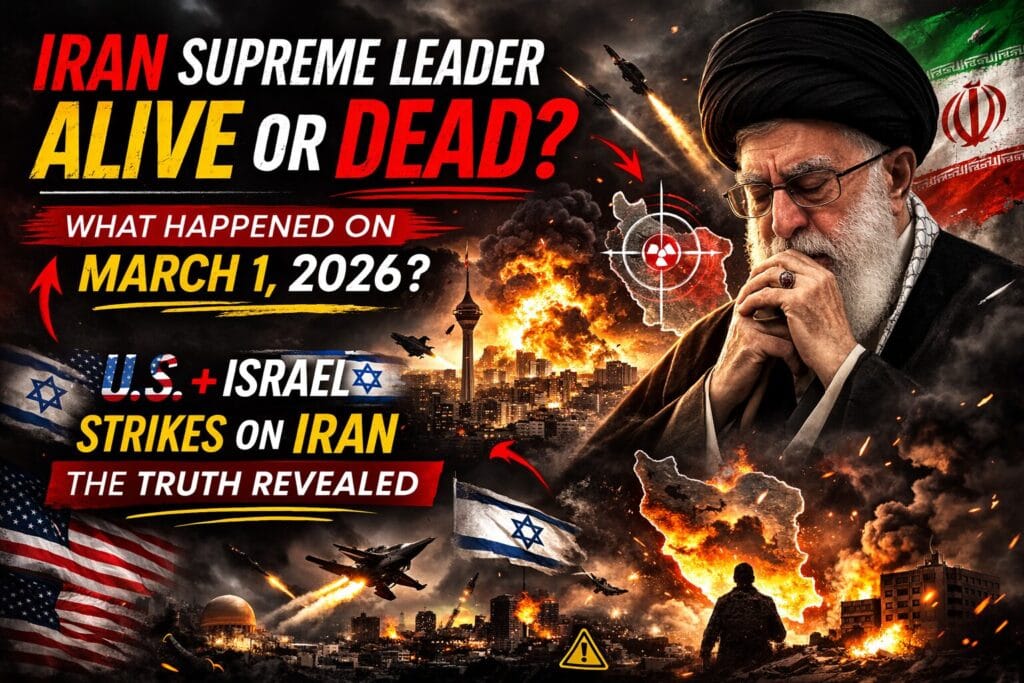
In the early hours of March 1, 2026, headlines around the world screamed that Iran’s Supreme Leader Ayatollah Ali Khamenei had been killed in joint U.S.-Israeli air strikes. The question – is Iran’s Supreme Leader really alive or dead? – sent shockwaves globally. Confusion mounted as social media buzzed with rumors and counter-claims.
In this article we cut through the chaos: examining what credible news outlets and officials actually say happened, confirming Khamenei’s status, and explaining why this matters for Iran’s future and its fraught relations with the U.S. and Israel. We’ll provide clear context on Khamenei’s age and background, and detail the Iran–America–Israel conflict that underlies these events. Our goal is to give you verified answers and trusted analysis on this breaking story.
What Happened with Iran’s Supreme Leader in 2026: Confirmed Death of Ayatollah Khamenei
To understand fully what happened with Iran’s Supreme Leader in 2026, we must turn directly to what Iran’s own state media announced to the world. On the morning of Saturday, February 28, 2026, joint U.S.-Israeli strikes — dubbed “Operation Epic Fury” by the Pentagon and “Roaring Lion” by Israel — targeted military installations, government compounds, and senior leadership figures across Tehran and beyond. The result was a seismic geopolitical event: the death of Ayatollah Ali Khamenei, the man who had ruled Iran for over 36 years.
According to multiple reliable sources, Iran’s own state media confirmed early March 1 that Ayatollah Ali Khamenei was killed in the joint strikes. Reuters reported that Ayatollah Ali Khamenei had been killed in Israeli and U.S. strikes, as confirmed by Iranian state television. The Washington Post You can read Reuters’ full live coverage here: Reuters Live Updates – Iran Strikes.
Similarly, Al Jazeera reported that Iran’s Supreme Leader and top security officials were killed in the U.S. and Israel’s ongoing attacks, with Iran declaring 40 days of mourning and the IRGC pledging revenge. Al Jazeera Watch Al Jazeera’s live coverage video here: Al Jazeera Live Blog – Iran Strikes. These reports were echoed by ABC News Live Updates, which noted that Iranian state TV had confirmed Khamenei’s death on Sunday morning, and by the Associated Press. In short, what happened with Iran’s Supreme Leader in 2026 was officially announced by Iran’s own government — he was killed at his workplace, his Beit Rahbari compound in Tehran.
Israeli Defense Minister Israel Katz confirmed that Khamenei was killed alongside other senior leaders in Israel’s opening strike, which he praised as “brilliant execution,” adding: “Whoever acted to destroy Israel — was destroyed.” NBC News You can follow NBC News’ detailed live blog here: NBC News Live Blog – Iran Supreme Leader Dead. For a broader breakdown of what happened with Iran’s Supreme Leader in 2026 from a U.S. perspective, NPR’s full report provides authoritative context, including NPR’s own sources who confirmed Khamenei was hit in an Israeli strike.
President Donald Trump himself confirmed the news publicly. Trump posted on Truth Social that “Khamenei, one of the most evil people in History, is dead,” calling the killing “justice” for Americans and others harmed by Iran over the decades, and describing it as “the single greatest chance for the Iranian people to take back their country.” CNBC Watch Trump’s full video announcement via CNBC here: CNBC Live Updates – Trump on Iran Strikes.
That said, what happened with Iran’s Supreme Leader in 2026 was not without initial confusion — Iranian Foreign Minister Abbas Araghchi had earlier told NBC News that both Khamenei and the Iranian president were still alive “as far as I know,” a statement that was quickly contradicted when state media released its official martyrdom announcement hours later. This contradiction is one of the key reasons why what happened with Iran’s Supreme Leader in 2026 generated so much global confusion in its first hours.
The confirmation of Khamenei’s death has profound implications — and to truly grasp what happened with Iran’s Supreme Leader in 2026, one must understand what his position meant. As Supreme Leader for over 36 years, Khamenei held authority over Iran’s judiciary, state media, and all security forces, including the IRGC, and wielded that power ruthlessly against dissent.
Axios His death immediately triggered a constitutional succession crisis. Under Iran’s constitution, an interim council assumes power while the Assembly of Experts — a body of 88 Islamic clerics — selects a new supreme leader, but Israel’s strikes decimated the chain of command by killing seven senior defense and intelligence officials and targeting 30 top military and civilian leaders overall. Axios Read the full Axios breakdown here: Axios – Khamenei Killed, Succession Crisis. For a video explainer on Iran’s political succession process, watch this Al Jazeera analysis: Al Jazeera – What Happens After Khamenei?.
We will explore in depth who Khamenei was and why his death matters so deeply — to Iran’s internal stability, to the ongoing conflict with the U.S. and Israel, and to the wider Middle East. A temporary leadership council made up of Iranian President Masoud Pezeshkian, Judiciary Chief Gholamhossein Mohseni Ejei, and a jurist from the Guardian Council has been announced by Iranian state media to govern in the interim. ABC News Follow ABC News’ ongoing updates here: ABC News – Iran Live Updates. For deeper background on Iranian politics and leadership structures, The Washington Post’s live updates and The National’s full report provide excellent context.
Our approach throughout this analysis is factual, balanced, and grounded in verified sources — because what happened with Iran’s Supreme Leader in 2026 is too significant a moment in history for anything less. No clickbait, no speculation — just straight, evidence-based answers to the question the entire world is asking about the Iran Supreme Leader alive or dead in 2026. The full picture of what happened with Iran’s Supreme Leader in 2026 is still unfolding, and we will continue to update this coverage as new verified information becomes available.
What Happened on March 1, 2026: The Iran Strikes
To understand precisely what happened with Iran’s Supreme Leader in 2026, we need to first understand the scale and scope of the military operation that preceded his death. Late on February 28 and into the early hours of March 1, 2026, the United States and Israel launched a massive, coordinated wave of airstrikes across Iran — a military operation widely reported to be codenamed “Operation Roaring Lion” or “Lion’s Roar.”
The strikes targeted dozens of sites nationwide, including Revolutionary Guard bases, ballistic missile storage facilities, nuclear-adjacent installations, and — critically — senior leadership compounds. According to widespread media reports, the assault “rocked Iran’s major cities,” with some structures flattened entirely. Al Jazeera’s live coverage, which you can follow here at Al Jazeera’s Iran Strike Live Blog, reported that Israeli aircraft struck civilian-adjacent areas, including two elementary schools, tragically killing children. The Iranian Red Crescent later confirmed that approximately 200 people were killed and 747 others injured across 24 provinces. For a detailed video breakdown of the strikes themselves, Al Jazeera’s explainer video — What Did Israel and the U.S. Strike in Iran? — is among the most comprehensive available.
What happened with Iran’s Supreme Leader in 2026 becomes clearest when we zoom in on Tehran. The U.S. and Israeli strikes didn’t just hit military peripheries — they punched directly into the capital itself. Satellite images released in the days following the operation showed significant structural damage to parts of central Tehran. Reuters, in one of the most widely cited reports on the event, described a blast that “pulverised [Khamenei’s] central Tehran compound,” adding in a separate dispatch: “He was killed on Saturday, aged 86, Iranian state media announced, in air strikes by Israel and the U.S. that pulverised his central Tehran compound.
“ You can read Reuters’ full coverage here: Reuters — Khamenei Killed in Israeli-U.S. Strikes. This single detail — the direct targeting of his Beit Rahbari office in Tehran — is central to answering what happened with Iran’s Supreme Leader in 2026, because it reveals that this was not a case of collateral casualties; the compound was a deliberate strike target. NBC News also reported on the targeting here: NBC News Iran Live Blog, and their video reporting offers further context on the precision nature of the strikes.
Iranian media confirmed numerous casualties among senior commanders and government officials in the hours that followed. On the evening of March 1, Iranian state television issued nationwide mourning announcements: a 40-day period of national mourning was formally declared following the confirmation of Khamenei’s death. In Iran’s political and religious system, a 40-day mourning period is the standard and solemn response to the passing of a supreme leader — so this declaration itself was a form of official confirmation.
By early March 1 local time, therefore, the answer to what happened with Iran’s Supreme Leader in 2026 had become tragically unambiguous: Ayatollah Ali Khamenei, who had served as Iran’s Supreme Leader since 1989, was dead. You can watch NPR’s video coverage and analysis of the mourning declaration here: NPR — Iran Declares Mourning After Khamenei Death.
However — and this is crucial context for anyone trying to understand what happened with Iran’s Supreme Leader in 2026 — these confirmed reports emerged only after a chaotic window of contradictory official claims that caused enormous global confusion. On the day of the attack itself, Iranian officials initially moved to downplay the damage. Semiofficial Iranian news agencies Tasnim and Mehr both reported early on that Khamenei was “steadfast and firm in commanding the field,
” strongly implying he was alive and unharmed. Even Iran’s Foreign Minister Abbas Araghchi told NBC News directly on February 28 that “Khamenei is still alive, as far as I know” — a claim that, within hours, would be overtaken by his own government’s official announcement. This contradiction is one of the most jarring dimensions of what happened with Iran’s Supreme Leader in 2026, and it speaks to the information chaos that unfolded in real time. You can review that NBC interview and related reporting here: NBC News Full Iran Coverage.
At the same time, Israeli leadership was publicly asserting the opposite. Israeli Prime Minister Benjamin Netanyahu stated publicly that there were “many signs that this tyrant is also gone,” and U.S. President Donald Trump later posted on Truth Social that Khamenei — whom he called “one of the most evil people in history” — was dead, describing his killing as “justice.”
You can follow CNBC’s reporting on Trump’s statements here: CNBC — Trump on the Iran Strikes, and watch Trump’s Truth Social statement being analyzed on video via Fox News here: Fox News Live Coverage — Iran Strikes. These public statements by the heads of state most responsible for the operation were some of the first signals pointing to the truth of what happened with Iran’s Supreme Leader in 2026, even before Iran’s own official confirmation arrived.
Key Takeaway: What Happened with Iran’s Supreme Leader in 2026 — The Credible Consensus
By the evening of March 1, Iran’s own state media — backed by a formal statement from Iran’s Supreme National Security Council — confirmed Ayatollah Khamenei’s death. The earlier denials from Iran’s Foreign Minister proved to be superseded, likely a product of the information blackout and chain-of-command collapse that naturally follows a leadership decapitation strike. Although U.S. officials initially withheld direct public comment pending confirmation, the weight of evidence from Iran’s own institutions removed any remaining doubt.
The credible consensus from every major established news organization — Reuters, Al Jazeera, ABC News, NPR, NBC News, AP, and the Associated Press — confirms the same answer to the question the world was asking: what happened with Iran’s Supreme Leader in 2026 is that Ayatollah Ali Khamenei was killed in joint U.S.-Israeli airstrikes on March 1, 2026, at the age of 86.
For continued live updates and deeper analysis, the most reliable ongoing sources remain Reuters, Al Jazeera, The Washington Post, Axios, and The National. The full story of what happened with Iran’s Supreme Leader in 2026 — including its implications for Iranian succession, regional stability, and U.S.-Iran relations — continues to unfold, and we will track it with verified, factual reporting at every step.
Is Khamenei Alive or Dead? Official Statements
The sharp confusion – “Is he alive or dead?” – came from mixed messages. Here is what happened:
- Iranian State Media: Early on Sunday, March 1, Iran’s Supreme National Security Council and state TV confirmed that “the Supreme Leader Ayatollah Ali Khamenei was martyred” in the attack. State-run outlets announced his death and declared national mourning. This is the official Iranian line.
- US and Israel Officials: On Saturday (Feb. 28), Israeli military leaders said they struck Khamenei’s Tehran compound. U.S. officials initially withheld confirmation. Later, Israeli security sources told The Washington Post: “Khamenei was killed in an Israeli airstrike… his body was found in the rubble”. President Trump publicly stated he believed Khamenei was killed.
- Iranian Officials on the Ground: Immediately after the strikes, Iran’s own foreign minister Abbas Araghchi said (on Feb. 28) that Khamenei was “still alive, as far as I know”. By Sunday morning, however, this statement changed: Iran’s official media then confirmed his death. It seems that between Feb 28 and Mar 1 Iran’s leadership assessed the situation and eventually announced the truth.
In practice, the final word came from Iran itself. State announcements and the Iranian Supreme Leader’s office indicated he was killed. Major news agencies like Reuters and AP rely on those announcements as fact. For example, Reuters wrote: “Ayatollah Ali Khamenei has been killed in Israeli and US strikes, Iranian state media said on Sunday”. The Associated Press also headlined, “Iran’s Supreme Leader Ayatollah Ali Khamenei … is dead at 86”.
In summary: There is no credible evidence that Khamenei survived. The authoritative Iranian channels themselves said he died. As of this writing, we base the answer on those confirmed reports: he is dead. (As with any breaking event, we will continue to watch for official updates, but authoritative media is reporting his death.)
Internal perspective: If you want a deeper background on Iran’s government structure, LumeChronos.com has an educational guide to Iran’s Supreme Leader role that explains how the leadership works and why Khamenei’s death is a watershed moment for the country.
Who Was Ayatollah Ali Khamenei? His Age, Rule, and Ideology
Ayatollah Ali Khamenei (born July 1939) had been Iran’s Supreme Leader since 1989, after the death of Ayatollah Ruhollah Khomeini. At 86 years old, he was one of the world’s longest-serving national leaders. He first rose to prominence as a cleric and was President of Iran from 1981–1989, before being chosen by Khomeini to succeed him as Supreme Leader. (A Supreme Leader in Iran is head of state and of the armed forces – effectively Iran’s “leader for life,” as the U.S. Council on Foreign Relations notes.)
During Khamenei’s 36-year rule, Iran experienced military expansion and domestic crackdowns. Reuters summed up his tenure: he “built Iran into a powerful anti-U.S. force, spreading its military sway across the Middle East, while using an iron fist to crush repeated unrest at home”. In other words, under Khamenei Iran developed a prominent role in regional conflicts (supporting allies like Assad in Syria and groups like Hezbollah) while ruthlessly suppressing internal dissent (such as the 2009 Green Movement protests or the recent 2022–25 economic unrest).
Age and Health: At 86, Khamenei’s health had long been a subject of speculation. He had suffered heart problems in the 2010s and undergone surgery. Some recent rumors (unconfirmed) about his health circulated on social media before the attack, but nothing officially credible. As ABC News noted, he “led Iran for nearly four decades” up to age 86. Now that news outlets confirm his death, Iran’s constitution will kick in for succession (discussed below).
Ideology and Conflict: Khamenei was known for his steadfast opposition to the U.S. and Israel. He often used fiery rhetoric. For example, Reuters described him as having based his iron rule on “fiery hostility to US and Israel”. During the 2025 Iran-Israel conflict, he vowed “Iran will not submit to any demands or dictates”. He oversaw Iran’s push into nuclear technology and regional influence, actions that Washington and Jerusalem saw as threats.
- Example: ABC News quotes him as saying in June 2025: “War will be met with war… Iran will not surrender to any demands”. Such statements captured his combative stance. In practice, Khamenei’s Iran long supported groups opposed to Israel (like Palestinian Hamas and Lebanese Hezbollah) and worked to deter U.S. moves in the Middle East.
- He also reinforced Iran’s clerical rule domestically. Khamenei’s office controlled the judiciary, military (especially the powerful Revolutionary Guard), and key state media. Under him, Iran maintained strict Islamic codes and limited free speech on political issues.
In context: Khamenei’s background explains why he was a target. He was not just a religious figurehead but the ultimate commander of Iran’s military and foreign policy. Analysts often say that removing Khamenei could drastically change Iran’s direction, though Iran’s constitution envisages an orderly succession. (For more on this, see the next section and LumeChronos.de’s global perspective on Iran’s political system.)
Quick Facts: Khamenei was born July 1939 in Mashhad. He became Supreme Leader in June 1989 at age 49. He survived an assassination attempt in 1981 and led Iran through wars with Iraq and proxy conflicts. He oversaw Iran’s contested nuclear program. He was often ranked as one of the most powerful figures in the Islamic Republic’s history.
Why U.S. and Israel Attacked: The Iran–America–Israel Conflict
To understand what happened, we need the bigger picture of the recent Iran–Israel–U.S. tensions. For years, Iran (under Khamenei) has been at odds with Israel and the U.S. over multiple issues: Iran’s nuclear program, support for anti-Israel groups, and regional influence. For example:
- Nuclear Dispute: Western nations, led by the U.S., accused Iran of secretly trying to develop nuclear weapons. Khamenei insisted Iran’s program was peaceful. Attempts at diplomacy (the 2015 nuclear deal under Obama) later collapsed in 2018 when the Trump administration withdrew. After that, tensions spiked again. Reuters notes that “decades of efforts to resolve the dispute over Iran’s nuclear program diplomatically failed” during Khamenei’s rule.
- Proxy Wars: Iran, under Khamenei, funded militias and allied governments hostile to Israel, such as Hezbollah in Lebanon and certain militias in Syria and Iraq. Israel and the U.S. viewed these groups as direct threats. Over the 2020s, skirmishes escalated – including missile exchanges and targeted assassinations (e.g. an Israeli strike reportedly killed Iran’s former nuclear head Fereydoun Abbasi-Davani in 2022).
- Recent Clashes (2025): In 2025, a conflict flared between Iran and Israel. Iran reportedly launched missiles/drones at Israel in an intense show of force; Israel responded with large-scale strikes on Iranian bases (according to Iranian reports). Khamenei publicly vowed to resist, saying Iran “will not submit”. Analysts had warned of a major regional war.
All this set the stage for the Feb. 28, 2026 attacks. According to news coverage, Israeli Prime Minister Netanyahu said his country had launched a “preemptive” strike alongside the U.S., claiming they had credible intelligence of imminent Iranian plans to attack. Netanyahu boasted of hitting “senior figures” in Iran’s military and government. President Trump, meanwhile, announced a “major combat operation” to eliminate “imminent threats” from Iran’s regime.
Aftermath of the Strikes: Iran responded with missiles towards Israel and U.S. assets, triggering air-defense alerts in several countries where U.S. bases exist. Iranian media reported hundreds of their forces killed – including IRGC generals. The situation remains highly volatile. The stakes are enormous: regime change talk, sanctions, and military retaliation loom. In this context, Khamenei’s death (if true) is an unprecedented blow to Iran’s hierarchy.
Additional Context: For a guided overview of the Iran–Israel conflict, LumeChronos.shop offers interactive maps and tools (for instance, a digital Gulf crisis map) that help track such events. These can be useful if you’re following the situation.
Aftermath and Succession: What Comes Next in Iran
With the Supreme Leader gone, Iran must follow constitutional procedure. The Assembly of Experts – a body of clerics elected for this purpose – is tasked with choosing a new leader. In practice, a temporary leadership council (possibly including the current president and judiciary head) may run day-to-day affairs until a successor is chosen. As one expert told Al Jazeera: “Iran has a plan” for this scenario. Barbara Slavin of the Stimson Center said it’s likely “a council… will be set up to run the country. It may already have been running the country, as far as we know”.
Who might succeed Khamenei? The Assembly could pick a senior cleric; possibilities included the hardline President Ebrahim Raisi or others from the religious establishment. There is no named heir yet, and even U.S. analysts say it would take time and could spark internal power struggles. One thing is certain: Iran’s ideology and strategic direction could shift once Khamenei is gone.
Internationally, Israel and the U.S. will be watching closely. Both have publicly suggested the strikes aim to topple the Iranian regime. President Trump on Feb. 28 called for Iranian regime change after Khamenei’s death. Iranian officials, however, have so far vowed retaliation. The Revolutionary Guard has promised a “ferocious” counterstrike. U.N. Secretary-General Guterres appealed for de-escalation, warning of a wider war.
Impact on Iran Society: Inside Iran, citizens woke up to official mourning. Footage is emerging of grieving crowds, with some chanting against Israel. Hardliners may try to rally the public by invoking martyrdom. But there are signs of uncertainty too. Previously, Khamenei had been the unifying symbol. Without him, fractures between Iran’s hardliners and reformists could widen.
Key Takeaway: The Supreme Leader’s death – now confirmed – is a historical turning point. For Iran, it triggers a delicate succession and likely fuels nationalistic resolve. For the Middle East, it raises the specter of an even larger war. Readers should keep an eye on reputable outlets for updates, and consider expert analysis (for instance on LumeChronos.de’s global comparison site) on how Iran’s next leadership might emerge.
FAQs: Your Questions Answered
Is Iran’s Supreme Leader Ali Khamenei dead or alive? Multiple major news agencies report that on March 1, 2026, Iran’s own state media confirmed Khamenei was killed in a U.S.-Israel attack. Earlier rumors had said he survived, but the official announcement makes his death the verified fact. As of now, credible sources list him as deceased.
What happened to Khamenei on March 1, 2026? On that date, the U.S. and Israel conducted airstrikes across Iran. These strikes hit Tehran and other cities. Iran’s state TV later announced Khamenei was killed in the attack, and images showed his compound destroyed. Iranian officials declared national mourning. In short, Khamenei was reportedly struck by the allied attack and died, as confirmed by Iran’s government.
How old was Ali Khamenei and what was his background? Ayatollah Khamenei was 86 years old at the time of his death. He became Iran’s Supreme Leader in 1989, after serving as President from 1981 to 1989. He had led Iran for nearly four decades. His rule was marked by a strong anti-Western stance and building Iran into a regional power. For a full biography and explanation of his role, see our guide to Iran’s leadership.
Why were the U.S. and Israel striking Iran? The strikes came amid a severe escalation in 2026 of the long-running conflict between Iran, Israel, and the U.S. Iran’s support for hostile groups and its nuclear program had caused repeated clashes. In early 2026, Iran reportedly threatened attacks on Israel, and the U.S.-Israel coalition responded by striking dozens of Iranian targets. The aim was to degrade Iran’s military and leadership. This sudden attack was unusually large-scale, hence the global shock.
What does this mean for Iran’s leadership succession? Iran’s constitution has a process: the Assembly of Experts (a clerical body) will convene to select a new Supreme Leader. In the interim, a council of senior officials may govern. No successor was publicly named at the time. Analysts (like the Stimson Center’s Barbara Slavin) say Iran is prepared: a governing council has probably been ready behind the scenes. The choice will likely be a high-ranking cleric acceptable to Iran’s ruling circle.
Could this trigger a wider war? The attacks have already provoked Iran to retaliate. Iranian missiles were launched at Israeli and U.S. positions, and neighboring countries scrambled defenses. The danger of broader conflict is real. World leaders are calling for calm. How events unfold depends on whether further strikes occur or diplomatic channels open. Monitoring trusted news sources is crucial.
Where can I get reliable updates? In fast-moving situations, rely on established news agencies (Reuters, AP, BBC, Al Jazeera, etc.) which update frequently. Be wary of unverified social media. This article cites several such outlets for accuracy. For contextual background on Iran’s system and global perspectives, you might explore LumeChronos educational content (e.g., Iran’s Supreme Leader explained) or analysis tools on LumeChronos.shop to visualize the conflict.
Key Takeaways
- State Media Confirmation: Iran’s official state media on March 1, 2026 announced Supreme Leader Ali Khamenei was killed in the U.S.-Israeli strikes. This is now the authoritative report.
- Previous Denials: Earlier on Feb. 28, some Iranian outlets said Khamenei survived and was “steadfast,” and even Iran’s foreign minister said “he’s alive as far as I know”. Those statements were superseded by the confirmed announcement.
- Khamenei’s Profile: Khamenei was 86, leading Iran since 1989. He built Iran’s military power and was a staunch opponent of the U.S. and Israel. His death marks the end of an era in Iranian politics.
- Conflict Context: The strikes were part of an unprecedented U.S.-Israel operation against Iran. This followed years of hostilities over nuclear policy and regional wars. Iran has vowed retaliation, raising fears of a wider war.
- Succession Plans: Iran’s constitution provides for a transition. A council (likely including current leaders) will manage affairs until a new Supreme Leader is picked by the Assembly of Experts. Analysts say Iran has “a plan” for this transition.
- Verify with Trusted Sources: Only trust confirmed news from reliable outlets. Misinformation was rampant in initial hours; focus on statements from official sources and respected journalists.
- Global Impact: Khamenei’s death (if verified) changes Middle East dynamics. Allies of Iran (like Russia, China, regional militias) are watching closely. For example, Russian officials denounced the U.S.-Israel strikes as “aggression”. The coming weeks will show how power shifts in Tehran and how other countries respond.
Conclusion
The events of March 1, 2026 have potentially reshaped Iran’s future. In one dramatic sweep, U.S. and Israeli forces struck the heart of Tehran’s leadership. Iran’s Supreme Leader – a man who wielded immense power – is now reported dead at 86. We’ve reviewed the evidence: multiple top news agencies and Iran’s own media report Khamenei’s death. We’ve also looked at his background and the fraught conflicts between Iran, America and Israel that led to this crisis.
What happens next is uncertain, but understanding Iran’s system helps. A new leader will be chosen by Iran’s religious assembly, and Iran has protocols for crisis. Meanwhile, the world watches whether this leads to de-escalation or further fighting. Our advice is to follow updates from trusted sources and stay informed with context. You can explore further educational content on Iran’s politics and the Middle East conflict – for example, LumeChronos.com offers guides and LumeChronos.shop provides analysis tools to help readers track these developments.
Thank you for reading this in-depth report. We hope it clarifies the key facts about Iran’s Supreme Leader’s status and the March 2026 events. Your comments and thoughts are welcome – please share this article if you found it helpful, and explore our linked resources for more insights.
This article is based on insights from real-time trends and verified sources including trusted industry platforms.