


Introduction
There’s a moment when geopolitical tension stops being a news headline and starts being something you feel at the gas pump. We may be living through exactly that moment right now.
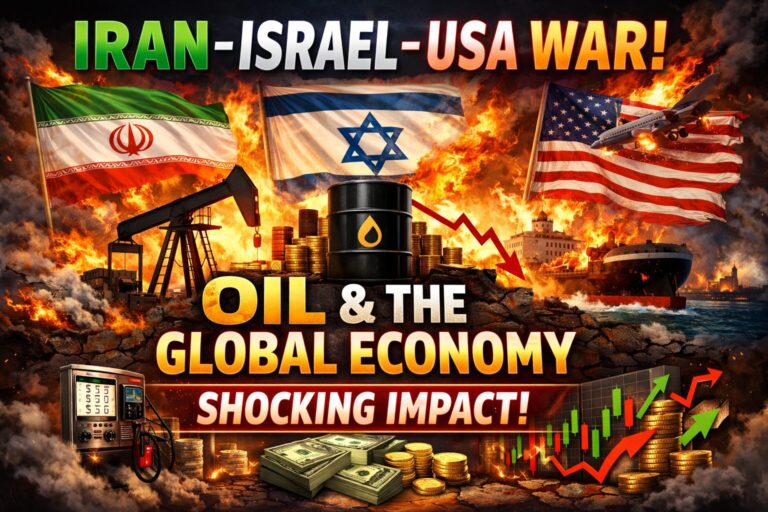
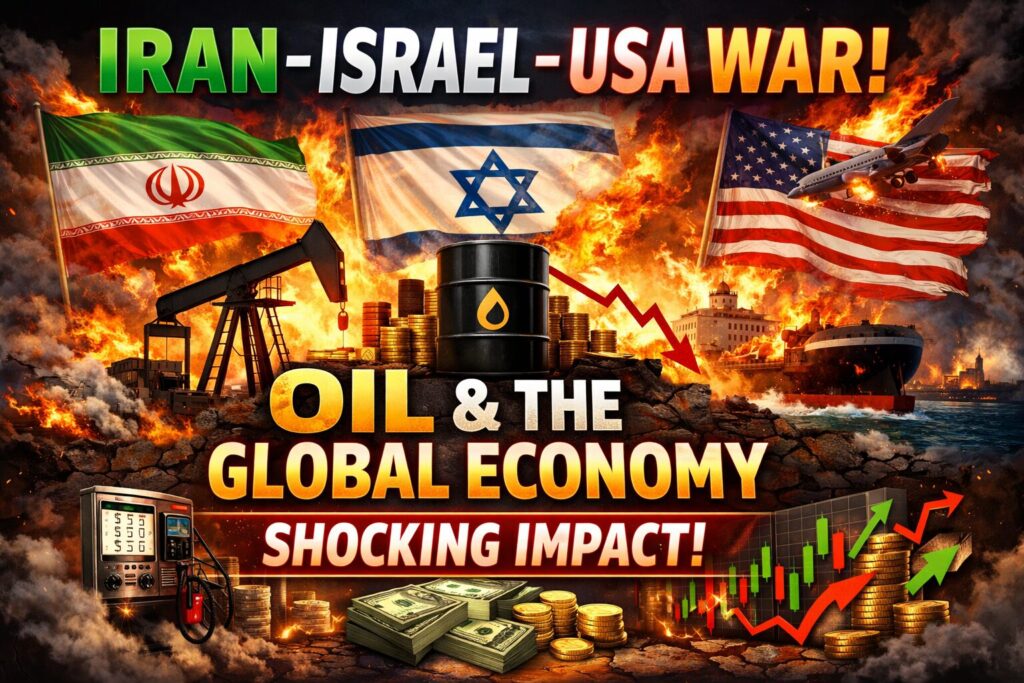
The Iran-Israel-USA war impact on oil prices and the global economy is not a future scenario anymore — it’s actively reshaping supply chains, energy markets, inflation curves, and the financial decisions of governments from Tokyo to Toronto. Most people see the headlines but miss the deeper mechanics. They hear “oil prices rising” and assume it will pass. In practice, this conflict has tentacles that reach far deeper than crude futures on the trading floor.
What makes this particularly difficult to understand is the sheer number of moving parts. You have Iran — the world’s third-largest OPEC producer — sitting right next to the Strait of Hormuz, through which roughly 20% of the world’s oil passes every single day. You have Israel engaging in a widening regional conflict. And you have the United States, simultaneously a military actor, a major oil producer, and the country whose currency (the dollar) underpins nearly all global energy trade.
This article breaks it all down clearly — section by section — so you walk away understanding not just what’s happening, but why it matters to you, regardless of whether you’re in Chicago, Cairo, or Colombo.
Let’s get into it.
Why the Middle East Still Controls the World’s Oil — And Why That Matters Now More Than Ever
Most people assume that with the US now a major oil producer thanks to the shale boom, Middle East conflicts matter less. That’s one of the most expensive misconceptions in modern economics.
Here’s the reality: the United States may produce a lot of oil, but the global price of oil is set by the market. And that market is still acutely sensitive to anything that happens near the Persian Gulf.
The Strait of Hormuz — The World’s Most Valuable Bottleneck
Think of the Strait of Hormuz as a narrow hallway between Iran on one side and Oman and the UAE on the other. It is only about 21 miles wide at its narrowest point. And yet, approximately 17–20 million barrels of oil pass through it every single day.
That’s roughly 20% of the entire world’s oil supply — every single day — squeezed through a corridor that Iran has, on multiple occasions, threatened to close. In 2019, Iran seized a British-flagged oil tanker right there. In the current conflict escalation, Iran-backed forces have already attacked commercial shipping in the Red Sea, forcing major shipping companies to reroute around the Cape of Good Hope — adding weeks and thousands of dollars in costs per voyage.
If Iran were to partially or fully disrupt the Strait of Hormuz — even temporarily — analysts estimate oil prices could spike to $130–$150 per barrel within days. The last time prices went that high was during the 2022 Ukraine-Russia conflict, and that alone contributed to the worst global inflation surge in four decades.
Key countries most exposed to Hormuz disruption:
| Country | % of Oil Imports via Hormuz | Risk Level |
|---|---|---|
| Japan | ~87% | Extreme |
| South Korea | ~76% | Very High |
| India | ~65% | High |
| China | ~40% | High |
| European Union | ~25% | Moderate |
| United States | ~10–15% | Moderate |
Expert tip: Even countries that don’t import directly from the Gulf feel the impact — because oil is a globally priced commodity. When Hormuz tightens, every barrel everywhere gets more expensive.
📺 Recommended Watch: “How the Strait of Hormuz Could Trigger an Oil Crisis” — Reuters Explains (YouTube) 📺 Recommended Watch: “Iran’s Oil Weapon Explained” — Bloomberg QuickTake (YouTube)
🐦 Trending on X (Twitter): Search
#HormuzCrisisand#OilPricesfor real-time market reactions and analyst commentary from verified energy economists.
How the Iran-Israel-USA War Is Directly Impacting Oil Prices Right Now
Here’s where it gets very concrete. Whenever military exchanges escalate between Iran and Israel — or when the US imposes new sanctions or conducts strikes — oil markets react almost immediately. Traders price in what’s called a “geopolitical risk premium,” which is essentially extra cost added to every barrel because of uncertainty.
What a “War Premium” Means for Oil — And for You
In normal market conditions, oil prices are driven by supply and demand fundamentals: how much OPEC produces, how much the US pumps, how strong industrial demand is from China and Europe.
But in a conflict scenario, a second layer appears. Even if actual oil supply hasn’t been disrupted yet, the fear of disruption is enough to push prices up. This is the war premium. During periods of heightened US-Iran tensions in 2019–2020, analysts at Goldman Sachs estimated this premium added $5–$10 per barrel above fundamental value.
In the current conflict environment, that premium is even larger because the stakes are higher. There are multiple simultaneous fronts: Houthi attacks on Red Sea shipping backed by Iran, direct Israeli strikes on Iranian territory, and US naval assets deployed in the region. Each new escalation adds to the premium.
What this means in practical terms:
When Brent crude rises by $10 per barrel, the average American household pays roughly an extra $200–$300 per year in gasoline and energy costs. For developing countries that import oil and have weaker currencies, the impact is far more severe — sometimes tipping entire economies into crisis territory.
OPEC’s Role — Friend or Fuel to the Fire?
OPEC, led largely by Saudi Arabia, has an interesting dilemma here. Saudi Arabia and Israel are not exactly allies, but Saudi Arabia has even more tension with Iran, which supports rival factions across the Arab world. So Saudi Arabia has limited motivation to flood the market and collapse oil revenues — especially when those revenues fund their ambitious Vision 2030 economic transformation.
In practice, OPEC is likely to maintain or even tighten production cuts during a conflict period, which keeps prices elevated. Russia — which coordinates with OPEC as part of the OPEC+ alliance — also benefits from higher oil prices and has zero incentive to help stabilize markets that punish Western economies.
📺 Recommended Watch: “OPEC+ Strategy During Middle East Conflict” — CNBC International (YouTube)
Country-by-Country Breakdown — Who Gets Hurt Most and Why
This is the section most news outlets skip. They focus on “oil prices rising” as if it’s a uniform global experience. In reality, the Iran-Israel-USA war impacts countries in wildly different ways depending on whether they’re oil exporters, oil importers, emerging markets, or reserve currency holders.
The United States — Paradox of the World’s Largest Oil Producer
The US is in a fascinating paradox. It is simultaneously the world’s largest oil producer (thanks to shale) and a net importer of certain types of crude. More importantly, the US is the world’s largest military actor in this conflict — which means higher defense spending, more geopolitical uncertainty, and significant political pressure on energy policy.
For American consumers, the main impact is at the pump. But there’s a second-order effect too: inflation. When energy prices rise, they push up the cost of almost everything — transportation, manufacturing, food distribution, home heating. This makes the Federal Reserve’s job harder, potentially keeping interest rates higher for longer, which in turn affects mortgage rates, car loans, and business investment.
For American investors, the picture is mixed. Energy stocks (Exxon, Chevron, ConocoPhillips) tend to benefit from higher oil prices. Defense contractors (Lockheed Martin, Raytheon, Northrop Grumman) often see increased government contracts. But the broader S&P 500 can suffer if investors fear sustained inflation or a recession.
You can explore deeper analysis and real-time education on global economic trends at LumeChronos — a strong resource for those wanting to understand international market dynamics beyond the headlines.
Europe — Already Weakened, Now Under More Pressure
Europe is in a genuinely difficult position. After the Russia-Ukraine war forced the continent to scramble for new energy supplies, European economies managed to stabilize — but with higher baseline energy costs than before. Now, a Middle East escalation threatens to undo that fragile stability.
Countries like Germany — which is highly industrial and already in recession — are especially vulnerable. Higher energy costs squeeze manufacturing margins, reduce exports, and push consumers toward austerity. Southern European countries like Italy and Greece, which already carry heavy debt loads, face currency pressure and rising import costs.
The euro tends to weaken against the dollar during Middle East crises because the dollar is the global safe-haven currency. A weaker euro means imports cost more, which is inflationary — another vicious cycle.
China and India — The Swing Variables That Could Change Everything
Here’s something most Western analysts undervalue: China and India together consume roughly 35% of the world’s oil. Their response to the conflict can either cushion or amplify the global impact.
China has been buying discounted Iranian oil in large quantities despite US sanctions — essentially acting as a buyer of last resort for Iranian crude. If the conflict escalates and the US enforces sanctions more aggressively, China faces a supply disruption that could slow its already sluggish economic recovery.
India is similarly caught. India buys heavily from Russia (discounted post-sanctions oil) and the Gulf. A Hormuz disruption would force India to compete more aggressively for alternative supplies, driving up the rupee’s pressure and potentially accelerating inflation in a country where a large portion of the population is acutely sensitive to food and fuel prices.
Emerging Markets — The Real Victims of This Crisis
The countries that suffer most from oil price shocks are often not the ones making headlines. Sub-Saharan African nations, South Asian economies, and Latin American countries that import oil and hold debt in US dollars face a brutal combination:
Their currencies weaken as investors flee to dollar safety. Their fuel import bills rise in dollar terms. Their debt repayment costs climb because it’s denominated in dollars. And their central banks face the impossible choice between raising rates (to defend the currency but killing growth) or cutting rates (to support growth but accelerating inflation).
Sri Lanka’s 2022 economic collapse — while not entirely oil-driven — was a vivid preview of what happens when a small import-dependent economy is hit by simultaneous currency, energy, and debt shocks. A sustained Middle East conflict could push multiple fragile economies toward similar crises.
For a global comparative perspective on how different regions manage economic volatility, LumeChronos.de offers internationally focused content worth bookmarking.
Beyond Oil — The Knock-On Effects on Global Supply Chains, Inflation, and Finance
One of the most important things to understand about this conflict is that “oil impact” is just the first domino. When oil moves, everything downstream moves too.
Shipping and Global Trade — The Red Sea Disruption Is Already Costing Billions
Even before any direct Hormuz closure, the Houthi attacks on Red Sea shipping — backed by Iran — have already caused massive disruption. Major shipping companies including Maersk, Hapag-Lloyd, and MSC rerouted their vessels around the Cape of Good Hope rather than risk the Suez Canal route.
This adds roughly 10–14 days to shipping times between Asia and Europe. When shipping times increase, container freight rates spike. When freight rates spike, costs rise across almost every imported product — electronics, clothing, car parts, pharmaceuticals. These costs eventually land on retail shelves.
The shipping disruption alone has added an estimated $400–$600 in freight costs per 40-foot container, and analysts estimate it contributed 0.5–1% to European import inflation in early 2024. That may sound small, but in an environment where central banks are desperately trying to get inflation down to 2%, every fraction matters.
Gold, the Dollar, and Safe-Haven Flows
When Middle East conflict escalates, two assets reliably surge: the US dollar and gold. Both are “safe havens” — assets investors flock to when they’re scared.
For gold, this has been strikingly visible. Gold prices hit all-time highs above $2,400 per ounce in 2024, driven heavily by Middle East tensions. For investors, this is actually an opportunity — but for developing economies that hold their reserves in other assets, dollar and gold appreciation means their relative wealth decreases.
The dollar’s safe-haven status also creates its own irony: the very country that is most militarily involved in creating the uncertainty (the United States) also benefits financially in the short term from that uncertainty, as capital flows into dollar-denominated assets.
If you’re looking for tools and resources to track global commodities and economic indicators in real time, LumeChronos Shop offers curated resources for serious market watchers and informed investors.
What Happens If the Conflict Escalates Further? Scenarios and Outcomes
This section requires intellectual honesty. Nobody knows exactly what will happen — but scenario planning is a legitimate and valuable exercise used by governments, central banks, and major corporations.
Scenario 1 — Contained Regional Conflict (Base Case)
In this scenario, the conflict remains primarily between Israeli and Iranian-backed forces, with the US engaged through sanctions and naval presence but not in direct large-scale combat. Oil prices remain elevated — perhaps in the $90–$110 per barrel range — but global supply is not catastrophically disrupted. Global growth slows modestly, inflation stays sticky, and emerging markets face continued pressure. This is the scenario most markets are currently pricing in.
Scenario 2 — Direct US-Iran Military Exchange (Elevated Risk)
If the US and Iran engage in direct military conflict — either through strikes on Iranian nuclear or oil facilities, or Iranian retaliation against US assets — markets would likely experience a sharp shock. Oil could spike to $130–$150 per barrel quickly. Global equities would sell off. The Fed and other central banks would face enormous pressure. A short global recession becomes quite plausible. Recovery could take 1–3 years.
Scenario 3 — Hormuz Closure (Tail Risk, High Consequence)
This is the nightmare scenario. If Iran closes or seriously disrupts the Strait of Hormuz — even for 30–60 days — the economic consequences would be historic. Oil above $150, possible spikes to $200. Severe recessions in Asia and Europe. Emergency OPEC reserve releases. US strategic petroleum reserve deployment. Food price spikes globally (because agriculture runs on diesel). This scenario is considered low-probability but not impossible, and its consequences justify serious preparation by policymakers.
What This Means for Everyday People — Practical Takeaways
Understanding macro geopolitics is valuable. But most people reading this want to know: what should I actually do with this information?
For American Consumers
Gas prices will likely remain volatile. Budget accordingly — and consider that this isn’t just a pump problem. Higher energy costs filter into grocery prices, utility bills, and the cost of almost every product that requires transportation. Planning personal budgets with a $0.30–$0.50 per gallon buffer above current prices is reasonable in an uncertain conflict environment.
For Investors and Savers
Diversification matters more than ever. Energy stocks, commodities, and gold tend to perform well in geopolitical uncertainty. Overexposure to emerging market bonds or currencies carries elevated risk. If you hold international exposure, understanding which countries are most energy-import-dependent helps you calibrate risk.
For Business Owners
Supply chain diversification is the most important lesson from both COVID-19 and the current conflict environment. Businesses still heavily reliant on single-source shipping routes or energy-intensive manufacturing face disproportionate risk. This is a good moment to stress-test supply chains and explore hedging strategies for energy costs.
❓ FAQ — People Also Ask (PAA-Optimized)
Q1: How does the Iran-Israel conflict affect global oil prices?
When Iran and Israel exchange military attacks, oil markets price in a “geopolitical risk premium” — an extra cost per barrel that reflects the fear of supply disruption. Iran sits adjacent to the Strait of Hormuz, through which about 20% of the world’s daily oil supply flows. Any credible threat to that corridor — whether through missile attacks, shipping disruptions, or sanctions escalation — causes traders to bid up oil futures. Even if actual supply isn’t disrupted yet, the expectation of disruption is enough to move prices significantly, often by $5–$20 per barrel depending on escalation severity.
Q2: Will the US-Iran war cause a global recession?
A full direct US-Iran war would significantly increase recession risk, but not all scenarios lead there. In the base case (contained conflict), the impact is slower growth and higher inflation rather than outright recession. However, if the conflict escalates to include direct strikes on Iranian oil infrastructure or a Hormuz disruption, the economic shock would be severe enough to tip multiple major economies into recession — particularly in Europe and Asia, which are most dependent on Gulf oil. The US, with its domestic production, would be more resilient but not immune.
Q3: Which countries are most affected by Middle East oil disruptions?
The countries most vulnerable are those that: (a) import a high percentage of their oil from the Persian Gulf region, and (b) have weaker currencies and limited financial buffers. Japan, South Korea, and India top the list for sheer volume dependency. Sub-Saharan African and South Asian developing nations top the list for economic fragility. Europe faces significant structural vulnerability given its already-strained energy transition. The US is relatively insulated due to domestic production but still affected through global price mechanisms.
Q4: What is the Strait of Hormuz and why does it matter so much?
The Strait of Hormuz is a narrow waterway between Iran and Oman connecting the Persian Gulf to the open ocean. It is the world’s single most important oil chokepoint — approximately 17–20 million barrels of oil pass through it every day, representing roughly 20% of global supply. Saudi Arabia, UAE, Iraq, Kuwait, and Qatar all export their oil through this corridor. If it were disrupted even partially, there is no alternative route capable of absorbing that volume quickly, making it an irreplaceable artery in the global energy system.
Q5: How does the conflict affect inflation and interest rates?
Higher oil prices translate directly into higher energy costs, which ripple through the economy as transport costs, manufacturing costs, and food prices all rise. This adds to general inflation. Central banks — particularly the US Federal Reserve and European Central Bank — are then caught in a bind: they want to cut interest rates to support growth, but persistent inflation from energy prices may force them to keep rates high longer. Sustained high interest rates slow business investment, cool housing markets, and increase the cost of government and consumer debt worldwide.
Q6: Is gold a good investment during the Iran-Israel-USA conflict?
Historically, gold performs strongly during periods of geopolitical uncertainty. The 2024 gold price rally to record highs above $2,400 per ounce was significantly driven by Middle East tensions. Gold serves as a hedge against both inflation (rising energy costs) and currency weakness in developing markets. However, it’s important to treat it as one component of a diversified strategy rather than a guaranteed safe play. During very severe risk-off events, even gold can experience short-term volatility before resuming its upward trend.
Q7: How does this conflict affect food prices globally?
The connection between oil and food is often underappreciated. Modern agriculture is deeply dependent on petroleum — for diesel-powered machinery, for fertilizer production (natural gas-intensive), and for food transportation. When oil prices rise significantly, food production and distribution costs rise with them. This is most acutely felt in developing countries where food represents 40–60% of household spending. The UN Food and Agriculture Organization has specifically flagged energy price volatility as a primary driver of food insecurity risk in a conflict escalation scenario.
Q8: What can governments do to protect their economies from this impact?
Governments have several tools, though none are perfect. Strategic petroleum reserve releases (used effectively by the US and IEA members) can temporarily suppress price spikes. Currency interventions can stabilize exchange rates under pressure. Emergency fuel subsidies can protect consumers in the short term — though they are fiscally expensive. Longer-term, accelerating the transition to domestic renewable energy reduces dependency on imported fossil fuels, which is both an economic and strategic imperative that this conflict is making clearer to every policymaker globally.
🧾 Key Takeaways
The most important things to carry away from this breakdown are these:
The Strait of Hormuz is the single most critical chokepoint in the global energy system, and Iran’s proximity to it means any escalation creates immediate oil market risk — even before a single barrel is actually disrupted.
The war’s impact on global economies is profoundly unequal. The United States and oil-exporting Gulf states are relatively more insulated. Europe, South Asia, and developing nations face the most severe combination of currency pressure, inflation, and debt stress.
Oil price increases from geopolitical conflict are not just a gasoline problem — they cascade into food prices, shipping costs, manufacturing expenses, and monetary policy decisions that affect interest rates, mortgages, and investment globally.
OPEC’s decisions during this period will be as consequential as the military actions themselves. Production cuts during a conflict environment amplify price shocks; production increases could moderate them.
Investors and businesses should view this conflict not as a temporary news event but as a structural risk factor that warrants defensive portfolio positioning, supply chain stress-testing, and serious engagement with energy cost hedging.
The scenarios that seem extreme — Hormuz disruption, direct US-Iran combat — carry low probability but extraordinary consequences, and serious preparation at the government, business, and individual level is both rational and responsible.
The geopolitical conflict is also accelerating the long-term transition away from fossil fuels, as every energy crisis reminds governments and corporations alike of the vulnerability of petroleum dependence.
🧠 Final Conclusion + CTA
Let’s be real about what this conflict represents. It’s not just a military story. It’s an economic stress test being administered in real time to the entire global system — and most people aren’t watching closely enough.
The Iran-Israel-USA dynamic is reshaping oil markets, shifting capital flows, complicating central bank decisions, and pushing fragile developing economies closer to the edge. Understanding these connections doesn’t just make you better informed — it makes you better prepared. Whether you’re a consumer building a household budget, an investor positioning a portfolio, or a business owner managing a supply chain, these dynamics affect you in concrete ways.
The good news is that this isn’t unknowable. The mechanisms are clear, the historical parallels exist, and the data tells a coherent story if you know where to look.
Start by staying educated. Dive deeper into global economic analysis at LumeChronos, where you’ll find clear, expert-led breakdowns of complex international trends. Explore tools and resources for serious market monitoring at LumeChronos Shop. And for a uniquely international perspective on how different regions are navigating these challenges, LumeChronos.de is worth your time.
If this article gave you a clearer picture of what’s happening — share it. Spread the understanding. Drop a comment with your perspective or questions. And if you found something here you hadn’t considered before, that’s exactly the point.
The world is interconnected in ways that headlines rarely capture. Now you know a little more of the picture.
📺 Recommended Video Resources:
- “Iran vs Israel: What Happens to Oil?” — Al Jazeera English
- “How Middle East War Affects Your Wallet” — CNBC
- “Strait of Hormuz: The World’s Most Dangerous Chokepoint” — DW News
🌐 Reference Sources & Further Reading:
- U.S. Energy Information Administration (EIA)
- International Energy Agency (IEA)
- Reuters Energy Desk
- Council on Foreign Relations — Middle East Conflict Tracker
- Bloomberg Energy
This article is based on insights from real-time trends and verified sources including trusted industry platforms.