




ISRO CMS-03 Satellite Launch
Introduction
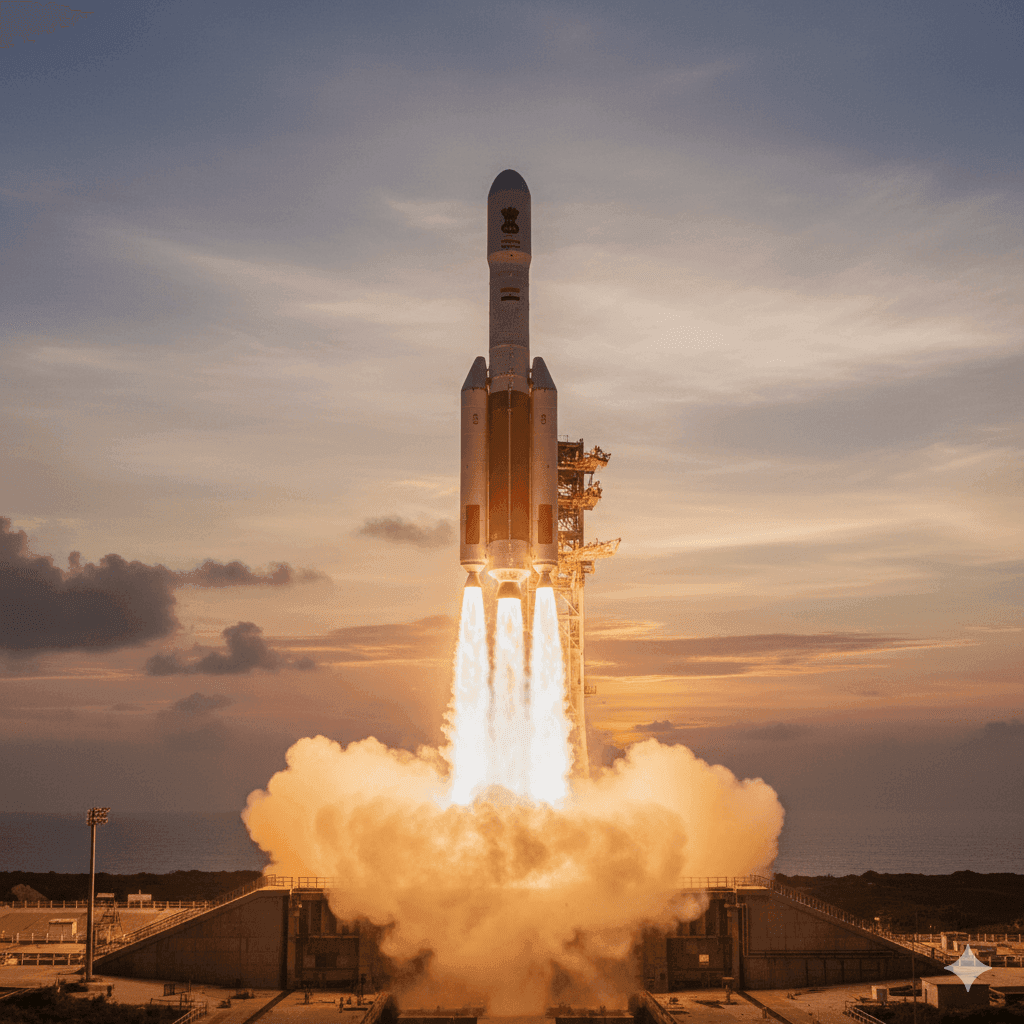
The ISRO LVM-3 ‘Bahubali’ heavy-lift rocket on the launch pad at Sriharikota (image credit: India Today/ISRO).* India’s space agency ISRO is set to launch ISRO CMS-03, the country’s heaviest-ever communication satellite, in early November 2025. CMS-03 is a 4,410 kg multi-band communications spacecraft that will ride atop the powerful LVM-3 rocket (nicknamed “Bahubali”). Liftoff is scheduled for 5:26 PM IST on 2 November 2025 from the Satish Dhawan Space Centre in Sriharikota. This high-profile mission underscores India’s growing space capabilities: CMS-03 will expand digital and naval communications across the subcontinent and surrounding oceans.
About the ISRO CMS-03 Satellite
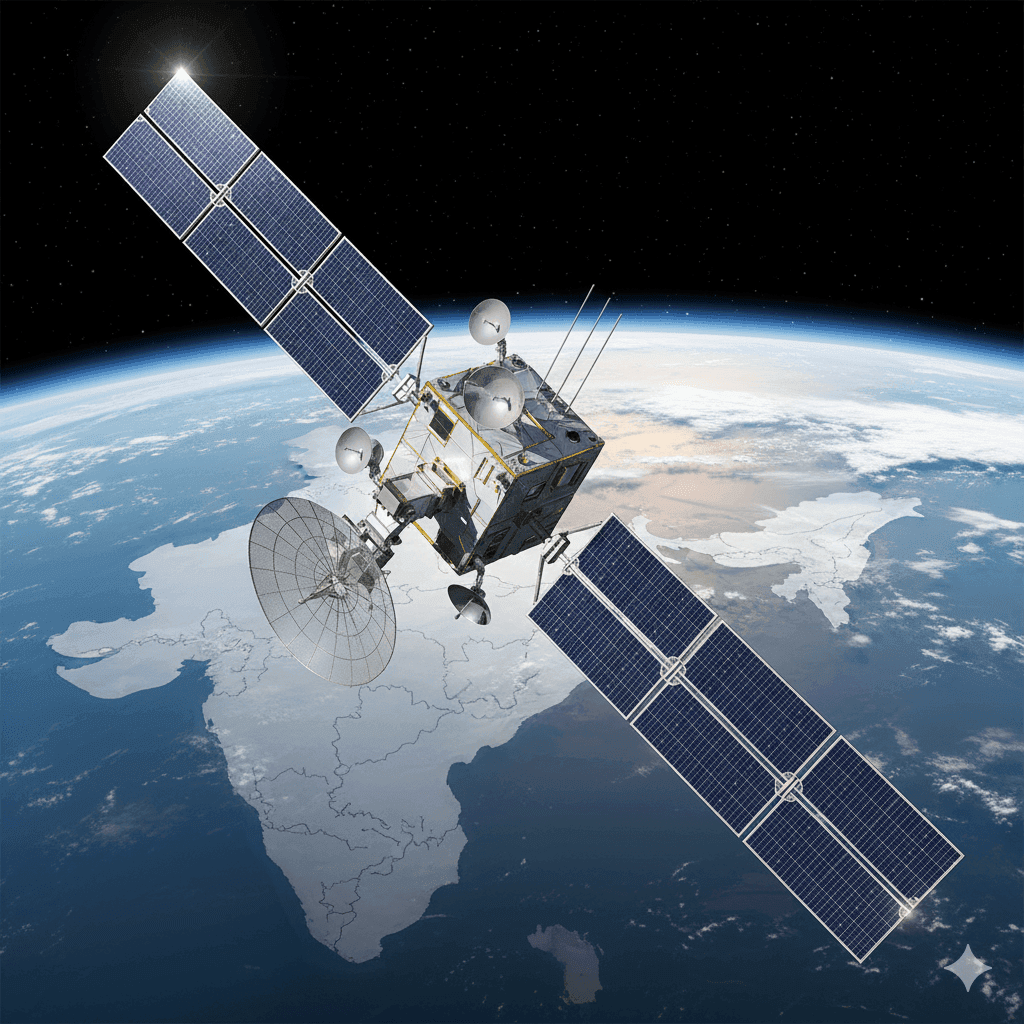
CMS-03 (also referred to as GSAT-7R) is a multi-band communication satellite designed to cover the Indian landmass and wide oceanic regions. Its payload includes C-band, extended C-band, and Ku-band transponders, enabling high-throughput data, voice and video links. In practice, CMS-03 will serve as the backbone of India’s naval communication network – providing secure, real-time links between warships, submarines, aircraft, and land command centers. Compared to its predecessor (GSAT-7 “Rukmini” launched in 2013), the new satellite offers vastly increased coverage and bandwidth. Beyond defense uses, CMS-03’s enhanced connectivity will benefit civilian needs: broadcasting, internet access, telemedicine and disaster management across remote areas can all improve thanks to this satellite.
LVM-3 Rocket (“Bahubali”) Details
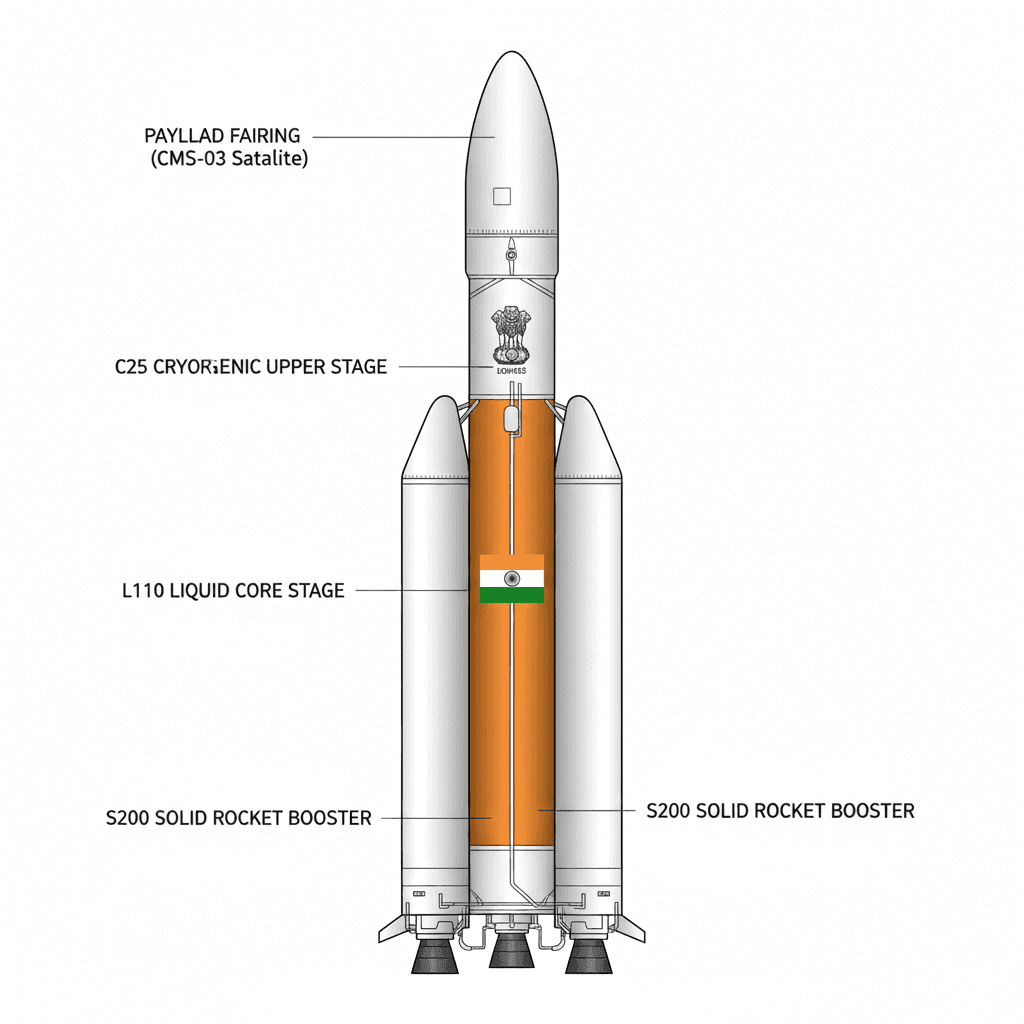
The LVM-3 “Bahubali” heavy-lift rocket on its launch pad at Sriharikota. (Image: Space.com/ISRO).* The mission’s launch vehicle is ISRO’s LVM-3 (Launch Vehicle Mark-3), also known as GSLV MK III. It is a three-stage rocket featuring two large solid strap-on boosters (S200 stage), a liquid-fueled core (L110 stage with twin Vikas engines), and a cryogenic upper stage (C25). At 43.5 meters tall and 642 tonnes at liftoff, LVM-3 is India’s most powerful rocket. It can carry up to ~4,000 kg to Geosynchronous Transfer Orbit (GTO) and ~8,000 kg to Low Earth Orbit – making it well-suited for large communication satellites like CMS-03. The rocket earned the nickname “Bahubali” for this heavy-lift prowess.
LVM3-M5 (the CMS-03 mission) is the fifth operational flight of this vehicle. Previous successes include sending Chandrayaan-3 to the Moon’s south pole (July 2023) and deploying large satellites for OneWeb. With CMS-03, ISRO continues to reduce reliance on foreign launchers for heavy payloads: earlier, India had to use an Arianespace Ariane-5 to orbit its 5,854 kg GSAT-11 satellite in 2018. Today, the fully assembled LVM-3 rocket (now mated with CMS-03) stands on Sriharikota’s Second Launch Pad, awaiting final checks before blastoff.
for more business detail with https://lumechronos.com/category/news/business-news/
Launch Sequence and Schedule
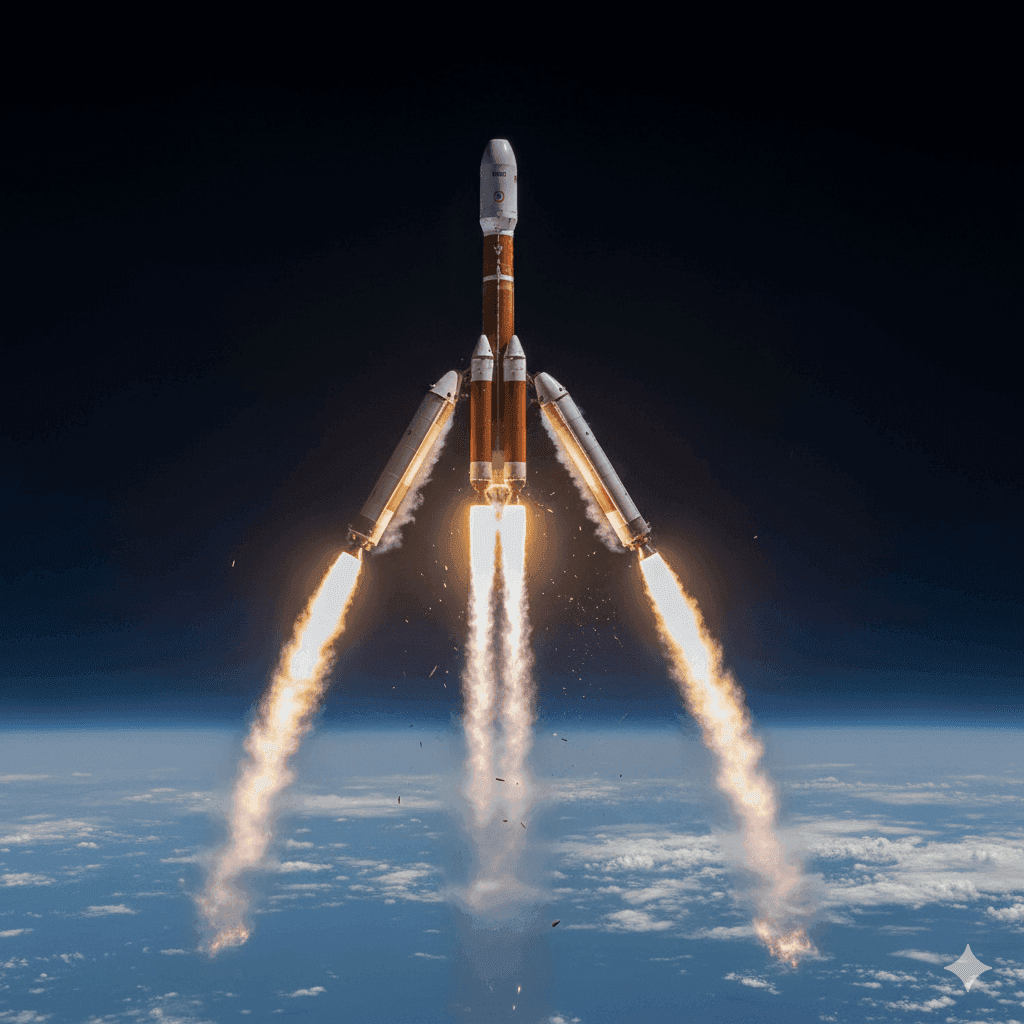
After final preparations, the launch countdown began roughly 24 hours before liftoff. Key events in the ascent include ignition of the twin S200 boosters at liftoff, separation of those boosters after about 2 minutes, staging of the core L110 liquid stage, and finally ignition of the cryogenic C25 upper stage to place CMS-03 into GTO. ISRO reports that all systems were declared “GO” and the stack was transferred to the pad on October 26, 2025 for final checks. Assuming normal weather and no delays, the LVM3-M5 rocket will launch exactly at 5:26 PM IST on November 2, 2025.
Key Launch Details:
- Date & Time: November 2, 2025, 5:26 PM IST (Scheduled).
- Launch Site: Satish Dhawan Space Centre, Sriharikota, India.
- Orbit: Geosynchronous Transfer Orbit (GTO), followed by maneuvering to geostationary orbit.
- Payload: CMS-03 communications satellite (4,410 kg).
Significance of the Mission
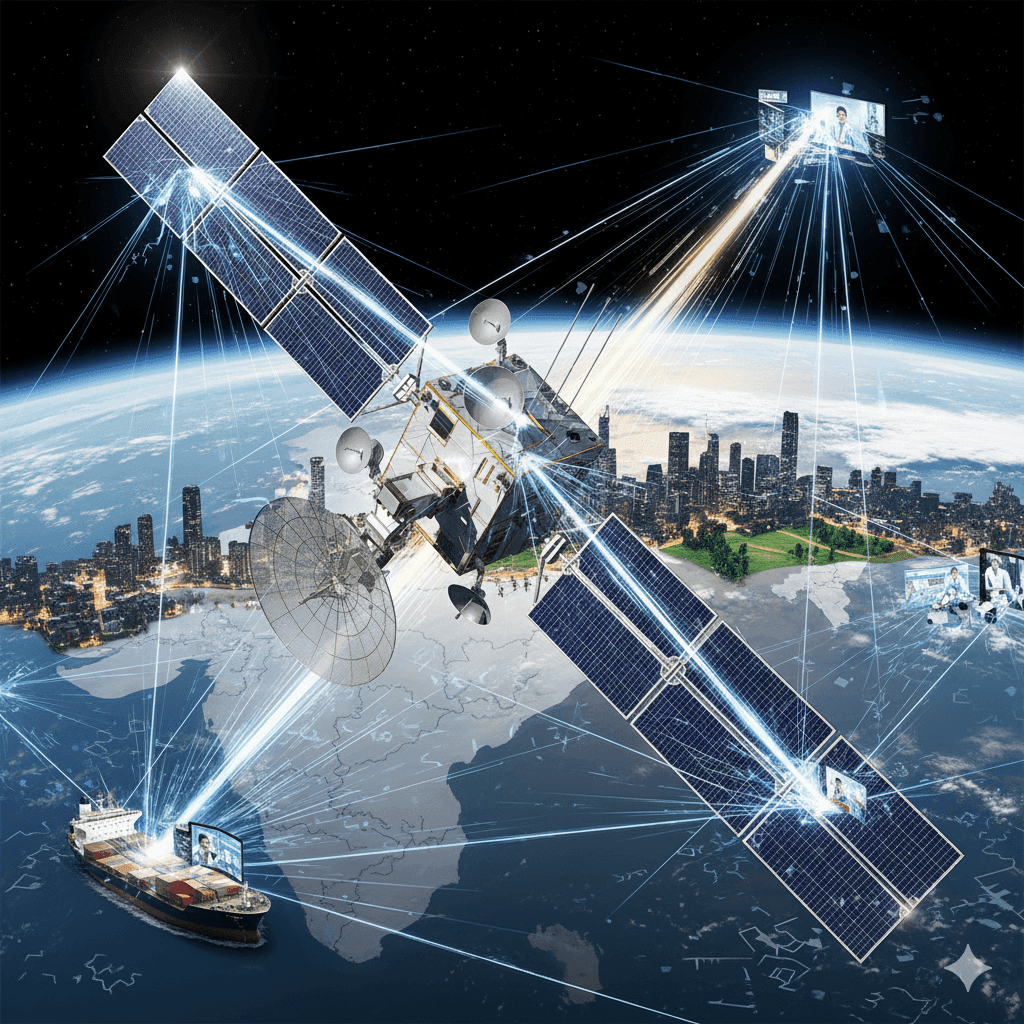
The CMS-03 launch marks a major milestone for India’s space program. Key benefits include:
- Enhanced Communications: CMS-03 will dramatically boost India’s domestic communication infrastructure – expanding internet, broadcast and maritime connectivity according to India Today. Remote education, telemedicine and disaster relief in hard-to-reach areas will all benefit from stronger satellite links as reported by The Economic Times.
- Naval & Security Capability: As a dedicated military communications asset, CMS-03 strengthens naval command and control. It provides secure, high-bandwidth links for the Indian Navy’s “blue-water” operations across the Indian Ocean, improving situational awareness and strategic reach as covered by India Today and Space.com.
- Heavy-Lift Demonstration: Successfully orbiting a 4,410 kg satellite from Indian soil proves ISRO’s heavy-lift capability. LVM-3’s performance underpins confidence in future missions – including national endeavors like the crewed Gaganyaan program – and reduces dependency on foreign launch services as detailed by The Economic Times and The Federal.
- Cost & Autonomy: Launching satellites natively (versus hiring rockets abroad) saves time and foreign exchange. The mission highlights India’s push for self-reliance (Aatmanirbhar Bharat) in space technology according to India Today and The Economic Times.
- Proven Track Record: CMS-03’s launch continues the string of LVM-3 successes (e.g. Chandrayaan-3) as reported by The Economic Times and The Federal, reinforcing ISRO’s reputation as a reliable provider of satellite launch services.
By placing CMS-03 into service, India not only secures vital communication assets for civilian and defense uses, but also cements its position as a capable spacefaring nation. The satellite’s operation in geostationary orbit will ensure uninterrupted coverage: sitting ~36,000 km above Earth, it “hovers” over the region constantly. This continuous coverage is crucial for real-time data links across the subcontinent and ocean.
Conclusion
The upcoming LVM3-M5/CMS-03 mission is a landmark event in India’s space history. It showcases ISRO’s advanced rocketry and satellite technology while directly benefiting society. Students and the general public alike can look forward to enhanced internet connectivity, television broadcasting, weather forecasting and defense communications thanks to CMS-03. As ISRO carries out this heavy-launch, the mission will be streamed live online according to Space.com and The Economic Times, inviting everyone to witness “Bahubali” carry India’s latest satellite into space.
Ultimately, CMS-03’s success will pave the way for more indigenous heavy-lift launches, reducing wait times and costs. It exemplifies India’s growing expertise – from designing complex multi-band satellites to engineering reliable rockets – and inspires the next generation of scientists and engineers.
Sources: Authoritative news and ISRO releases provide details on the CMS-03 mission. Each statement above is backed by these sources.
- LVM3-M5/CMS-03 MISSION
- Isro launches 4.4-tonne satellite on LVM3 to boost Navy’s communication grid – India Today
- ISRO’s ‘Bahubali’ LVM3-M5 rocket to launch 4,410 kg CMS-03 satellite into orbit: What it will do and why it matters – The Economic Times
- LVM3-M5 lifts off from Sriharikota with ISRO’s heaviest satellite CMS-03
- Watch India’s most powerful rocket launch a huge military communications satellite to orbit today | Space
- Countdown begins for launch of ISRO’s communication satellite CMS-03 onboard LVM3-M5 – The Economic Times