




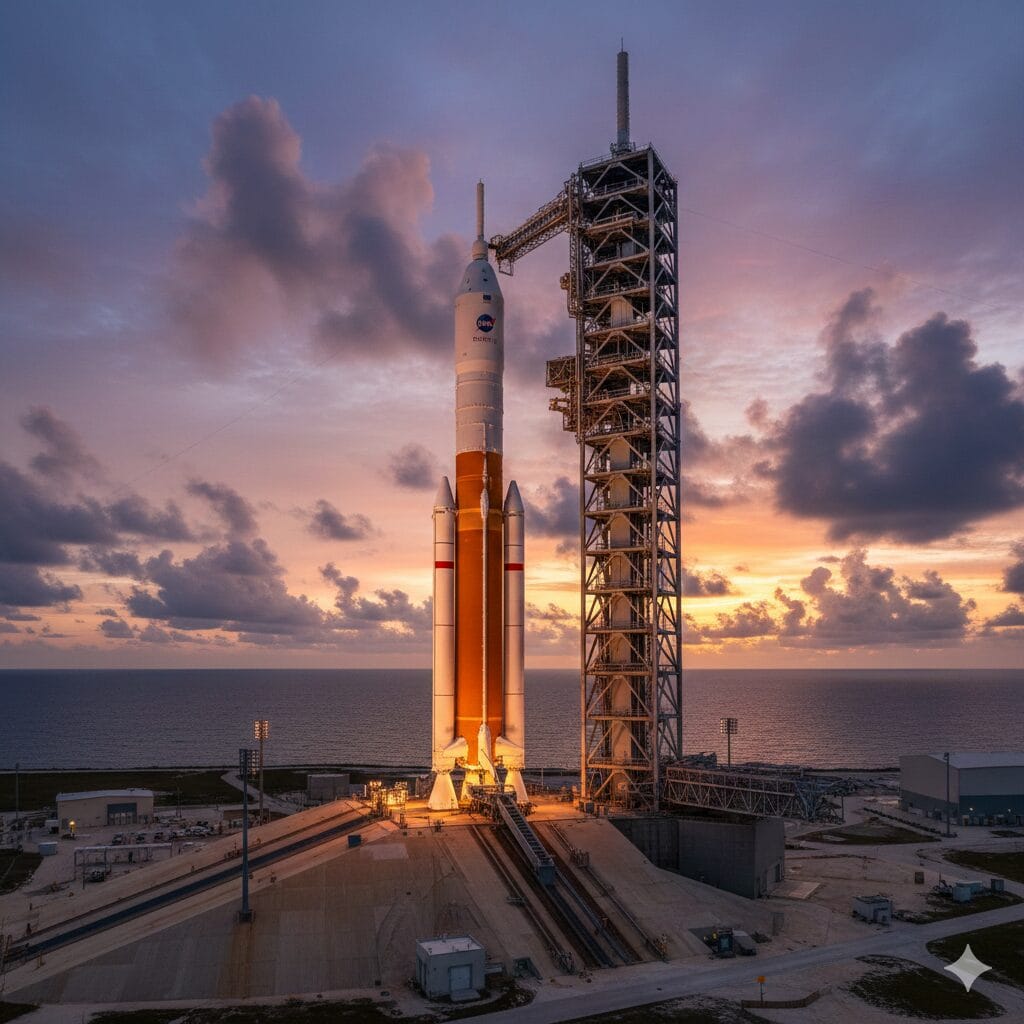
Historic Moment: NASA Artemis II Rocket Reaches Launch Pad 39B at Kennedy Space Center
In a momentous achievement marking humanity’s return to lunar exploration, NASA’s Artemis II Space Launch System rocket and Orion spacecraft successfully arrived at Launch Pad 39B on January 17, 2026. This milestone represents a critical step toward sending astronauts around the Moon for the first time in over five decades, signaling a new era of deep space exploration.
The Journey to the Launch Pad: A Slow but Steady Trek
At precisely 6:42 p.m. EST on Saturday evening, the towering Artemis II rocket completed its nearly 12-hour journey from the Vehicle Assembly Building to the historic Launch Pad 39B at Kennedy Space Center in Florida. The massive crawler-transporter 2 carried the 11-million-pound integrated stack at a cautious maximum speed of just 0.82 miles per hour, ensuring the safety of this precious cargo that represents years of engineering excellence and human ambition.
The four-mile trek began early Saturday morning at 7 a.m. EST, with NASA teams carefully monitoring every inch of progress. During the rollout, engineers repositioned the crew access arm—a critical bridge that will provide the astronauts access to the Orion spacecraft on launch day. This meticulous attention to detail underscores NASA’s unwavering commitment to crew safety and mission success.
Meet the Artemis II Crew: Pioneers of Modern Lunar Exploration
The Artemis II mission will carry four exceptional astronauts on this historic journey around the Moon. Commander Reid Wiseman leads the crew, bringing extensive spaceflight experience and leadership to this groundbreaking mission. Pilot Victor Glover will make history as the first person of color to travel to the Moon, representing a significant milestone in space exploration diversity.
Mission specialist Christina Koch joins the crew, poised to become the first woman to venture to lunar vicinity, breaking barriers and inspiring future generations of explorers. Rounding out the team is Canadian Space Agency astronaut Jeremy Hansen, who will become the first non-American to journey to the Moon, highlighting the international collaboration at the heart of the Artemis program.
Together, these four pioneers will spend approximately 10 days testing NASA’s most advanced deep space exploration systems, paving the way for future lunar surface missions and ultimately human exploration of Mars.
What Makes Artemis II Different: Testing Tomorrow’s Technology Today
Unlike the uncrewed Artemis I mission that successfully flew in 2022, Artemis II represents the first complete test of NASA’s human deep space exploration capabilities with astronauts aboard. The mission serves several critical objectives that will validate technology and procedures for future lunar landings.
The crew will rigorously assess the performance of life support systems designed to generate breathable air and remove carbon dioxide and water vapor in the demanding deep space environment. These systems will be tested under various conditions, from high metabolic activity during exercise periods to lower metabolic rates during sleep cycles, ensuring reliability across all mission phases.
Astronauts will also manually control the spacecraft during proximity operations demonstrations with Orion and its European-built service module. These capabilities prove essential for future Artemis missions, particularly for delivering and positioning Gateway elements—components of the planned lunar orbital outpost that will support sustained lunar exploration.
The Technical Marvel: Space Launch System and Orion Spacecraft
The Space Launch System rocket stands as NASA’s most powerful launch vehicle ever built, designed specifically for deep space missions beyond Earth orbit. The Block 1 configuration launching Artemis II generates tremendous thrust to propel the Orion spacecraft and its crew toward the Moon, breaking free from Earth’s gravitational pull.
Orion spacecraft represents cutting-edge engineering, featuring advanced heat shielding designed to protect astronauts during their return to Earth at speeds exceeding 24,000 miles per hour. The European Service Module provides propulsion, power, thermal control, and supplies for the crew, demonstrating international partnership in advancing space exploration capabilities.
During their mission, the crew will fly approximately 4,600 miles beyond the Moon—farther than any human has traveled from Earth—testing navigation, communications, and guidance systems in real deep space conditions. This data collection proves invaluable for planning future missions, including the anticipated Artemis III lunar landing mission scheduled for 2027.
What Happens Next: Preparing for Launch Day
With the rocket now positioned at Launch Pad 39B, NASA teams immediately began connecting ground support equipment, including electrical lines, fuel environmental control system ducts, and cryogenic propellant feeds. Engineers will power up all integrated systems at the pad for the first time, ensuring flight hardware components function properly with each other, the mobile launcher, and ground infrastructure systems.
At the end of January, NASA will conduct the wet dress rehearsal—a comprehensive prelaunch test demonstrating the ability to load more than 700,000 gallons of cryogenic propellants into the rocket. This rehearsal includes conducting a launch countdown and practicing safe propellant removal procedures, all without astronauts onsite. The rehearsal helps identify and resolve any potential issues before the actual launch day.
Following successful completion of the wet dress rehearsal, NASA will convene a flight readiness review where the mission management team assesses the readiness of all systems. This includes evaluating flight hardware, infrastructure, and launch, flight, and recovery teams before committing to a specific launch date.
Launch Windows and Mission Timeline: When Will Artemis II Fly?
The Artemis II launch window opens as early as February 6, 2026, with additional opportunities extending through February 11. However, complex orbital mechanics create a challenging pattern—approximately one week of launch opportunities followed by three weeks without viable launch windows. March and April 2026 also offer launch periods if February dates prove unworkable.
Several unique constraints govern Artemis II launch availability. The trajectory must allow the Space Launch System to deliver Orion into a high Earth orbit where crews evaluate spacecraft systems before venturing toward the Moon. The spacecraft must align properly with Earth and Moon positions during the trans-lunar injection burn, which places Orion on its free-return trajectory around the Moon.
The mission profile also requires ensuring Orion experiences no more than 90 consecutive minutes of darkness, allowing solar array wings to continuously receive sunlight for power generation. These technical requirements, combined with NASA’s commitment to crew safety, mean the final launch date depends on successful completion of all testing and rehearsals.
The Broader Artemis Program: Building a Sustainable Lunar Presence
Artemis II represents the second major flight in NASA’s ambitious Artemis campaign, which aims to establish a sustained human presence on and around the Moon. This presence will enable scientific discoveries, economic opportunities, and preparation for eventual human missions to Mars—humanity’s next giant leap in space exploration.
The mission builds upon lessons learned from Artemis I, which successfully tested the uncrewed Orion spacecraft and Space Launch System rocket in 2022. Artemis II’s crewed flight test will validate critical systems before Artemis III attempts to land astronauts near the lunar south pole, where scientists believe water ice deposits could support long-term lunar habitation.
Future Artemis missions will contribute to building and maintaining the Gateway lunar orbital outpost, conduct extended surface operations, and develop technologies for in-situ resource utilization. These capabilities form the foundation for sustainable exploration architecture that could eventually support human presence throughout the solar system.
International Collaboration: A Global Effort for Lunar Exploration
The Artemis program exemplifies international cooperation in advancing human spaceflight. The European Space Agency provides the critical service module for Orion, supplying propulsion, power, and life support capabilities. Canada’s participation through astronaut Jeremy Hansen reflects the strong partnership formalized in treaties enabling international crew participation.
In September 2024, NASA announced it would fly five CubeSats from international partners aboard Artemis II. These payloads come from nations signing the Artemis Accords—an international framework for peaceful, transparent lunar exploration. Germany’s TACHELES satellite will examine space conditions’ impact on electrical components used in lunar vehicles. Argentina’s ATENEA satellite will study radiation shielding and test long-distance communication systems.
CubeSats from the Korea Aerospace Research Institute and Saudi Space Agency will also fly, advancing global scientific and technological research while broadening international access to deep space. This collaborative approach ensures lunar exploration benefits all humanity, not just individual nations.
The Significance of Launch Pad 39B: A Historic Platform for Space Exploration
Launch Pad 39B holds special significance in space exploration history. This same pad supported numerous Apollo missions that first took humans to the Moon, as well as many Space Shuttle launches during that program’s three-decade operational lifetime. Now, it serves as the launching point for America’s return to lunar exploration through Artemis.
The mobile launcher positioned at Pad 39B stands over 380 feet tall, providing the infrastructure needed to fuel, power, and support the Space Launch System rocket and Orion spacecraft. The crew access arm—repositioned during the rollout—will be the last structure astronauts touch before entering their spacecraft on launch day, just as Apollo astronauts did decades earlier.
This continuity between past and future space exploration programs highlights how each generation builds upon the achievements of those who came before. The Artemis II crew literally follows in the footsteps of Apollo astronauts, but with vastly improved technology and broader mission objectives aimed at sustainable exploration rather than brief visits.
Looking Ahead: The Future of Human Space Exploration
As the Artemis II rocket stands ready at Launch Pad 39B, it represents more than just another space mission. It symbolizes humanity’s enduring drive to explore, discover, and push beyond known boundaries. The data and experience gained from this mission will directly inform the design and execution of Artemis III, which aims to return humans to the lunar surface for the first time since 1972.
NASA Administrator Jared Isaacman emphasized the mission’s significance, stating that Artemis II represents progress toward establishing a lasting lunar presence and sending Americans to Mars. The approximately 10-day test flight will confirm all spacecraft systems operate as designed in the deep space environment, providing confidence for subsequent missions with more ambitious objectives.
The Artemis program’s ultimate goal extends beyond the Moon to Mars and potentially other destinations in our solar system. Technologies developed and validated through lunar missions—from advanced life support systems to in-space manufacturing capabilities—will prove essential for longer-duration missions to more distant destinations. The Moon serves as humanity’s proving ground for becoming a truly spacefaring civilization.
Conclusion: A New Chapter in Human Exploration Begins
The arrival of NASA’s Artemis II rocket at Launch Pad 39B marks a pivotal moment in space exploration history. After more than 50 years since humans last ventured to lunar vicinity, we stand on the threshold of a new era characterized by sustainable exploration, international cooperation, and ambitious goals that extend to Mars and beyond.
As we watch this magnificent rocket undergo final preparations, we witness the culmination of decades of engineering innovation, scientific advancement, and human determination. The four astronauts who will soon board this spacecraft carry with them the hopes and dreams of people worldwide, demonstrating what humanity can achieve when we work together toward common goals.
Whether Artemis II launches in February or later in 2026, it will represent a historic achievement—the first crewed deep space mission of the 21st century and a critical stepping stone toward establishing humanity’s permanent presence beyond Earth. The countdown to this extraordinary journey has begun, and the world watches with anticipation as we prepare to return to the Moon and venture onward to new frontiers.
External References and Resources
For more information about NASA’s Artemis program and space exploration:
- NASA Artemis II Official Mission Page
- NASA’s Artemis II Press Kit
- European Space Agency Artemis II Overview
- Kennedy Space Center Visitor Complex Artemis II Information
- Space.com Artemis 2 Mission Coverage
Related Articles on LumeChronos:
- The Evolution of Space Exploration Technology – lumechronos.com
- Historic Moon Missions That Changed Humanity – lumechronos.com
- Understanding NASA’s Deep Space Capabilities – lumechronos.com
- International Space Collaboration in the 21st Century – lumechronos.com
Explore More on Our Network:
- Precision Timekeeping in Space Missions – Discover how atomic clocks and advanced timing systems enable accurate space navigation
- Space Exploration Timepieces Collection – Premium watches inspired by humanity’s greatest space achievements
Stay tuned to LumeChronos for continued coverage of the Artemis II mission as we count down to this historic launch.