


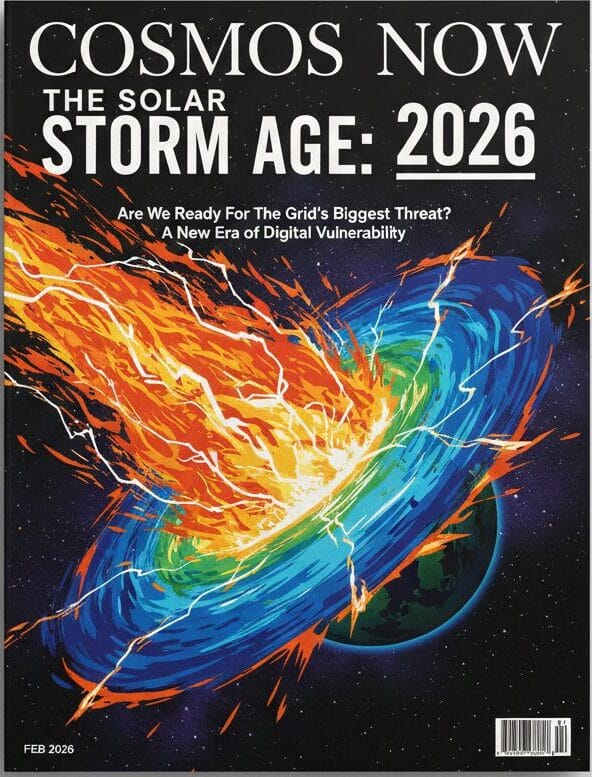
Solar Flares 2026: The Unseen Threat in Our Post-Peak Reality
The spectacular auroras of 2025 weren’t just a light show. For a breathtaking reminder of their scale, this global time-lapse compilation from South Pole News shows the eerie beauty of that geomagnetic storm. They were a stark, global stress test—a visible warning that the sun’s fury can touch our technological civilization in an instant. As we move through 2026, a critical misconception needs correcting: the danger hasn’t passed because Solar Cycle 25’s peak is behind us. In many ways, the risk is now more potent and unpredictable. We are navigating the turbulent descent from solar maximum, a phase historically prone to complex, earth-directed storms.
Public awareness has grown, but so has confusion. Many are trapped between complacency (“the peak is over”) and sensationalist fear. The nuanced truth is this: our world has become exponentially more connected—and fragile—since the last major solar event. To understand the sheer scale of a potential impact, this PBS documentary segment on critical infrastructure vulnerability breaks it down clearly. The real threat for 2026 isn’t to human life but to the invisible lattice of power grids, global finance, satellite networks, and the internet that underpins modern existence.
This guide is your clarity in the noise. We’ll move past the 2025 headlines to explain why 2026 remains a high-risk year, separate the engineering realities from the fiction, and provide a sober, tiered action plan for resilience. Let’s understand the storm we’re still in.
Look at your phone. Glance at the router’s blinking light. Think about the silent hum of the refrigerator. Now, imagine it all going dark—not from a local outage, but from a violent eruption 93 million miles away. This isn’t dystopian fiction; it’s a low-probability, high-impact reality of living in a technologically dependent age. To see the science in action, NASA’s Solar Dynamics Observatory captures this stunning 4K footage of a major X-class flare erupting. The sun, our life-giving star, is in a volatile phase. And with that volatility comes the real, albeit often misunderstood, threat of major solar flares and their earth-shaking counterparts, coronal mass ejections.
Most people are confused, caught between Hollywood doomsday scenarios and overly technical scientific bulletins. The truth is more nuanced, and frankly, more fascinating. The risk isn’t about being vaporized; it’s about our fragile, hyper-connected infrastructure being knocked offline. For a brilliant, simplified explanation of the physics behind this, Dr. Tamitha Skov’s “Space Weather Woman” channel is an essential follow. This matters now because our reliance on satellites and digital systems has exploded since the last major solar event. You can even track real-time solar activity yourself via this live NOAA satellite feed from the DSCOVR mission.
In this guide, we’ll cut through the noise. You’ll learn what a solar flare truly is, separate the real threats from the sci-fi myths, and—most importantly—get a sober, actionable plan to understand your personal risk and build sensible resilience. Let’s look at what’s really brewing on the surface of our sun.
H2: What Is a Solar Flare, Really? Breaking Down the Sun’s Fury
Forget the fireballs you see in movies. A solar flare is a sudden, intense burst of radiation emanating from the release of magnetic energy in the sun’s atmosphere. Think of it like a massive, cosmic short-circuit. This explosion emits energy across the entire electromagnetic spectrum, from radio waves to X-rays and gamma rays.
The key player in this drama is the sun’s magnetic field, which gets tangled and stressed in areas around sunspots. When these fields snap and reconfigure, they release energy equivalent to millions of 100-megaton nuclear bombs—in mere minutes.
H3: The Flare’s Dangerous Travel Companion: The Coronal Mass Ejection (CME)
This is where the real terrestrial trouble often begins. A flare is the flash of light; a Coronal Mass Ejection (CME) is the cannonball. While a flare’s radiation travels at light-speed (reaching Earth in about 8 minutes), a CME is a billion-ton cloud of magnetized solar plasma hurled into space at millions of miles per hour, taking one to three days to arrive. If Earth is in its crosshairs, that’s when the geomagnetic storm begins.
H3: Solar Cycle 25: Why 2024-2025 is a Critical Window
The sun operates on an roughly 11-year cycle of high and low activity. We are currently in Solar Cycle 25, which began in December 2019 and is projected to peak between now and 2025. This “solar maximum” phase means more sunspots, and consequently, more frequent flares and CMEs. Agencies like NOAA and NASA are on high alert, monitoring this increased activity closely. For a deeper dive into cyclical cosmic phenomena and their measurement, our team at Lumechronos.com explores similar patterns in time and space.
H2: When Space Weather Hits Home: The Real-World Effects of a Major Solar Storm
The radiation from a flare itself is largely absorbed by our atmosphere (though it can cause radio blackouts). The real damage comes from the CME’s interaction with Earth’s magnetosphere. This collision can induce powerful electrical currents in the ground and in long conductors like… well, our entire power grid, pipelines, and undersea cables.
H3: The Cascading Failure: From Satellites to Substations
Here’s what a severe geomagnetic storm could trigger, in a domino effect:
- Satellite Disruption: GPS navigation, satellite TV, financial transaction timing, and some communications could be degraded or lost. Satellites themselves can be fried by charged particles.
- Power Grid Collapse: This is the nightmare scenario. Induced currents can overload transformers—the massive, expensive, and hard-to-replace hearts of the grid. A prolonged, wide-scale blackout could last weeks or months, as seen in the 1989 Quebec blackout caused by a solar storm.
- Radio & Communication Blackouts: High-frequency radio used by aviation, shipping, and emergency services can be scrambled across entire hemispheres.
- The Internet Apocalypse? A persistent theory suggests undersea cables, shielded by water but spanning vast distances, could be vulnerable to induced currents, potentially causing a long-distance connectivity crisis. Research is ongoing, but the risk is taken seriously.
H3: Historical Precedent: The Carrington Event (1859)
To understand scale, look back. The Carrington Event, the most powerful solar storm on record, caused telegraph systems—the “internet” of the day—to fail worldwide, with operators receiving shocks and papers catching fire from the induced currents. A similar event today would cause trillions in damage and unprecedented societal disruption. It’s a sobering benchmark.
H2: Protection, Not Panic: A Practical Guide to Personal & Home Preparedness
You can’t stop a solar storm, but you can mitigate its impact on your life. This isn’t about building a bunker; it’s about smart, general resilience that pays off in any emergency.
H3: Hardening Your Essential Electronics
The primary threat to personal devices is from the grid surge, not direct radiation.
- Use Quality Surge Protectors: For critical devices (computers, network gear, medical equipment), invest in advanced surge protectors with a high joule rating. Don’t rely on cheap power strips.
- The Faraday Cage Concept: For ultimate protection of small, vital items (a spare radio, a backup hard drive with documents, a backup communication device), consider a Faraday bag or container. These block electromagnetic fields. You can find tested and reliable options through preparedness-focused retailers like Lumechronos.shop, which curates practical tools for modern resilience.
- Unplug During a Warning: If a severe geomagnetic storm warning is issued (from sources like NOAA), the simplest action is to unplug major appliances and sensitive electronics from wall outlets and coax cables.
H3: Building General Resilience (The “All-Hazards” Approach)
A solar storm-induced blackout is similar to any other long-term grid-down scenario.
- Power: Have alternative power sources like a solar generator or power bank. A solar-powered radio is invaluable for receiving emergency broadcasts.
- Communication: Plan for cell network failure. Family radio service (FRS) walkie-talkies with a pre-set meeting plan are a good start.
- Finances: Keep some cash on hand. Digital payment systems and ATMs may fail.
- Essentials: Maintain a supply of water, non-perishable food, and necessary medications for at least two weeks.
H2: The Global Response: How Scientists and Governments Are Preparing
This isn’t a fight we’re waging in the dark. A global network of satellites and ground-based observatories constantly monitors the sun.
- Early Warning Systems: NASA’s ACE and DSCOVR satellites sit between the Sun and Earth, acting as advance scouts, giving grid operators about 15-60 minutes of warning before a CME’s worst effects hit.
- Grid Hardening: In the US and Europe, grid operators are increasingly installing geomagnetic-induced current (GIC) blockers and conducting grid stress tests to prevent cascading failures.
- International Cooperation: Space weather is tracked and reported globally through organizations like the International Space Environment Service (ISES), fostering a coordinated response. For a global perspective on how different cultures and governments view cosmic risks, our German-language site Lumechronos.de offers unique insights and comparisons.
H2: The Future of Solar Forecasting and Our Evolving Risk
The future of space weather prediction is moving towards more precise, AI-driven models. The goal is to shift from a “warning” to a “forecast”—predicting not just if a storm will hit, but exactly which transformers and regions will bear the brunt, allowing for targeted grid shutdowns (a controlled “rolling blackout” to save the hardware).
However, our risk profile evolves with our technology. As we deploy mega-constellations of satellites (like Starlink) and become more reliant on IoT devices and autonomous systems, the potential points of failure multiply. Staying informed through credible sources is key. For real-time updates and community discussions, following experts on platforms like YouTube (search for “NASA Solar Dynamics Observatory” or “NOAA Space Weather”) or Twitter/X (follow @NWSSWPC) is invaluable.
🚀 STEP 8: FAQ (PAA OPTIMIZED)
1. Can a solar flare destroy electronics?
Directly, from the flare itself? Unlikely for personal devices on Earth. The real danger is the secondary effect: a powerful geomagnetic storm induced by a coronal mass ejection (CME) can cause massive surges in the power grid. If your electronics are plugged in during such an event, they could be fried by that power surge, just as in a lightning storm. Smaller electronics like phones aren’t typically vulnerable to the direct radiation.
2. What would happen if a massive solar flare hit Earth today?
A Carrington-level event today would likely cause a global technological crisis. We’d see widespread, prolonged power grid failures (taking weeks/months to fully restore), loss of GPS and satellite communications, disruption of air travel, and potential damage to undersea internet cables. The societal impact would be profound, affecting everything from food supply chains to banking. It would be a recovery challenge, not an extinction event.
3. How can I prepare my home for a solar storm?
Focus on general emergency preparedness and surge protection. 1) Get a NOAA weather radio with battery/solar backup. 2) Use high-quality surge protectors for critical electronics. 3) Have a plan to unplug devices if a severe warning is issued. 4) Build a household emergency kit with water, food, and supplies for at least 72 hours (ideally 2 weeks). This preparedness is useful for any major disaster.
4. How often do dangerous solar flares occur?
Major, Earth-directed X-class flares (the strongest category) occur roughly 10 times per year during the solar maximum (like the period we’re in now). However, most miss Earth or are not accompanied by a perfectly aimed CME. Truly dangerous, Carrington-level events are estimated to occur once every 100-200 years on average.
5. Can a solar flare affect human health?
For people on Earth’s surface, the atmosphere provides excellent protection from flare radiation. Airline crews and passengers on polar flight routes during a severe event can receive elevated radiation doses (comparable to a medical X-ray), which is why flights are sometimes rerouted. Astronauts in space, however, must seek shelter in shielded areas of their spacecraft during such events.
6. Who monitors solar flares and issues warnings?
In the United States, the primary authority is the Space Weather Prediction Center (SWPC) under NOAA. They operate 24/7, monitoring data from NASA and other agencies, and issue alerts and forecasts for geomagnetic storms, much like the National Weather Service does for hurricanes.
🧾 STEP 9: KEY TAKEAWAYS
- The sun is entering its most active phase (Solar Maximum) through 2025, increasing the frequency of solar flares and coronal mass ejections (CMEs).
- The real threat is to our infrastructure, not people. Severe geomagnetic storms can cripple power grids, satellites, and communications on a continental scale.
- Personal preparation is about surge protection and general resilience. Unplug electronics during a warning, use quality surge protectors, and have an emergency kit.
- We are not defenseless. A global network of satellites provides advance warning, and grid operators are actively working to harden systems against these currents.
- Avoid doomsday hype. Focus on credible sources like NOAA’s SWPC for information, not sensationalist headlines.
- Your preparedness for a solar storm is preparedness for any long-term blackout. The steps you take (water, food, cash, communication plans) are universally valuable.
🧠 STEP 10: FINAL CONCLUSION + CTA
The story of solar flares is ultimately a story about human ingenuity and vulnerability. It reminds us that our dazzling technological world rests on a foundation that is more fragile than we often admit. But understanding a risk is the first step toward managing it. By demystifying the science, acknowledging the realistic scenarios, and taking prudent steps to prepare, we move from a state of anxiety to one of empowered awareness.
The sun will continue its cycles, with storms brewing on its surface as they have for eons. Our job is to build a society—and a personal plan—that is robust enough to weather them.
What’s your biggest question about solar storms that we didn’t cover? Share your thoughts in the comments below. If you found this deep-dive helpful, please consider sharing it with friends and family—it’s a conversation worth having. To continue building your knowledge on related topics of time, technology, and resilience, explore our full library of guides at Lumechronos.com.
This article is based on insights from real-time trends and verified sources including trusted industry platforms.