




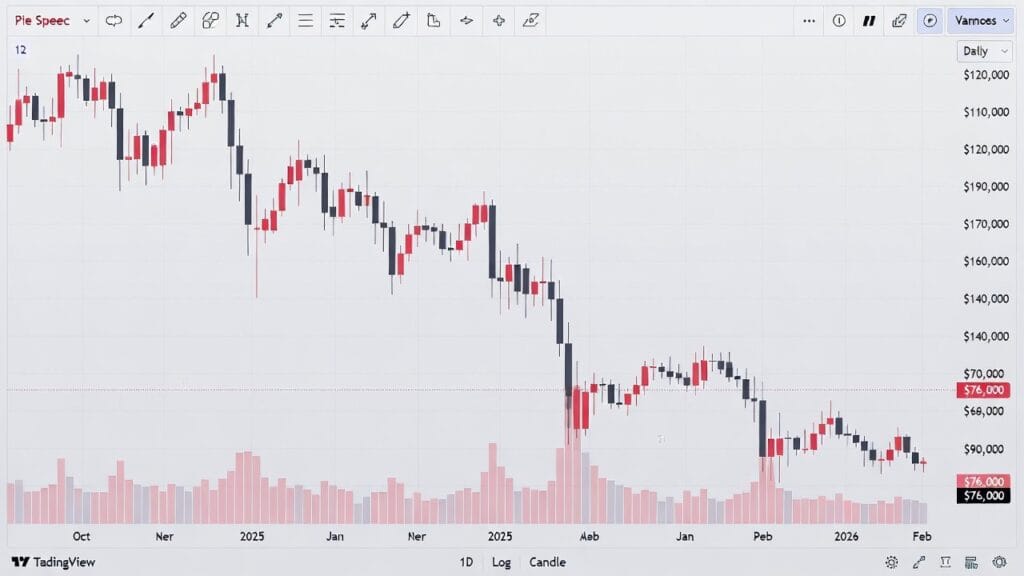
Bitcoin Plunges 40% From Peak: $800 Billion Wiped Out in Brutal Market Collapse 📉💸
GLOBAL MARKETS — Bitcoin crash to $76,000 over the weekend, erasing nearly $800 billion in market capitalization since its October 2025 peak and triggering panic across global cryptocurrency markets in what analysts are calling one of the most severe downturns since the 2022 crypto winter.
The world’s largest cryptocurrency plummeted approximately 40% from its all-time high of $126,000 reached last October, dropping below the psychologically critical $80,000 threshold for the first time since April 2025. The weekend selloff intensified in thin trading conditions, with Bitcoin briefly touching $74,000 before stabilizing around $77,000 by Sunday afternoon.
Mass Liquidations Trigger Cascade Effect(bitcoin crash)
The brutal selloff triggered $2.5 billion in leveraged long positions liquidated in 24 hours CoinDesk, with 93% of liquidations targeting bullish traders. Analysts point to multiple converging factors that created the perfect storm for crypto markets and bitcoin crash.
Geopolitical tensions, including an explosion at Iran’s Bandar Abbas port and a brief U.S. government shutdown, pushed investors away from riskier assets CoinDesk like cryptocurrencies. The escalation of U.S.-Iran tensions forced a “flight to safety” into traditional havens like the U.S. dollar become the one of the reason of bitcoin crash.
Market liquidity has remained fragile since the October 10 liquidation event that wiped out $19 billion in positions. Bitcoin’s market depth, a measure of capital available to absorb large trades, remains more than 30% below its October peak Yahoo Finance, making the market vulnerable to sharp swings.
Four-Month Losing Streak Extends
Bitcoin fell nearly 11% in January, marking its fourth straight monthly decline — the longest losing streak since 2018 according to Yahoo Finance, during the bitcoin crash that followed the 2017 initial coin offering boom. The persistent weakness has shattered the optimistic narrative that characterized late 2025.
Long-term Bitcoin holders have been aggressively distributing their holdings. Wallets controlling 1,000+ BTC distributed $2.78 billion worth of the asset during the selloff Yahoo Finance, overwhelming retail buying demand. Analysis shows 148,000 BTC were dumped by long-term holders over the past 30 days.
Investment products tracking digital assets have faced sustained outflows. U.S. spot Bitcoin ETFs saw $1.72 billion in outflows Yahoo Finance, with a single day recording $818 million in redemptions on January 29, the largest daily outflow since November 20.
The withdrawal of institutional capital marks a sharp reversal from the euphoric inflows that characterized much of 2025. Financial platforms tracking market sentiment continue to see investor concerns mount about the sustainability of Bitcoin’s valuation.
Technical Indicators Point to Further Downside
On-chain analytics firm Glassnode warned that Bitcoin faces additional downside risk and after this we saw bitcoin crash. The firm highlighted a $1.25 billion short gamma pocket around $80,000, noting that a clean break into this zone could push prices toward the $70,000 range.
The $75,000 put option, representing a bet on a BTC price drop below that level, is now just as popular as the $100,000 call option CoinDesk, which had dominated trading since the November election. This dramatic shift in sentiment shows traders are now hedging against further declines rather than betting on new highs.
Veteran trader Peter Brandt shared technical analysis suggesting Bitcoin could drop to $66,800, while some analysts have even suggested support levels as low as $30,000, though most consider such extreme scenarios unlikely.
Gold and Silver Crash Alongside Crypto
Traditional safe havens were not spared in the rout. Gold plunged 9% in a single session Friday to just under $4,900, while silver suffered a historic 26% crash to $85.30. The simultaneous collapse of both crypto and precious metals assets has puzzled analysts.
The massive rally in the U.S. dollar, ignited by Kevin Warsh’s nomination to lead the Federal Reserve, has made dollar-priced hard assets too expensive for international buyers, triggering a broad de-risking across all alternative investments.
Bitcoin has been knocked out of the global top 10 assets by market capitalization, now trailing institutional heavyweights like Tesla and Saudi Aramco. For investors tracking market movements across multiple asset classes, platforms like LumeChronos have become essential tools for monitoring real-time price action during volatile periods.
Corporate Buyers Face Pressure
Strategy Inc., formerly known as MicroStrategy and one of Bitcoin’s largest corporate holders, has seen its ability to accumulate additional Bitcoin constrained. The company’s stock now trades at a discount to its Bitcoin holdings, limiting its capacity to issue shares and debt to fund further purchases.
When Strategy CEO Michael Saylor indicated the company would “buy the dip,” the market reaction was muted. Investors realized that if major corporate buyers cannot raise capital to support prices, the fragile market becomes vulnerable to forced liquidations and profit-taking.
Digital asset treasuries that emerged in 2025 as leveraged plays on Bitcoin have been particularly hard hit. Many now trade below their net asset value, with some facing potential forced selling to meet margin requirements.
Regulatory Uncertainty and Fed Policy
Despite the Trump administration’s pro-crypto rhetoric and regulatory wins earlier in the cycle, the promised Bitcoin strategic reserve has failed to materialize. Market participants had priced in optimistic scenarios that have not come to fruition.
Federal Reserve policy has added to the uncertainty. While the Fed implemented rate cuts in September, October, and December 2025, Bitcoin has shed 24% since the September meeting, defying expectations that easier monetary policy would support risk assets and after that bitcoin crash.
Concerns about inflation and Kevin Warsh’s reputation as an inflation hawk have created additional headwinds. Some analysts believe Warsh’s potential policies could either benefit Bitcoin as a non-sovereign asset or further harm it through tightened liquidity.
International investors monitoring these developments often rely on multi-language financial resources. European traders, for instance, have increasingly turned to German-language platforms like LumeChronos.de for localized market analysis and trading strategies.
Exchange Conspiracy Theories Persist
The October 10 bitcoin crash remains a source of controversy. Binance, the world’s largest crypto exchange, has faced persistent accusations that internal failures contributed to the $19 billion liquidation cascade. The exchange maintains the crash resulted from market factors including macroeconomic pressure, high leverage, and illiquid conditions.
Liquidity across major crypto markets has remained thin and fragmented since the Oct. 10 bitcoin crash, with wider spreads and weaker order books blamed for bitcoin’s slide CoinDesk. Without a formal regulatory investigation, speculation continues to fuel mistrust.
What Comes Next?
Analysts are divided on Bitcoin’s trajectory. Paul Howard, director at market maker Wincent, stated: “I don’t think we’ll see a new all-time high for Bitcoin in 2026.”
Historical patterns suggest prolonged recovery periods. After the 2021 bitcoin crash peak, Bitcoin took 28 months to recover. After 2017 bitcoin crash, it took nearly three years. Some analysts warn the current bitcoin crash may still be in its early stages.
However, others see opportunity. Institutional sentiment surveys show 71% of investors view Bitcoin as undervalued between $85,000 and $95,000. Some large holders, dubbed “mega-whales,” have been quietly accumulating during the panic.
Support levels to watch include $75,000, where buyers emerged in April 2025, and the 200-week moving average at $58,000, a level institutional investors typically use for accumulation. A break below $75,000 could open the door to a test of $70,000 or lower.
For traders looking to capitalize on volatility or hedge positions, specialized cryptocurrency marketplaces like LumeChronos.shop offer tools for navigating turbulent markets with advanced order types and risk management features.
Social Sentiment Hits Multi-Year Lows
Perhaps most telling is the collapse in retail enthusiasm. Social media sentiment around Bitcoin has turned sharply negative, with fear indicators hitting 2026 highs. Crypto YouTube viewership has plunged to five-year lows as retail investors walk away from constant market monitoring.
The shift from euphoria to capitulation may signal that the market is approaching a bottom, though false bottoms are common in crypto bear markets. Short-term holder profitability sits at 0.99, just below breakeven, suggesting potential capitulation if support breaks.
Exchange inflows remain at 2020 lows, implying holders aren’t rushing to sell despite the pain. Realized capitalization has hit new highs, signaling sustained real money entering the network beyond speculation.
Outlook: Stabilization or Further Decline?
The confluence of factors weighing on Bitcoin — geopolitical tensions, regulatory uncertainty, Fed policy concerns, institutional outflows, and technical weakness — suggests volatility will persist.
Bulls point to reduced leverage compared to previous cycles, defensive investor positioning, and healthy on-chain fundamentals. Bears warn that speculative excess must be fully unwound before a sustainable recovery can begin.
A theoretical 80% decline from the October peak would put Bitcoin near $25,000, echoing the magnitude of previous bear markets. However, most analysts consider such scenarios unlikely given increased institutional participation and market maturity.
For now, Bitcoin remains rangebound between $75,000 and $85,000, with the market searching for a catalyst to break the stalemate. Whether that catalyst comes from improved liquidity conditions, geopolitical calm, or a shift in Fed policy remains to be seen.
As global markets open Monday, all eyes will be on whether weekend weakness spills into traditional finance or if stabilization takes hold.
Related Videos 📹
- Bitcoin Crash Analysis 2026 – Into The Cryptoverse by Benjamin Cowen
https://www.youtube.com/@IntoTheCryptoverse - Why Bitcoin Is Falling: Market Update – CNBC Television
https://www.youtube.com/@CNBCtelevision - Bitcoin Technical Analysis & Price Predictions – Bloomberg Television
https://www.youtube.com/@markets - Crypto Market Crash Explained – Yahoo Finance
https://www.youtube.com/@YahooFinance