
It happens the same way every night.
You fall asleep without much trouble. A few hours pass. Then, out of nowhere, your eyes open. The room is dark. The house is silent. You look at your phone.3:04 AM. Again.
Your brain immediately kicks on — replaying something that happened yesterday, worrying about something coming tomorrow, or just spinning with no clear reason at all. You know you need to sleep. You try to force it. But the harder you try, the more awake you feel. By the time you finally drift off, your alarm is an hour away.
If this is a regular part of your life, you are far from alone. More than one in three adults report waking up in the middle of the night at least three times per week. And a huge percentage of those wake-ups cluster around the same time — 2 to 4 AM — so reliably that researchers have specifically studied why.
There are real biological reasons this happens, and there are real things you can do to change it. This article covers both.
Is Waking Up at 3 AM Actually Normal?
Before anything else, let’s clear something up: waking up in the middle of the night is not, by itself, abnormal.
Your brain does not sleep in one long, uninterrupted stretch from the moment your head hits the pillow to when your alarm goes off. Instead, it cycles through repeating stages — light sleep, deep sleep, and REM (rapid eye movement) sleep — in roughly 90 to 110-minute loops. Most adults complete four to six of these cycles each night.
The important thing to understand is that at the end of each cycle, sleep naturally becomes very light. Your brain briefly surfaces toward wakefulness between cycles — and on most nights, you fall right back into the next cycle without ever fully waking up or even remembering it the next morning.
The problem happens when something pulls you across the line from that light, between-cycle moment into full consciousness. And the 2 to 4 AM window is when your brain is most vulnerable to exactly that.
Why 3 AM Specifically? The Science Behind the Timing

This is not a coincidence. Several biological shifts happen specifically during those early morning hours that make waking up at this time far more likely than at, say, midnight or 5 AM.
Your Cortisol Starts Rising
Cortisol is often called the “stress hormone,” but that label undersells it. Cortisol is also your body’s primary waking hormone. It is what gives you energy in the morning, keeps you alert during the day, and helps mobilize your body’s resources.
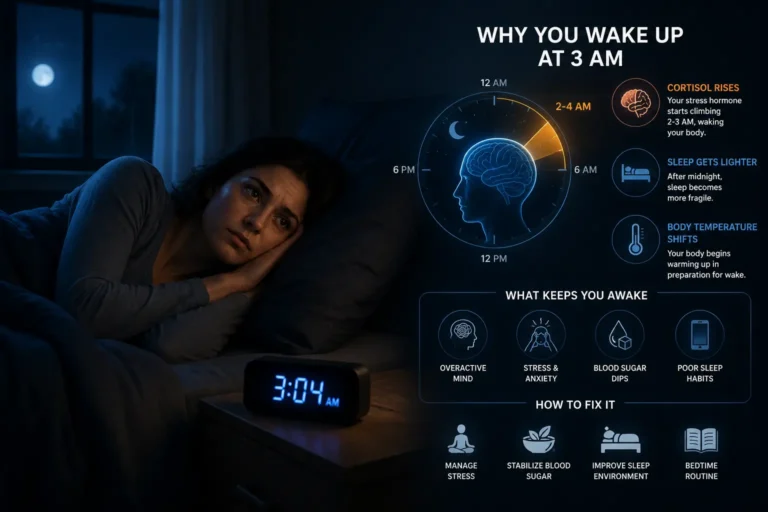
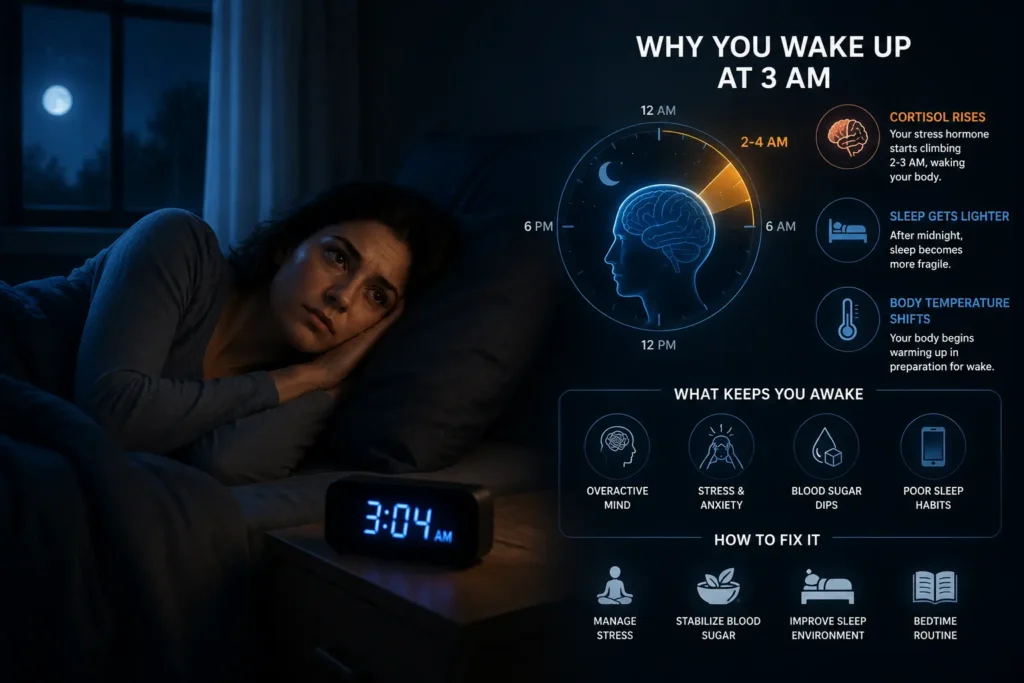
Under healthy conditions, cortisol follows a predictable daily rhythm. It drops to its lowest point around midnight to allow deep, restorative sleep. Then, in the early morning hours — starting around 2 to 3 AM — it begins a gradual climb. By the time you wake up naturally, it has already risen significantly. Within 30 to 45 minutes of opening your eyes, it peaks in what is known as the Cortisol Awakening Response.
This early morning cortisol rise is completely normal. In most people, it is gentle enough that they sleep right through it. But when your nervous system is already stressed, overtaxed, or running in a chronic state of high alert, that same gentle cortisol rise can feel like a jolt. Your body interprets the hormonal shift as an emergency signal. Your heart rate picks up. Your mind switches on. You are awake before you had any intention of being.
People under chronic stress, anxiety, or prolonged poor sleep tend to show an earlier and steeper cortisol rise than people who are well-rested and calm. Which means if you are stressed, the exact biological process designed to wake you up gently is instead waking you up hard — and hours too early.
Your Sleep Gets Lighter After Midnight
Deep sleep — the most restorative stage — happens mostly in the first half of the night. By around 3 AM, you have already had most of your deep sleep for the evening. The second half of the night is dominated by lighter sleep and more REM cycles.
This matters because lighter sleep means smaller disruptions can pull you into full wakefulness. A noise that your body would have slept through at 11 PM becomes enough to fully wake you at 3 AM. A worry that would have stayed buried at midnight surfaces clearly at 3 AM. Your body’s defenses against waking up are simply lower during these hours.
Your Core Body Temperature Is Shifting
Your body temperature follows its own daily rhythm. It drops during the early part of the night to facilitate deep sleep, reaches its lowest point around 2 to 4 AM, and then begins rising again in preparation for waking.
This temperature shift is another biological process that — when combined with elevated cortisol or external disruptions — can contribute to early morning waking. Any interference with your body’s temperature regulation during this vulnerable window, whether from a bedroom that’s too warm, alcohol in your system disrupting your thermoregulation, or your own stress hormones keeping your body warmer than it should be, makes waking up far more likely.
The Real Reasons You Can’t Fall Back Asleep
Waking up is one problem. But for many people, what makes 3 AM genuinely miserable is not the waking itself — it is the hour or two of lying awake afterward, unable to get back to sleep.
Here is why that happens, and why it is so hard to break.
Your Brain Has No Distractions At Night
During the day, your attention is constantly occupied. Work tasks, conversations, decisions, scrolling — there is always something pulling your focus outward. This constant external stimulation acts as a natural buffer against anxious thoughts, quietly keeping them from taking hold.
At 3 AM, the buffer is gone. The house is silent. There is nothing to look at, nothing to do. And your brain — specifically the Default Mode Network, which activates during rest — has a completely open space to fill. It fills it with exactly what you pushed aside all day. Unresolved worries. Worst-case scenarios. Conversations that went badly. Things you need to do tomorrow.
Psychologist Greg Murray, who has studied this specifically, notes that nighttime overthinking is particularly aggressive because we know there is nothing we can actually do to solve our problems at that hour. During the day, worry at least comes with the possibility of action. At 3 AM, all we can do is sit with the discomfort — which is exactly what makes it feel so much worse.
If this kind of anxious overthinking is something you deal with beyond just 3 AM wake-ups, it is worth understanding the deeper pattern. The same anxiety that shows up in the middle of the night often shows up throughout the day in quieter ways — and the connection between anxiety and disrupted sleep runs deeper than most people realize.
Alcohol Is Betraying You in the Second Half of the Night
Alcohol is one of the most common — and most misunderstood — contributors to 3 AM waking.
A drink or two in the evening genuinely does help most people fall asleep faster. Alcohol is a depressant, and it temporarily suppresses the nervous system in a way that makes drifting off feel easier. This is why so many people reach for it as an evening wind-down.
But here is what happens a few hours later. As your body metabolizes the alcohol, it produces a rebound effect — your nervous system swings in the other direction and becomes more active than it was before you drank. This rebound typically hits three to four hours after your last drink, which, depending on when you went to bed, lands right around 2 to 4 AM.
The result is fragmented sleep in the second half of the night, lighter and more restless REM cycles, and early morning waking that many people never connect back to the glass of wine they had with dinner.
Your Blood Sugar Dropped During the Night
This one often comes as a surprise, but it is a well-documented trigger for early morning waking.
Your brain requires a constant supply of glucose to function, even during sleep. If your blood sugar drops too low in the middle of the night — which can happen if you ate a light dinner, consumed a lot of sugar earlier in the evening, or have any degree of insulin sensitivity — your body treats it as a threat.
The response is automatic: your adrenal glands release cortisol and adrenaline to raise your blood sugar back up. This surge of stress hormones is exactly what pulls you out of sleep. You wake up, sometimes feeling your heart pounding, often with your mind already racing, and no idea that the whole thing started with your glucose levels dropping.
Stress and Anxiety Are Keeping Your System On High Alert
When you are dealing with prolonged stress — whether from work, relationships, finances, or anything else chronic — your body’s threat detection system runs at a higher baseline level than it should.
The HPA axis, which is the communication chain between your brain and adrenal glands that controls cortisol release, becomes sensitized under chronic stress. It starts responding to smaller and smaller signals as if they were major threats. A routine cortisol rise at 3 AM that a well-rested person sleeps right through can feel, to an overstimulated nervous system, like an alarm going off.
This is a particularly cruel cycle. Poor sleep makes stress worse. More stress makes sleep worse. And the 3 AM wake-up sits right in the middle of that loop, getting fed by both sides.
If financial pressure is part of what is driving your stress, it is worth knowing that money worry and sleep disruption are directly connected in ways that are well documented. The impact of financial stress on your health goes far beyond just worrying about bills — it physically changes how your nervous system operates at night, making 3 AM wake-ups significantly more common among people dealing with economic pressure.
Digital Burnout Is Quietly Draining Your Sleep Reserves
There is a specific kind of exhaustion that builds up from being constantly connected, constantly responsive, and constantly stimulated — and it hits your sleep quality in ways that people often don’t recognize until they take a real break.
Overstimulation from screens, notifications, and the relentless pace of modern information consumption keeps your nervous system in a low-level activated state even when you’re technically at rest. That background hum of alertness makes the 3 AM cortisol rise land much harder than it would in a genuinely rested, calm system.
If you feel perpetually drained despite sleeping a reasonable amount, and 3 AM waking is a regular part of your nights, digital burnout may be one of the contributing factors you haven’t considered yet.
How to Actually Fix Waking Up at 3 AM
Understanding why it happens is useful. But what you actually want is to sleep through the night. Here is what the research supports.
1. Get Your Bedtime Consistent — Even on Weekends
Your cortisol rhythm is tightly linked to your circadian clock. When you go to bed and wake up at unpredictable times, your body can never stabilize its hormonal schedule. The early morning cortisol rise ends up firing at irregular times — which makes waking up at different points in the night far more likely.
Pick a consistent bedtime. Pick a consistent wake time. Hold both, even on weekends. Within two to three weeks, your body’s cortisol rhythm starts syncing to your schedule — and the 3 AM surge becomes a gentler process your sleeping brain can stay in rather than be jolted out of.
2. Eat Something Small Before Bed If You Wake Up Hungry
If blood sugar drops are contributing to your 3 AM waking, the fix is straightforward: a small, protein-and-fat snack an hour before bed. Half a banana with almond butter, a handful of nuts, or a small amount of Greek yogurt can provide a slow, sustained glucose release through the night that prevents your body from triggering that cortisol surge.
This is not about eating a full meal. It is about preventing the blood sugar crash that sends your adrenal glands into emergency mode at 3 AM.
3. Cut Alcohol Out of Your Evenings (Or Move It Earlier)
If you drink in the evening and frequently wake up between 2 and 4 AM feeling anxious or restless, this is the most likely cause. The rebound effect from alcohol metabolism is one of the most common — and most reversible — causes of early morning waking.
Try going alcohol-free for two weeks and track whether your 3 AM wake-ups decrease. Most people who do this are genuinely surprised by the results. If cutting it out completely is not realistic, moving your last drink to earlier in the evening — before 7 PM — gives your body more time to metabolize it before the vulnerable 3 AM window arrives.
4. Wind Down Your Nervous System Before Bed
The state your nervous system is in when you fall asleep matters enormously for whether you can stay asleep. A nervous system that is still activated and alert when you go to bed will have a lower threshold for waking during the night.
In the hour before bed, deliberately lower stimulation. Dim your lights. Put your phone in another room. Avoid news and social media. Do something that actively lowers your nervous system’s arousal level — light stretching, slow reading, journaling, or just sitting quietly with a cup of herbal tea.
The goal is not to tire yourself out. It is to arrive at sleep in a calm state rather than a wired one.
5. Do Not Lie In Bed Awake and Frustrated
If you wake at 3 AM and cannot fall back asleep within 20 to 25 minutes, get out of bed. This is counterintuitive, but it is one of the most well-supported recommendations in sleep science.
Every time you lie in bed awake and frustrated, you are training your brain to associate your bed with alertness and anxiety rather than rest. Over time, the bed itself becomes a trigger for wakefulness. Getting up breaks that association. Sit somewhere quiet and dim. Do not check your phone. Read something calm or just sit still until you genuinely feel sleepy — then return to bed.
6. Process Your Worries Before You Sleep, Not At 3 AM
Your brain will find a time to work through unresolved stress. If you do not give it a structured opportunity during the day or early evening, it will take the 3 AM wake-up as its chance.
Journaling before bed — even five minutes of writing out what is on your mind, what you are worried about, and what you plan to do about it tomorrow — gives your brain permission to let those thoughts rest. Research consistently shows this reduces both the frequency of nighttime awakenings and the duration of the rumination that follows when waking does occur.
The deeper pattern behind this kind of nighttime mental activity, where your brain uses the quiet of night to process everything it set aside during the day, is something that affects far more than just your sleep. If overthinking is a consistent feature of your nights, exploring why your brain does this and what you can do to interrupt the pattern makes a real difference. The mental health and sleep category at Lume Chronos covers this in depth across several articles.
7. Get Morning Sunlight as Early as Possible
This one sounds like it has nothing to do with waking up at 3 AM. But it is actually one of the most powerful anchors for your entire circadian rhythm.
Your cortisol rhythm is regulated in part by light signals — specifically, bright natural light in the morning. Getting outside within the first hour of waking, even for ten minutes, sends a strong signal to your internal clock that establishes when your cortisol should peak and, by extension, when it should start its night-time decline.
People who consistently get morning light show more stable cortisol rhythms, fall asleep faster, and wake up in the middle of the night less frequently. It is one of the cheapest and most effective sleep interventions available — and almost nobody does it deliberately.
8. Lower Your Overall Stress Load During the Day
This feels like vague advice, but it is grounded in direct physiology. The baseline level of cortisol your body carries into the night determines how sensitive your system will be to the natural 3 AM rise. High daytime stress means high baseline cortisol. High baseline cortisol means a steeper, earlier morning rise. Steeper, earlier rise means 3 AM wake-ups.
Anything you do to genuinely reduce your chronic stress load has a direct positive effect on your sleep architecture. Exercise is one of the most effective — it metabolizes stress hormones directly. Regular time outside, connection with people you trust, creative activities, and moments of genuine rest during the day all reduce the cortisol load your body carries into sleep.
When 3 AM Waking Might Signal Something More
For most people, consistent 3 AM wake-ups are driven by the lifestyle and physiological factors covered above. But sometimes frequent early morning waking is a sign of something that deserves direct attention.
Depression is closely linked to early morning awakening — it is actually one of the hallmark symptoms. People experiencing a depressive episode frequently wake one to two hours earlier than intended and cannot return to sleep. This is different from general insomnia and tends to be accompanied by persistent low mood, loss of interest in things, and a feeling of heaviness that does not lift. If this sounds like what you are experiencing, speaking with a healthcare provider or mental health professional is important. Understanding how depression affects sleep and daily life — and what actually helps — is a meaningful starting point.
Sleep apnea is another common and frequently missed cause. People with obstructive sleep apnea experience repeated breathing disruptions throughout the night, which can cause awakenings they often do not connect to the breathing issue. If you wake up feeling unrefreshed, snore, or your partner has noticed you stopping breathing during sleep, it is worth discussing with a doctor.
Hormonal changes — particularly during menopause — can cause significant sleep disruption including early morning waking, night sweats, and hot flashes that pull people out of sleep repeatedly.
If your 3 AM wake-ups have persisted for more than three months, happen most nights, and are significantly affecting how you function during the day, these are signals worth discussing with a healthcare provider rather than managing entirely on your own.
What To Do Right Now At 3 AM
If you are reading this at 3 AM because you just woke up and cannot sleep — here is what to do right now:
Do not pick up your phone and start scrolling. The blue light suppresses melatonin and the stimulating content activates your nervous system, making sleep much harder.
Do not start mentally reviewing your problems. This sounds obvious, but it takes conscious effort. When a worry surfaces, imagine placing it in a box and putting the box on a shelf. You will open it tomorrow. Right now is not the time.
Breathe slowly and deliberately. Inhale for four counts, hold for seven, exhale for eight. Do this three or four times. It directly activates your parasympathetic nervous system — the part responsible for calming your body down.
Ground yourself in the physical present. Notice the weight of your blanket. Notice the temperature of the air. Notice the sounds around you. This pulls your attention out of the thought spiral and into the moment, which is the only place sleep can actually find you.
If twenty minutes pass and sleep has not returned, get up. Sit somewhere calm and dimly lit. Stay there until you feel genuinely sleepy. Then go back to bed.
Final Thoughts
Waking up at 3 AM every night is not random, and it is not a flaw in your character. It is the intersection of your body’s natural biological rhythms with the specific pressures — stress, hormones, lifestyle habits, unprocessed worry — that your nervous system is carrying into the night.
The good news is that most of the causes are modifiable. Consistent sleep timing, stress reduction during the day, alcohol adjustments, morning light exposure, and smarter bedtime habits can all shift the pattern within weeks for most people.
You do not have to make all the changes at once. Pick one. Starting tonight. Let the results show you what else to try.
The goal is simple: you should be able to fall asleep, stay asleep, and wake up feeling like you actually rested. For most people, that is genuinely achievable — even if it does not feel that way at 3 AM right now.
Frequently Asked Questions
Is waking up at 3 AM every night a sign of anxiety?
It can be. Anxiety keeps your nervous system in a heightened state, which makes the natural cortisol rise at 3 AM feel much more intense than it should. When your baseline stress level is high, even a small hormonal shift can pull you into full wakefulness. If your 3 AM wake-ups come with racing thoughts, a pounding heart, or a sense of dread that you cannot explain, anxiety is very likely involved. This does not mean something is seriously wrong — but it does mean the anxiety deserves attention during your waking hours, not just at 3 AM.
Why do I wake up at 3 AM with a racing heart?
A racing heart at 3 AM is usually triggered by a cortisol and adrenaline surge. This can happen when your blood sugar drops during the night, when your stress levels are chronically elevated, or when your HPA axis — the system that regulates your stress hormones — has become oversensitized from prolonged anxiety or poor sleep. The body interprets the normal early morning cortisol rise as an emergency signal and responds accordingly. It feels alarming, but it is rarely dangerous. However, if racing heart episodes are frequent or severe, it is worth mentioning to your doctor.
Can alcohol cause you to wake up at 3 AM?
Yes — and it does so very reliably. Alcohol helps you fall asleep faster but disrupts the second half of the night. As your body metabolizes it, your nervous system rebounds into a more activated state, which typically hits around three to four hours after your last drink. If you drink in the evening and regularly wake up between 2 and 4 AM feeling restless or anxious, alcohol is almost certainly part of the reason.
Why do I wake up at 3 AM and cannot go back to sleep?
This usually comes down to two things working together. First, your cortisol is already beginning its morning rise, making your body slightly more alert than it was earlier in the night. Second, the quiet of 3 AM removes all the daytime distractions that normally keep anxious thoughts at bay — so the moment you surface into wakefulness, your mind has nowhere to go except into worry. The combination of a biologically lighter sleep stage and a brain with no distractions makes falling back asleep genuinely difficult, especially if you start to feel frustrated about being awake.
Does waking up at 3 AM mean I am depressed?
Early morning awakening is one of the recognized symptoms of depression, but waking up at 3 AM alone does not mean you are depressed. Many people wake at this time due to stress, cortisol disruption, or lifestyle factors with no connection to depression. What separates depression-related early waking from other causes is the accompanying mood — persistent sadness, loss of interest in things you used to enjoy, a heavy or hopeless feeling that is present even when you are not particularly tired. If your 3 AM waking comes with those emotional symptoms consistently, it is worth speaking with a mental health professional.
How long does it take to stop waking up at 3 AM?
Most people see noticeable improvement within two to three weeks of consistently applying the right changes — particularly if they address the biggest contributors like alcohol, sleep schedule irregularity, and high daytime stress. If the wake-ups are tied to deeper anxiety or depression, improvement may be more gradual and may benefit from professional support. The key is consistency: small habits done every day are far more effective than dramatic changes done occasionally.
What should I do immediately when I wake up at 3 AM?
Do not reach for your phone. Take slow, deliberate breaths — try the 4-7-8 method. Ground yourself in physical sensations rather than thoughts. If sleep does not return within 20 to 25 minutes, get out of bed and sit somewhere quiet and dim until you feel genuinely sleepy. Avoid anything stimulating — no screens, no news, no problem-solving. The goal is to stay calm and give your nervous system the signal that it is still nighttime and rest is still available.
Struggling with sleep and stress together? Explore our full Health and Sleep section at Lume Chronos for more research-backed guides on building better nights and calmer days.