




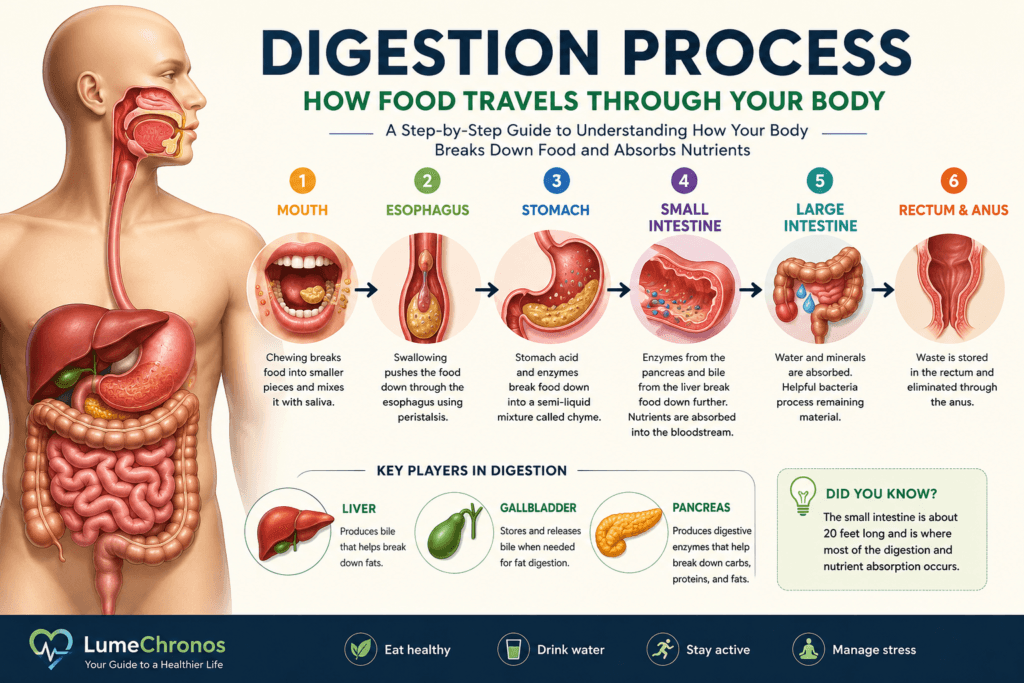
Have you ever wondered what happens to food after you take your first bite? The digestion process is a complex series of mechanical and chemical actions that breaks food into smaller nutrients your body can absorb and use for energy, growth, and repair. Digestion begins in the mouth and continues through the stomach and intestines before undigested waste is eliminated.
In this guide, we’ll explain the digestion process step by step, including what happens in each digestive organ, how carbohydrates, proteins, and fats are broken down, and how nutrients are absorbed into the body.
What Is the Digestion Process?
The digestion process is the way your body breaks food down into smaller substances that can be absorbed and used by the body.
Digestion involves two main types of breakdown:
- Mechanical digestion: Physically breaking food into smaller pieces through chewing and muscular movements.
- Chemical digestion: Using enzymes, stomach acid, bile, and other digestive substances to break large food molecules into smaller molecules.
The digestive process can be divided into four major stages:
- Ingestion
- Digestion
- Absorption
- Elimination
Although these stages sound simple, several organs work together to complete them.
What Are the 4 Main Steps of Digestion?
1. Ingestion
Ingestion begins when you put food or drink into your mouth.
Your teeth break food into smaller pieces while your tongue helps move it around. Saliva begins mixing with the food and starts the digestion of certain carbohydrates.
The partially digested food is then formed into a soft mass called a bolus, which can be swallowed.
2. Digestion
After swallowing, food travels through the digestive tract, where it is mechanically and chemically broken down.
The stomach mixes food with digestive fluids, while enzymes produced by different digestive organs help break down carbohydrates, proteins, and fats.
3. Absorption
Once food has been broken down into small molecules, nutrients can be absorbed.
Most nutrient absorption takes place in the small intestine. Nutrients such as glucose, amino acids, vitamins, minerals, and components of fats pass through the intestinal lining and enter circulation or other transport systems.
4. Elimination
Not everything you eat can be absorbed.
Undigested material moves into the large intestine, where water and electrolytes are absorbed. The remaining material becomes stool and is eventually eliminated from the body.
Digestion Process Step by Step
1. Mouth: Where Digestion Begins
The mouth is the first major stop in the digestive process.
When you eat, your teeth mechanically break food into smaller pieces. This increases the surface area available for digestive enzymes.
At the same time, salivary glands release saliva. Saliva moistens food and contains enzymes that begin breaking down starch.
Your tongue then mixes the food with saliva and helps push the bolus toward the throat for swallowing.
What happens in the mouth?
- Teeth chew food.
- Saliva moistens food.
- Salivary enzymes begin carbohydrate digestion.
- The tongue forms and moves the bolus.
- Swallowing sends food toward the esophagus.
2. Esophagus: Moving Food to the Stomach
After swallowing, the bolus enters the esophagus.
The esophagus is a muscular tube that connects the throat to the stomach. It does not perform most of the chemical digestion itself. Instead, muscles in its walls contract in coordinated waves called peristalsis.
Peristalsis pushes food toward the stomach.
A muscular valve at the lower end of the esophagus helps control the movement of food into the stomach.
3. Stomach: Acid and Enzymes Break Food Down
The stomach acts as both a storage chamber and a digestive organ.
When food enters the stomach, muscles in the stomach wall contract and mix the food with gastric secretions.
The stomach produces acid and digestive enzymes that help break down food, particularly proteins.
One important enzyme is pepsin, which begins breaking proteins into smaller fragments.
The stomach’s muscular contractions also turn the food into a thick, semi-liquid mixture called chyme.
What happens in the stomach?
- Food is stored temporarily.
- Muscular contractions mix the food.
- Stomach acid creates a highly acidic environment.
- Enzymes begin protein digestion.
- Food is gradually released into the small intestine.
The stomach does not complete digestion by itself. Much of the digestive and absorptive work continues in the small intestine.
4. Small Intestine: Where Most Digestion and Absorption Occur
The small intestine is one of the most important parts of the digestive system.
When chyme leaves the stomach, it enters the first part of the small intestine, called the duodenum.
Here, digestive secretions from the pancreas and bile from the liver and gallbladder help continue digestion.
The pancreas produces several digestive enzymes. Bile helps the body process dietary fats by breaking large fat droplets into smaller ones, making them easier for digestive enzymes to act on.
As digestion continues, carbohydrates, proteins, and fats are broken down into smaller molecules.
Nutrient absorption
The lining of the small intestine contains numerous tiny structures called villi, with even smaller projections known as microvilli.
Together, these structures greatly increase the surface area available for absorption.
Nutrients can then move through the intestinal lining and enter the body’s transport systems.
This is why the small intestine plays such an important role in both digestion and nutrient absorption.
5. Large Intestine: Water and Waste
After most nutrients have been absorbed, the remaining material moves into the large intestine.
The large intestine includes the colon and other sections of the lower digestive tract.
One of its important functions is absorbing water and electrolytes from the remaining material.
The large intestine is also home to many microorganisms that interact with undigested components of food, including certain types of dietary fiber.
As water is removed, the remaining material becomes more solid and eventually forms stool.
6. Rectum and Anus: Elimination
The final stage of the digestive process is elimination.
Stool is stored temporarily in the rectum. When the body is ready to remove it, stool passes through the anus.
This completes the journey of food through the digestive tract.
How Are Carbohydrates, Proteins, and Fats Digested?
Different nutrients require different digestive processes.
| Nutrient | Where digestion occurs | What it becomes |
|---|---|---|
| Carbohydrates | Mouth and small intestine | Simple sugars |
| Proteins | Stomach and small intestine | Amino acids and smaller peptides |
| Fats | Mainly small intestine | Fatty acids and other smaller components |
Carbohydrate Digestion
Carbohydrate digestion begins in the mouth when salivary enzymes start breaking down starch.
Digestion continues in the small intestine, where pancreatic and intestinal enzymes further break carbohydrates into smaller sugars that can be absorbed.
One important final product is glucose, which the body can use as an energy source.
Protein Digestion
Protein digestion begins primarily in the stomach.
Stomach acid helps create the appropriate environment for protein-digesting enzymes such as pepsin.
Protein digestion continues in the small intestine with enzymes produced by the pancreas and intestinal lining.
Eventually, proteins are broken down into amino acids and smaller molecules that can be absorbed.
Fat Digestion
Most fat digestion takes place in the small intestine.
Bile released into the small intestine helps disperse dietary fats into smaller droplets. Pancreatic enzymes then break fats into smaller components that can be processed and absorbed.
Fat digestion and absorption are closely connected with the function of bile, the pancreas, and the small intestine.
What Do the Liver, Gallbladder, and Pancreas Do?
The digestive system includes organs that help digestion even though food does not travel directly through them.
Liver
The liver produces bile, which is important for the digestion and absorption of dietary fats.
The liver also performs many other functions involved in metabolism and processing substances absorbed from the digestive tract.
Gallbladder
The gallbladder stores and concentrates bile produced by the liver.
When needed, bile is released into the small intestine to help with fat digestion.
Pancreas
The pancreas produces digestive enzymes that enter the small intestine.
These enzymes help digest carbohydrates, proteins, and fats.
The pancreas also produces bicarbonate, which helps neutralize acidic material arriving from the stomach.
Mechanical vs. Chemical Digestion
Mechanical and chemical digestion work together.
| Mechanical Digestion | Chemical Digestion |
|---|---|
| Breaks food physically | Breaks molecules down chemically |
| Begins with chewing | Begins with digestive enzymes in the mouth |
| Uses muscular contractions | Uses enzymes, acid, bile, and other secretions |
| Helps increase food surface area | Produces smaller molecules that can be absorbed |
For example, chewing an apple is mechanical digestion. The chemical breakdown of carbohydrates in the apple by digestive enzymes is chemical digestion.
How Long Does the Digestion Process Take?
There is no single exact amount of time that digestion takes for everyone.
Food moves through different parts of the digestive tract at different speeds, and the overall process can vary depending on factors such as the type and amount of food, fiber content, hydration, and individual digestive function.
It is also important to distinguish digestion from total gastrointestinal transit.
Digestion refers to breaking food down and preparing nutrients for absorption, while gastrointestinal transit refers to the movement of material through the entire digestive tract.
Therefore, saying that every meal takes exactly a certain number of hours to digest can be misleading.
Where Does Digestion Begin?
Digestion begins in the mouth.
Chewing physically breaks food into smaller pieces, while saliva begins the chemical digestion of starch.
However, digestion is not completed in the mouth. Food continues through the esophagus into the stomach and then the small intestine, where further digestion and nutrient absorption occur.
Where Does Most Digestion Occur?
A large portion of chemical digestion occurs in the small intestine, particularly with the help of pancreatic enzymes and bile.
The small intestine is also the main site for absorption of many nutrients.
The stomach contributes significantly to digestion, especially protein digestion, while the large intestine has important roles in water absorption and processing undigested material.
What Happens to Food After You Eat It?
The journey can be summarized like this:
Food → Mouth → Esophagus → Stomach → Small Intestine → Large Intestine → Rectum → Anus
During this journey:
- Food is chewed and mixed with saliva.
- It travels through the esophagus.
- The stomach mixes it with acid and enzymes.
- The small intestine completes much of the chemical digestion.
- Nutrients are absorbed.
- The large intestine absorbs water and processes remaining material.
- Waste is stored and eventually eliminated.
Digestion Process: A Simple Example
Imagine you eat a meal containing rice, chicken, vegetables, and some healthy fat.
First, your teeth chew the food and saliva begins working on carbohydrates.
The food then travels through the esophagus and reaches the stomach. The stomach mixes the meal with acid and enzymes, beginning substantial protein digestion.
The partially digested meal moves into the small intestine. Here, pancreatic enzymes continue breaking down carbohydrates and proteins, while bile helps with fat digestion.
The resulting nutrients are absorbed through the small intestine.
The material that cannot be digested or absorbed continues into the large intestine. Water is removed, and the remaining waste eventually leaves the body.
This entire process allows your body to obtain nutrients from the food you eat.
Frequently Asked Questions About the Digestion Process
What is the digestion process?
The digestion process is the mechanical and chemical breakdown of food into smaller nutrients that can be absorbed and used by the body.
Where does digestion begin?
Digestion begins in the mouth. Chewing breaks food apart mechanically, while saliva begins the chemical digestion of starch.
What happens to food in the stomach?
The stomach stores and mixes food with gastric secretions. Acid and enzymes help break down food, especially proteins, and turn the contents into a semi-liquid mixture called chyme.
Where does most nutrient absorption occur?
Most nutrient absorption occurs in the small intestine, whose specialized lining provides a large surface area for absorbing nutrients.
What is the role of the pancreas in digestion?
The pancreas produces digestive enzymes that help break down carbohydrates, proteins, and fats. It also releases bicarbonate into the small intestine to help neutralize stomach acid.
What does bile do during digestion?
Bile helps disperse dietary fats into smaller droplets, making them easier for digestive enzymes to act upon.
How long does digestion take?
Digestion and gastrointestinal transit do not have one fixed duration. The time varies between individuals and depends on the food consumed and other factors.
What happens to undigested food?
Undigested material moves into the large intestine. Water and electrolytes are absorbed, and the remaining material eventually becomes stool and is eliminated.
Key Takeaway
The digestion process is a coordinated journey that begins in the mouth and continues through the stomach and intestines. Mechanical actions break food into smaller pieces, while acids, bile, and enzymes chemically break nutrients down into forms the body can absorb.
The small intestine plays a particularly important role because it completes much of the digestion and absorbs many of the resulting nutrients. The large intestine then helps recover water and prepares undigested material for elimination.
Understanding this process makes it easier to see how the digestive organs work together to turn the food you eat into nutrients your body can use.
Important: This article is for general educational purposes and is not a substitute for professional medical advice. If you have persistent digestive symptoms or concerns about your digestive health, speak with a qualified healthcare professional.