


Last updated: September 2026
If a letter, text, or email mentioning a “State Farm dividend” has shown up in your world recently, you’re not imagining things. State Farm Mutual Automobile Insurance Company is in the middle of handing back a record $5 billion in cash to auto insurance customers — and a lot of people are trying to figure out where they stand.
Quick answer: you’re generally eligible for a State Farm dividend payment if you had an active State Farm Mutual personal auto policy at any point during 2025. No application is required, the average payout is around $100 per insured vehicle, and payments are rolling out automatically in waves through the second half of 2026. Below is the full breakdown of State Farm dividend eligibility for 2025 — who qualifies, how much you might get, when it arrives, and how to tell a real notice from a scam.
What Is the State Farm $5 Billion Dividend?
State Farm announced the dividend on February 26, 2026, calling it the largest policyholder payout in the company’s more than 100-year history. The move came after a strong year for the company’s auto insurance business: State Farm reported an underwriting gain of roughly $1.5 billion for 2025, a sharp turnaround after several years of underwriting losses across the industry, driven mainly by fewer collisions and lower repair costs.
Because State Farm Mutual is a mutual company rather than a publicly traded one, it doesn’t answer to outside shareholders. Instead of holding onto extra profit or paying it out as stock dividends, a mutual insurer can return surplus earnings directly to the customers who are, in effect, its owners. State Farm Mutual President and CEO Jon Farney framed the payout as a direct result of that structure, saying the company’s financial strength gave it room to put a strong year’s results to work for the customers it serves, in the form of both lower rates and cash back.
The dividend isn’t happening in isolation, either. Alongside the payout, State Farm has cut auto insurance rates by an average of about 10% across 40 states, a combined savings the company estimates at $4.6 billion a year — separate from the one-time dividend itself.
State Farm Dividend Eligibility 2025: Who Qualifies
This is the part most people searching for State Farm dividend eligibility actually want answered. Here’s how State Farm has defined it.
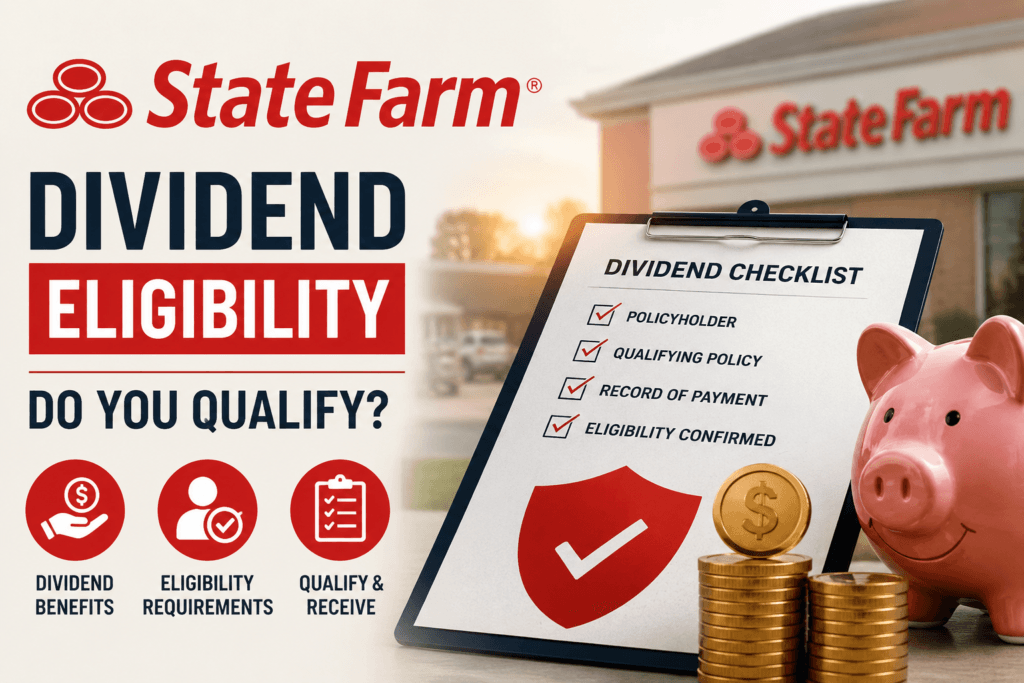
You’re likely eligible if:
- You held an active State Farm Mutual private passenger (personal) auto policy at any point between January 1 and December 31, 2025 — even briefly
- Your calculated dividend amount comes out to roughly $10 or more
- You’ve since switched insurers, moved, or canceled your policy — coverage sometime in 2025 is what matters, not whether you’re still a customer today
- You were insured through one of State Farm’s regional auto underwriting companies, including State Farm Indemnity Company, State Farm Fire and Casualty Company, State Farm General Insurance Company, State Farm Florida Insurance Company, State Farm Lloyds, or State Farm County Mutual Insurance Company of Texas — not only policies written under the “State Farm Mutual” name itself
- You have multiple insured vehicles on one or more qualifying policies — each is calculated and paid separately, so you may receive more than one notification
You likely don’t qualify if:
- Your only State Farm coverage was homeowners, renters, life, or health insurance — this dividend applies to personal auto policies only
- Your auto coverage was written through a state-assigned risk plan rather than a standard State Farm Mutual policy
- Your calculated dividend falls under State Farm’s roughly $10 minimum for issuing a payment
If you’re unsure which category you fall into, your State Farm agent or the dedicated dividend line can confirm your specific status faster than guessing from the general rules above.
How Much Will Your State Farm Dividend Be?
There’s no flat check amount. Instead, each payment is calculated as a percentage of the premium you paid on a qualifying 2025 policy, and that percentage is set state by state based on how much that state contributed to State Farm’s overall 2025 underwriting results.
Nationally, State Farm has said individual payments will fall somewhere between 4% and 10% of 2025 premium, averaging out to about $100 per insured vehicle. But “average” hides a lot of variation, as a few real state examples show:
| State | Reported Rate | Approx. Average Payment |
|---|---|---|
| Georgia | 8% of premium | ~$135 per vehicle |
| Nevada | Varies by policy | ~$66 per vehicle |
| Nationwide | 4%–10% of premium | ~$100 per vehicle |
Georgia’s insurance commissioner confirmed the state’s payout will total nearly $279 million across the state, reflecting an 8% return on premium for drivers with a preferred voluntary auto policy in force at the end of 2025. Louisiana, where State Farm insures close to a third of all drivers, is expecting a statewide total near $136 million. Your own number depends entirely on your state and what you paid in premium — there’s no single “correct” figure to expect.
When Will You Get Paid?
State Farm began notifying qualifying customers in late summer 2026, and it says the full nationwide rollout — covering more than 49 million insured vehicles — will take several months to complete. Payments are being released in waves by state, tied to where a policy is assigned, which is exactly why one household might already have a check while a neighbor with a different state’s policy is still waiting.
If your state’s wave hasn’t come around yet, that alone doesn’t mean anything is wrong with your eligibility.
How State Farm Is Sending Payments
The delivery method depends on what State Farm already has on file for you:
- If you have an email address on file, you’ll receive a message with instructions from Veritas, the payment administrator State Farm has engaged to manage distribution. That email directs you to a payment portal where you choose between a digital payment or a mailed check.
- If you don’t have an email on file, you don’t need to do anything — State Farm will automatically mail a physical check to your address on record.
It’s worth checking your spam or promotions folder if you’re expecting an email, since a payout notice can easily get filtered alongside routine marketing messages.
Does the Dividend Affect Your Future Rates?
No. State Farm has been explicit that this dividend is issued as a separate cash payment, not a credit applied to your policy, and it has no bearing on how your future premiums are calculated. Rates are still set based on projected future costs — claims trends, repair and medical costs, and so on — while this dividend is a look backward at how 2025 actually performed. One doesn’t change the other.
Is the State Farm Dividend Taxable?
For most policyholders, no — but the honest answer has a caveat. Policyholder dividends paid by mutual insurance companies are generally treated by the IRS as a return of premium rather than income, similar to a rebate, since you’re essentially getting back a portion of what you already paid in. That treatment typically holds as long as your dividend doesn’t exceed the total premiums you paid into the policy.
This isn’t tax advice, and individual situations can vary, so if you want certainty for your own return, it’s worth a quick check with a tax preparer or accountant, especially if you received an unusually large payment.
How to Avoid State Farm Dividend Scams
A payout this large, distributed by email to tens of millions of people, is exactly the kind of event scammers try to piggyback on. A few ways to protect yourself:
- Go direct. If you want to confirm a payment is real, use the official portal at sfdividend.com or call 1-888-808-9532 rather than clicking a link in an unexpected text or email.
- No fee is ever required. State Farm will not ask you to pay anything — a processing fee, a tax payment, a “release fee” — to receive your dividend. Any message asking for payment to unlock your check is a scam.
- Check the sender before you click. Legitimate notices come through State Farm’s or Veritas’s official channels, not a random personal email address or unfamiliar link shortener.
- When in doubt, call your agent. Your local State Farm agent can confirm whether a dividend notice tied to your policy is genuine.
What If You Haven’t Heard Anything Yet?
Given the multi-month, state-by-state rollout, a few weeks (or longer) of silence doesn’t necessarily mean you’ve been left out. If you had a qualifying policy in 2025 and haven’t received anything:
- Double-check that your mailing address and email on file with State Farm are current
- Visit sfdividend.com for state-specific timing information
- Call the Dividend Customer Service Center at 1-888-808-9532
- Reach out to your State Farm agent directly for a status check
Key Takeaways
- State Farm is distributing a one-time, $5 billion cash dividend to auto insurance customers — the largest in company history
- Eligibility is automatic: an active State Farm Mutual personal auto policy at any point in 2025 is generally enough to qualify, even for former customers
- Typical payments run 4%–10% of 2025 premium, averaging around $100 per vehicle nationally, with real state averages ranging roughly from $66 to $135
- Notifications started in late summer 2026 and are rolling out state by state over several months
- The dividend is a separate payment, not a policy credit, and won’t change your future rates
- Dividends are typically not taxable, treated as a return of premium, though it’s worth confirming for larger amounts
- Verify anything through sfdividend.com or 1-888-808-9532 — State Farm will never charge a fee to release your payment
Conclusion
A dividend check you weren’t expecting is a nice problem to have, but it’s also a good moment to take a broader look at your coverage, your budget, and how prepared you are for the next surprise — good or bad. For more breakdowns of stories like this one, our team keeps digging into insurance, banking, and personal-finance news over at Lumechronos. If a surprise check has you thinking about putting the money toward something practical, it’s worth browsing current deals at the Lumechronos Shop. Und für unsere deutschsprachigen Leser, die den US-Versicherungsmarkt verfolgen: weitere Beiträge zu Versicherungen und Finanzen findet ihr auf Lumechronos.de.