




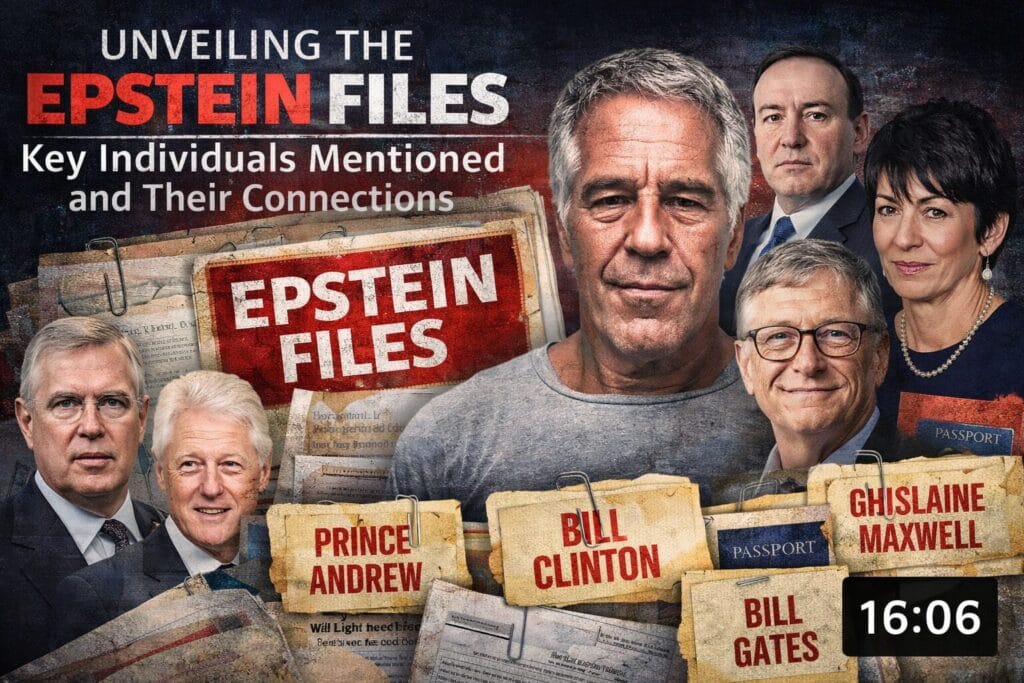
When a federal judge ordered the unsealing of documents related to Jeffrey Epstein in January 2024, the world braced for revelations. What followed was something different—a sprawling chronicle of power, influence, and missed opportunities for justice that would unfold over two years for Epstein Files.
The Epstein files aren’t just one document dump. They’re a series of releases spanning from January 2024 through early 2026, totaling over 3 million pages, 180,000 images, and 2,000 videos. here you can seen one off them video of Epstein Files These materials paint a disturbing picture of how a convicted sex offender moved through elite circles for decades, his crimes known to some yet unaddressed by the institutions meant to protect victims.
This investigation examines who appears in these files, what the documents actually reveal, and why mentions don’t equal guilt. We’ve reviewed court transcripts, DOJ releases, and credible news sources to provide context without speculation. Here’s what you need to understand about one of the most closely watched document releases in recent history.
Important Disclaimer: The presence of a name in Epstein Files does not indicate wrong doing. Many individuals mentioned were victims, witnesses, employees, or had casual social connections to Epstein. This article is based strictly on public court records and verified reporting. No assumptions of guilt are made.

The Evolution of the Epstein Files: From Court to Congress
Understanding the Epstein files requires knowing their origin. These aren’t leaked documents—they’re the product of legal battles, congressional action, and journalism that refused to look away.
Jeffrey Epstein built his wealth as a financier, though the exact sources of his fortune remain partly mysterious. What’s clear is that he cultivated relationships with powerful people across politics, business, entertainment, and academia. His social network became a shield that helped him avoid serious consequences for years, even after his crimes became known to law enforcement.
In 2008, Epstein struck a controversial plea deal that let him avoid federal prosecution despite substantial evidence of abuse. He pleaded guilty to Florida state charges of soliciting prostitution from a minor and served just 13 months in a county jail with work-release privileges. The deal, negotiated by then-U.S. Attorney Alexander Acosta, drew intense criticism when details emerged years later.
The breaking point came in 2019 when the Miami Herald published a groundbreaking investigation that re-examined Epstein’s crimes and that flawed 2008 deal. Federal prosecutors in New York subsequently charged Epstein with sex trafficking of minors. He was arrested in July 2019 but died by suicide in his Manhattan jail cell a month later, while awaiting trial.
His longtime associate Ghislaine Maxwell wasn’t as fortunate in evading accountability. She was arrested in 2020, tried in 2021, and convicted on five federal sex-trafficking charges. She’s currently serving a 20-year sentence and is appealing her conviction.
The unsealing process began with Virginia Giuffre’s 2015 defamation lawsuit against Maxwell. Giuffre, one of Epstein’s most vocal accusers, alleged she was trafficked as a teenager and forced to have sexual contact with powerful men in Epstein’s orbit. The lawsuit was settled in 2017, but the legal battle over whether to unseal the associated documents continued for years.
In December 2023, U.S. District Judge Loretta Preska ordered that documents identifying approximately 180 people connected to Epstein be unsealed. Those mentioned had until January 1, 2024, to appeal. The first batch—roughly 950 pages—was released on January 3, 2024.
But the story didn’t end there. In November 2025, Congress passed the Epstein Files Transparency Act with bipartisan and unanimous Senate support. President Donald Trump signed it into law. This legislation compelled the Justice Department to release investigative materials from federal probes into Epstein.
The DOJ’s initial December 2025 release drew immediate criticism from both parties for heavy redactions and missing content. Some files mysteriously disappeared from the public website within 24 hours. Worse, faulty redaction techniques allowed tech-savvy individuals to recover blacked-out information, revealing details about victims and trafficking methods that officials had tried to protect.
On January 30, 2026, the department released a massive trove: over 3 million pages, 180,000 images, and 2,000 videos. This release included FBI investigation files, grand jury materials, email correspondence, photographs from Epstein’s properties, and transaction records.
Throughout this period, Bloomberg News also independently obtained approximately 18,700 emails from Epstein’s personal Yahoo account, spanning 2002 to 2022. The outlet verified these emails through cryptographic analysis and external corroboration.
For those seeking primary sources, the DOJ maintains an Epstein Library where official materials can be accessed. Major news organizations including The New York Times, Miami Herald, CNN, and PBS have also published searchable repositories and curated guides to the documents.
Understanding Context: What “Mentioned” Really Means
Before diving into names, it’s critical to understand what it means to appear in these files. The documents include several categories of mention:
Victims and Survivors: Many names are those of women who came forward as accusers. Some remain anonymous (referred to as “Jane Doe” with numbers), while others like Virginia Giuffre have spoken publicly. These individuals deserve compassion and support, not scrutiny.
Witnesses: People who provided testimony in depositions or to investigators. Their inclusion doesn’t suggest participation in crimes—they may have simply observed Epstein’s lifestyle or interactions.
Employees and Associates: Staff members who worked at Epstein’s properties, assistants who managed his schedule, pilots who flew his planes. Some faced allegations of facilitating abuse; others were simply employed in legitimate roles.
Social and Professional Contacts: Business associates, academics who attended conferences he funded, celebrities who crossed paths at events, politicians who took donations or rides on his plane. Casual social connection is fundamentally different from criminal conspiracy.
Named in Flight Logs: Epstein owned a private jet, often called the “Lolita Express” in media coverage. Flight manifests show who traveled on the plane, but presence on a flight doesn’t prove knowledge of or participation in crimes.
Email Correspondence: Thousands of emails show Epstein communicating with people about legitimate business, philanthropy, introductions, and social events. An email exchange might reveal nothing more than professional networking.
The key principle: appearing in documents is not evidence of wrongdoing. Context matters enormously. Some people mentioned in these files are themselves victims. Others had professional reasons to interact with Epstein. Still others may have attended the same charity event once.
What the documents do reveal is the breadth of Epstein’s network and how someone with his background managed to maintain social cachet for so long.
The Names in the Epstein Files: A Comprehensive Breakdown
Based on the unsealed court documents and DOJ releases, here’s what we know about individuals mentioned across different categories:
Victims and Accusers
Virginia Giuffre (formerly Virginia Roberts) is the most prominent accuser whose name appears throughout the files. She alleged that Epstein trafficked her starting when she was 16 and that Ghislaine Maxwell directed her to have sexual contact with powerful men. Giuffre’s 2015 defamation lawsuit against Maxwell prompted the unsealing of these documents. Tragically, Giuffre died by suicide in 2025. Her family has criticized the DOJ for failing to properly redact victim identities in the January 2026 release, exposing at least 31 people who were victimized as children to unnecessary retraumatization.
Johanna Sjoberg provided a 2016 deposition that appears in the unsealed documents. She described working for Epstein and being pressured to give sexualized massages beyond her comfort level. Her testimony includes allegations about specific incidents at Epstein’s Manhattan townhouse.
Maria Farmer confirmed she filed a complaint with the FBI in September 1996 about Epstein’s involvement in child sex abuse. The newly released documents show this complaint existed—nearly a decade before Epstein’s first arrest. Farmer said in a 2026 statement that officials failed to investigate, calling the vindication “one of the best days of my life.”
Sarah Ransome is another accuser mentioned in documents who alleged abuse by Epstein and claimed to have met various public figures on his private island.
Many other victims remain anonymous, identified only as “Jane Doe” with assigned numbers. Their identities are protected due to the sensitive nature of sexual abuse cases.
Key Figures and Direct Associates
Ghislaine Maxwell appears throughout as Epstein’s closest associate and alleged co-conspirator. Court documents detail her role in recruiting young women, managing Epstein’s properties, and facilitating introductions. She was convicted in 2021 of sex trafficking and is serving 20 years in prison. In depositions, she denied allegations and accused Giuffre of being “an awful fantasist.”
Sarah Kellen (also known as Sarah Kensington) is mentioned as an assistant who helped with scheduling and logistics at Epstein’s properties. Depositions reference her involvement in daily operations.
Nadia Marcinkova appears in documents related to flight logs and as someone who trained as a pilot and was involved in flights on Epstein’s aircraft.
Jean-Luc Brunel was a French modeling agent accused by Giuffre and others of scouting young girls for Epstein under the guise of modeling opportunities. He died by suicide in a Paris jail in 2022 while awaiting trial on rape accusations.
Leslie Wexner, founder of Victoria’s Secret parent company L Brands, had extensive financial ties to Epstein. Epstein served as Wexner’s money manager and held power of attorney over his finances for years. At a 2019 investor conference, Wexner called Epstein’s actions “abhorrent” and said he cut ties in 2007. Documents show the depth of their financial relationship.
Political Figures
Bill Clinton is mentioned more than 50 times in the January 2024 unsealing, primarily in connection with flights on Epstein’s plane and attendance at events. Sjoberg testified that Epstein told her “Clinton likes them young, referring to girls.” In a 2016 deposition, Epstein invoked his Fifth Amendment rights repeatedly when asked questions about Clinton. An October 2009 email mentions Clinton attending an after-party at Maxwell’s house alongside Jeff Bezos. Clinton has not been accused of any wrongdoing related to Epstein in these documents.
Donald Trump appears throughout the files in various contexts. Sjoberg testified she never gave Trump a massage. Documents include emails where Epstein and others discussed Trump’s politics and shared news articles about him. One court filing alleged Epstein took a 14-year-old girl to Mar-a-Lago and introduced her to Trump with the comment “This is a good one, right?” according to the girl’s account, though she made no specific accusation against Trump. Photos from Epstein’s Manhattan home show framed pictures of Trump with Epstein and Maxwell from decades ago. Trump has not been accused of wrongdoing in these documents. His administration ultimately signed the Epstein Files Transparency Act into law.
Prince Andrew (Andrew Mountbatten-Windsor, formerly Duke of York) faces the most serious allegations among political figures. Giuffre alleged she was instructed to have sex with Andrew three times, including when she was 17. Sjoberg’s deposition described Andrew groping her breast during a photo opportunity at Epstein’s townhouse in 2001.
A now-famous photograph shows Andrew with his arm around Giuffre, with Maxwell in the background. Andrew repeatedly denied these allegations but settled Giuffre’s lawsuit against him out of court. The January 2026 DOJ release included hundreds of references to Andrew, including emails where Epstein appeared to arrange introductions to young women. Photos show Andrew in compromising positions at Epstein’s properties. King Charles III stripped Andrew of his royal titles and duties. British Prime Minister Keir Starmer suggested Andrew should cooperate with U.S. investigators.
Bill Richardson, former New Mexico governor and U.N. ambassador, was named in Giuffre’s deposition as someone Maxwell directed her to have sexual contact with. Richardson, who died in 2023, had denied these allegations.
Peter Mandelson, British ambassador to the U.S., appears in recent document releases in email correspondence with Epstein.
Thorbjoern Jagland and Boerge Brende, former Norwegian foreign ministers, along with diplomat Mona Juul and her husband Terje Rød-Larsen, appear in files that prompted Norway to open a parliamentary inquiry into its foreign ministry.
Business Leaders and Tech Figures
Elon Musk exchanges with Epstein show they communicated about holiday gatherings in the Caribbean. In a November 2012 email, Epstein asked Musk how many people would need helicopter transport to “the island.” Musk responded it would be just him and his then-wife Talulah Riley, asking “what day/night will be the wildest party on your island?” Musk later clarified he wanted to “hit the party scene in St. Barts” and that “a peaceful island experience is the opposite of what I’m looking for.” After the 2026 release, Musk posted on X that he’s “never been to any Epstein parties ever” and has “many times call[ed] for the prosecution of those who have committed crimes with Epstein.”
Bill Gates appears in emails discussing meetings with Epstein. Gates has acknowledged meeting Epstein several times for discussions about philanthropy, which he later called a “huge mistake in judgment.”
Jeff Bezos is mentioned in an October 2009 email about attending an after-party at Maxwell’s home.
Sergey Brin, Google co-founder, appears in photos that seem to show him at a 2011 “Billionaires’ Dinner” hosted by the Edge Foundation, a science organization Epstein supported. Accuser Sarah Ransome previously claimed she met Brin and his then-fiancée Anne Wojcicki on Epstein’s island.
Glenn Dubin, hedge fund manager and billionaire, was named in Giuffre’s testimony. She said Maxwell told her to give Dubin a massage, “which means sex.” Dubin has denied these allegations. His wife, Eva Andersson-Dubin, is also mentioned as someone Maxwell described as a friend.
Steve Tisch, New York Giants co-owner and Hollywood producer, is mentioned more than 400 times in the January 2026 release. Correspondence shows Epstein offering to connect Tisch to numerous women over the years, including crude exchanges about their physical attributes. Tisch acknowledged knowing Epstein but said they exchanged emails “about adult women” and discussed “movies, philanthropy and investments,” calling Epstein “a terrible person and someone I deeply regret associating with.”
Richard Branson, Virgin Group founder, exchanged emails with Epstein. In a 2013 message, Branson invited Epstein to his private Caribbean island, writing “Any time you’re in the area would love to see you. As long as you bring your harem!” In another email, Branson suggested Epstein could rehabilitate his image by having Bill Gates publicly vouch for him. A Virgin spokesperson said Branson was repeating Epstein’s own terminology and that Epstein had framed his legal troubles as a consensual relationship with someone “nearly 18.” The company stressed any contact was “limited to group or business settings” over a decade ago and that Branson would never have engaged had he known “the full picture.”
Casey Wasserman, president of the LA28 committee for the 2028 Olympics, exchanged flirtatious emails with Maxwell, including asking “what do I have to do to see you in a tight leather outfit?” in 2003.
Howard Lutnick, now Commerce Secretary under Trump, tried to get boat coordinates in December 2012 to meet up with Epstein, presumably at Epstein’s island.
Trump Administration Officials
Steve Bannon, Trump adviser and strategist, had text message exchanges with Epstein that reveal what documents describe as “the depth of the relationship” between them. Bannon served as chief strategist in Trump’s first term.
Dr. Mehmet Oz, now administrator of the Centers for Medicare and Medicaid Services, appears in a 2004 transaction report showing Epstein paid $1,592 for Oz’s travel expenses. Epstein was also invited to a 2014 event where Oz was a guest speaker but declined to attend. In 2016, Oz sent an email to Epstein, though the message content is redacted.
Pam Bondi, current U.S. Attorney General, oversaw the December 2025 and January 2026 DOJ releases as directed by President Trump.
Bret Ratner, director of the documentary “Melania” about First Lady Melania Trump, appears in photos from the January 2026 release. The images show Ratner on a sofa with his arms around a woman, next to Epstein who is embracing another woman. Ratner told Fox News he didn’t have a personal relationship with Epstein and was engaged to one of the women in the photo at the time. Ratner faced sexual misconduct allegations from six women in 2017, which he denied.
Celebrities and Entertainment Figures
Michael Jackson is mentioned in Sjoberg’s deposition. She said she saw Jackson at Epstein’s residence but testified she never gave him a massage.
Kevin Spacey appears in flight logs and documents showing he traveled with Clinton and others on Epstein’s plane. Sjoberg was asked if she met Spacey but said no.
Leonardo DiCaprio, Cate Blanchett, Cameron Diaz, Bruce Willis, and Naomi Campbell are mentioned in depositions where witnesses were asked if they had met these individuals. In most cases, the witnesses said no. None of these celebrities have been accused of any wrongdoing related to Epstein.
David Copperfield, the magician, is mentioned as having performed at Epstein’s events.
Scientists and Academics
Stephen Hawking, the late physicist, attended a conference on Epstein’s island, Little St. James, in 2006. Documents show Epstein funded scientific gatherings and cultivated relationships with prominent researchers.
Marvin Minsky, artificial intelligence pioneer and MIT professor, is mentioned in Giuffre’s deposition as someone Maxwell directed her to have sexual contact with. Minsky died in 2016. His family has disputed these allegations.
Dean Kamen, inventor of the Segway, appears in photos with Epstein and Richard Branson.
The Edge Foundation, led by literary agent John Brockman, organized scientific conferences that Epstein attended or sponsored, bringing him into contact with numerous academics and thinkers.
Legal and Professional Associates
Alan Dershowitz, Harvard law professor who represented Epstein, is mentioned extensively. Documents allege that Epstein forced a minor to have sexual contact with Dershowitz multiple times and that he witnessed abuse of other minors. Dershowitz has vehemently denied these allegations and has been involved in ongoing legal battles over them.
Kathryn Ruemmler, White House counsel under President Obama from 2011 to 2014, wrote in a December 2015 email that she “adores” Epstein. The context and nature of their relationship appear professional based on available documents.
Other Notable Mentions
Larry Visoski, Epstein’s longtime pilot, provided extensive testimony about flight logs and passengers who traveled on Epstein’s planes.
Peggy Siegal, New York socialite and publicist, sent emails to Epstein including the October 2009 message about the after-party at Maxwell’s house attended by Clinton and Bezos.
Alexander Acosta, U.S. Attorney who negotiated the controversial 2008 plea deal, served as Trump’s first Labor Secretary before resigning in 2019 when details of that deal became a scandal.
Numerous household staff, property managers, and other employees are mentioned in relation to their roles at Epstein’s residences in New York, Florida, New Mexico, and the Virgin Islands.
Sarah Ferguson, Duchess of York, publicly apologized in 2011 for letting Epstein pay off her debts. An email shows she later sought Epstein’s advice about how to answer questions about their relationship during an appearance on Oprah Winfrey’s show.
What the Files Actually Reveal: Patterns and Implications
While individual names attract headlines, the broader patterns in these documents are arguably more significant.
The FBI Knew Early—And Didn’t Act
Perhaps the most damning revelation is how long authorities had evidence of Epstein’s crimes without taking action. Maria Farmer’s September 1996 FBI complaint shows the Bureau was informed of child sex abuse allegations nearly a decade before Epstein’s first arrest in 2006.
The newly released documents reveal that by July 2006, the FBI had opened an investigation with multiple underage girls providing detailed accounts of abuse. Agents prepared a draft indictment by May 2007 that would have charged not only Epstein but also three of his personal assistants.
Interview notes from 2007 describe an employee at Epstein’s Florida estate explaining duties that included fanning $100 bills on a table near Epstein’s bed, placing a gun between mattresses, and cleaning up after “frequent massages with young girls, including disposing of used condoms.”
One witness told the grand jury she was hired at 16 to perform a sexual massage and subsequently recruited other girls from her high school. “For every girl that I brought to the table, he would give me $200,” she testified. She added that she told recruits who were underage to “just lie about it and tell him that you are 18.”
Despite this evidence, U.S. Attorney Alexander Acosta approved a non-prosecution agreement that let Epstein plead guilty to minor state prostitution charges and serve just 13 months. The Justice Department has since acknowledged this decision reflected “poor judgment.”
Epstein then continued his lifestyle for another decade, traveling with young women, hosting parties with powerful guests, and allegedly abusing more victims—all because federal prosecutors chose not to pursue the case they had built.
A Network Built on Wealth and Access
The documents illustrate how Epstein used money, connections, and the promise of access to maintain his network. Emails show him:
- Offering to introduce powerful men to women, often in crude terms
- Funding scientific conferences to cultivate relationships with academics
- Making charitable donations to gain social credibility
- Using his private jet and island to create obligation and leverage
- Positioning himself as a connector and advisor to the wealthy and influential
A 2013 email exchange with Richard Branson shows Epstein asking for image rehabilitation advice. Branson suggested getting Bill Gates to publicly vouch for him, demonstrating how Epstein tried to use one relationship to bolster another.
The Redaction Failures and Missing Files
The January 2026 release was plagued by technical failures that exposed information meant to be protected. Faulty redaction allowed recovery of victim names and details about trafficking operations. Within 24 hours of the December 2025 release, 16 files disappeared from the DOJ website without explanation.
Critics from both parties condemned these failures. Skye Roberts, Virginia Giuffre’s brother, told CBS News: “They’re redacting the names of perpetrators and they’re unredacting the names of victims, quite the opposite of what the Epstein Files Transparency Act was meant to do.”
International Implications
The files have prompted investigations beyond U.S. borders. Turkey opened an inquiry into allegations that Epstein trafficked Turkish children. Lithuania and Latvia launched investigations after documents revealed names of their citizens potentially victimized. Norway is conducting a parliamentary inquiry into foreign ministry officials who appear in the files.
These international responses suggest the scope of Epstein’s network and the potential for cross-border trafficking that hasn’t been fully examined.
What the Files Don’t Contain
It’s important to note what’s missing. Despite speculation about a comprehensive “client list,” a July 2025 DOJ memo confirmed no such document exists. What we have are:
- Court depositions and testimony
- FBI investigation notes
- Email correspondence
- Flight manifests
- Financial transaction records
- Photographs and videos
But there’s no master list of people who committed crimes or explicit evidence against most individuals mentioned. The documents are fragmented pieces of a larger puzzle, many with heavy redactions, others with context lost to time or inaccessible sources.
The Broader Context: Power, Accountability, and Justice
The Epstein case raises questions that extend far beyond any individual name in the files.
How Did This Happen?
Multiple institutions failed to stop Epstein or hold him accountable when evidence existed:
Law Enforcement: The FBI received complaints as early as 1996 but didn’t pursue prosecution. Local Florida police investigated in 2005 and built a strong case, only to have federal prosecutors negotiate a lenient plea deal.
The Legal System: The 2008 non-prosecution agreement violated federal law by not notifying victims. It wasn’t until 2019—after Epstein’s death—that a judge ruled the deal illegal.
Social and Professional Networks: Universities, philanthropies, and social circles continued associating with Epstein after his 2008 conviction as a registered sex offender. MIT, Harvard, and other institutions accepted his donations. High-society events still included him on guest lists.
Media and Public Attention: While some journalists pursued the story, particularly Julie K. Brown at the Miami Herald, Epstein largely avoided sustained media scrutiny for years.
The Victims’ Perspective
In the midst of document analysis and name recognition, it’s critical to center the experiences of survivors. These were young women—many still teenagers—who were exploited in a systematic trafficking operation.
Virginia Giuffre’s posthumously published memoir and her years of advocacy helped force this case into public consciousness. Maria Farmer’s 1996 complaint shows women tried to sound alarms decades ago and weren’t believed or protected.
Attorneys for survivors have criticized the DOJ’s handling of the 2026 release for exposing victim identities while heavily redacting information about alleged perpetrators. This reversal of priorities—protecting the powerful while re-traumatizing the vulnerable—echoes the dynamics that enabled Epstein’s crimes in the first place.
The Question of Prosecution
Many people reviewing these files wonder: Will anyone else be prosecuted?
Ghislaine Maxwell is currently the only person convicted in connection with Epstein’s trafficking operation. The statute of limitations has expired for many potential charges. Witnesses and evidence have become harder to gather with time and Epstein’s death.
Federal prosecutors have said they continue to investigate, but no new charges have been filed as of February 2026. The Epstein Files Transparency Act was meant to ensure public access to information, not necessarily to facilitate new prosecutions, though some hoped it would.
Elon Musk posted on X after the January 2026 release: “The acid test for justice is not the release of the files, but rather the prosecution of those who committed heinous crimes with Epstein.” Whether such prosecutions will materialize remains an open question.
How to Access and Verify the Epstein Files
For readers who want to examine primary sources rather than rely on media summaries, several options exist:
Official Government Source: The U.S. Department of Justice maintains the Epstein Library at justice.gov/epstein, where official DOJ disclosures and releases can be accessed.
Court Documents: The original unsealed documents from the Giuffre v. Maxwell defamation case can be found through PACER (Public Access to Court Electronic Records) or through news organizations that republished them.
News Organization Archives: Major outlets including The New York Times, Miami Herald, PBS, CNN, Reuters, and The Guardian have created searchable databases and curated lists of the documents.
Bloomberg’s Email Archive: In September 2025, Bloomberg News published analysis of approximately 18,700 emails from Epstein’s personal account, verified through cryptographic analysis.
When reviewing these materials:
- Cross-reference multiple sources to verify accuracy
- Pay attention to context—when was a deposition taken? What question was being answered?
- Distinguish between allegations and proven facts
- Remember that heavily redacted sections may contain critical context
- Note that being mentioned is not evidence of wrongdoing
Frequently Asked Questions
Q: Is there a definitive “Epstein client list”?
A: No. Despite widespread speculation, the Department of Justice confirmed in July 2025 that no comprehensive client list exists. What we have are court documents, emails, flight logs, and investigative materials that mention various individuals in different contexts.
Q: Does appearing in the Epstein files mean someone committed a crime?
A: Absolutely not. People appear in these documents for many reasons: as victims, witnesses, employees, social acquaintances, or business contacts. Context is essential. Many individuals mentioned had legitimate reasons to interact with Epstein or were simply at the same event once.
Q: Why were so many names already public knowledge?
A: Much of this information had been reported by journalists over the years, appeared in previous court filings, or was known through flight logs that had leaked earlier. The January 2024 unsealing didn’t contain many bombshell revelations—it officially confirmed information that had circulated through media reports.
Q: What’s the difference between the 2024 court unsealing and the 2025-2026 DOJ releases?
A: The January 2024 unsealing came from documents in Virginia Giuffre’s defamation lawsuit against Ghislaine Maxwell. These were civil court proceedings. The 2025-2026 DOJ releases resulted from the Epstein Files Transparency Act and included materials from federal criminal investigations, including FBI files, grand jury materials, and evidence collected during prosecutions.
Q: Why are there so many redactions in the files?
A: Redactions serve several purposes: protecting victim identities, safeguarding ongoing investigations, complying with grand jury secrecy rules, and protecting information about investigative methods. Unfortunately, some redactions also appear to shield information about potential perpetrators, which has drawn criticism.
Q: Will more documents be released?
A: Possibly. The Epstein Files Transparency Act required disclosure of certain materials, but disputes continue over what should remain sealed. Additional court proceedings, FOIA requests, or congressional actions could lead to further releases.
Q: What should people take away from these files?
A: The documents reveal systemic failures to protect vulnerable young women and hold a wealthy, connected perpetrator accountable despite substantial evidence. They show how power, wealth, and social networks can shield people from consequences. They also demonstrate the importance of believing survivors, the damage of institutional failures, and the ongoing need for justice and accountability.
Q: How can I support survivors of trafficking?
A: Organizations like RAINN (Rape, Abuse & Incest National Network), the National Center for Missing & Exploited Children, and Polaris Project work to combat trafficking and support survivors. Educating yourself about warning signs, supporting evidence-based prevention programs, and advocating for justice system reforms all make a difference.
Key Takeaways
- The Epstein files are not one document but multiple releases from 2024-2026, totaling over 3 million pages, 180,000 images, and 2,000 videos
- Being mentioned in these files does not indicate wrongdoing—context matters enormously
- The FBI received complaints about Epstein’s crimes as early as 1996 but failed to act for a decade
- The controversial 2008 plea deal let Epstein avoid federal prosecution despite substantial evidence
- Ghislaine Maxwell is currently the only person convicted in connection with the trafficking operation
- Most information in the files had been previously reported—the unsealing provided official confirmation
- The documents reveal patterns of how wealth and connections enabled Epstein’s crimes for decades
- Technical failures in redaction exposed victim identities while protecting some alleged perpetrators’ information
Conclusion: Transparency, Accountability, and the Path Forward
The unsealing of the Epstein files represents a step toward transparency, but it’s not justice. Justice would have meant stopping Epstein decades earlier when women first reported his crimes. Justice would mean full accountability for everyone who facilitated trafficking. Justice would mean systemic reforms to prevent similar failures.
What these documents do provide is a public record. They allow journalists, researchers, and citizens to understand how someone with Epstein’s background maintained elite status despite a criminal conviction. They reveal the institutional failures that enabled ongoing abuse. They confirm what many survivors had been saying for years.
The challenge now is what comes next. Will prosecutors pursue cases against others who facilitated these crimes? Will institutions that failed to act examine why and implement reforms? Will we as a society grapple with how wealth and power create different standards of accountability?
Virginia Giuffre, Maria Farmer, Johanna Sjoberg, and other brave women fought for years to make this information public. The least we can do is read it with care, resist jumping to conclusions, and commit to building systems that protect vulnerable people rather than powerful predators.
Understanding these connections isn’t about satisfying curiosity—it’s about preventing future abuses and honoring the courage of survivors who refused to stay silent.
We invite you to share your thoughts respectfully in the comments below. If you found this analysis helpful, please share it with others who are trying to understand these complex documents.
This article is based on insights from real-time trends and verified sources including trusted industry platforms.
Sources:
- U.S. District Court, Southern District of New York – Giuffre v. Maxwell case documents
- U.S. Department of Justice Epstein Library – justice.gov/epstein
- The Miami Herald investigative reporting by Julie K. Brown
- CNN, NBC News, PBS, Reuters, The New York Times, The Guardian – Document analysis and verification
- Bloomberg News – Epstein email archive
- Al Jazeera, CBC News, CBS News – International document coverage
- Congressional Record – Epstein Files Transparency Act proceedings
Internal Resources:
- Learn more about investigative journalism standards at Lume Chronos
- Explore tools for document verification at Lume Chronos Shop
- Read global perspectives on accountability at Lume Chronos DE