


Introduction
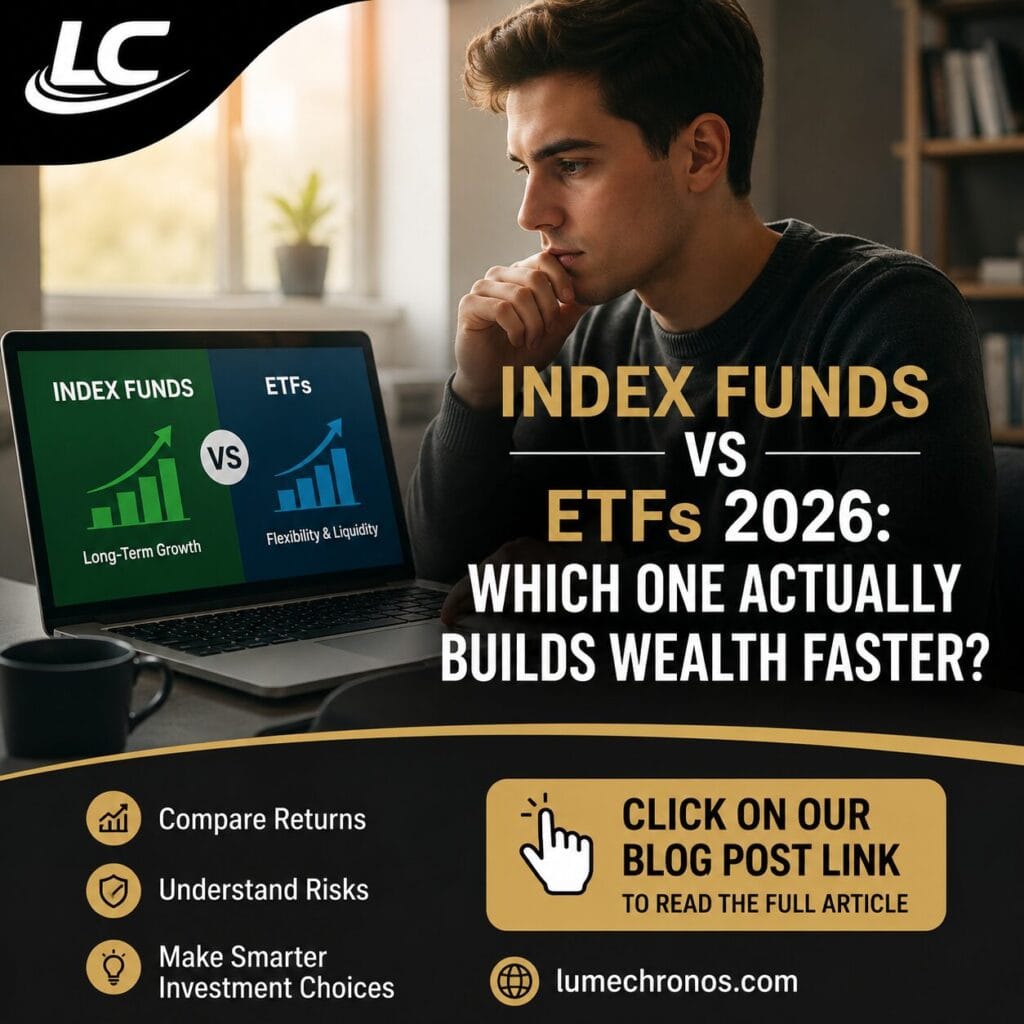
Here’s something that surprises a lot of new investors: two of the most popular investing tools in the world — index funds and ETFs — are actually more similar than different. And yet, millions of people waste weeks going back and forth between them, overthinking the choice when they could already be growing their money.
If you’ve typed “index funds vs ETFs 2026” into a search bar lately, you’re not alone. Google trends show a consistent spike in this query every year, especially as more people realize that traditional savings accounts aren’t keeping up with inflation. In 2026, with interest rates stabilizing and the stock market rewarding patient, low-cost investors, this debate matters more than ever.
The confusion is real, though. Both products track market indexes. Both offer diversification. Both are relatively cheap. So what’s actually different? And more importantly — which one is right for you?
This guide cuts through the noise. No fluff, no jargon overload, no vague advice. Just clear, honest comparisons built on how these products actually work in real life — for beginners, for long-term holders, and for people who want to keep more of what they earn.
Let’s get into it.
What Are Index Funds and ETFs, Really? (And Why People Mix Them Up)
Before we compare, let’s establish what each one actually is. This is where most articles either get too technical or too vague — so we’re going to land somewhere in the middle: accurate, but plain English.
Index Funds — The “Set It and Forget It” Classic
An index fund is a type of mutual fund designed to mirror the performance of a specific market index — like the S&P 500, the Nasdaq-100, or the Russell 2000. Instead of a fund manager picking stocks, the fund simply holds the same securities as the index, in roughly the same proportions.
You buy shares of an index fund through a brokerage or directly through a fund company like Vanguard, Fidelity, or Schwab. Purchases are processed at end-of-day pricing, called the NAV (Net Asset Value). That means if you place an order at 10 AM or 3 PM, you’ll get the same price: the one calculated when the market closes.
Real-world example: Fidelity’s ZERO Total Market Index Fund (FZROX) charges literally $0 in expense ratio. You invest, it tracks the US total stock market, and you check it every few months. Simple.
Pros:
- Automatic dividend reinvestment (in most cases)
- No bid-ask spread (you always buy at NAV)
- Easy to set up recurring investments
- Often lower minimum investment requirements via fractional access
Cons:
- Can only be traded once per day
- Some funds have minimum investment requirements
- Less flexible for tax-loss harvesting in active portfolios
📺 Watch: Index Funds for Beginners – Full Explanation (YouTube)
ETFs — The Flexible, Stock-Like Alternative
ETFs (Exchange-Traded Funds) are essentially index funds that trade on stock exchanges throughout the day — just like individual stocks. They also track indexes, sectors, commodities, or themes. The difference is mostly structural, not philosophical.
When you buy an ETF like SPY (which tracks the S&P 500) or VTI (Vanguard Total Stock Market ETF), you’re buying shares on an open market at whatever the current price is at that moment. That price can differ slightly from the underlying asset value (called a “premium” or “discount”).
Real-world example: You log into your Robinhood or Fidelity account at 11:30 AM and buy 5 shares of VTI at $243.18 per share. That’s your exact price — real-time, transparent, and instant.
Pros:
- Trade anytime during market hours
- Generally very low expense ratios
- Tax-efficient due to the creation/redemption mechanism
- No minimum investment (you can buy 1 share or even fractional shares)
- Great for tax-loss harvesting strategies
Cons:
- You pay bid-ask spreads (usually tiny, but real)
- Requires a brokerage account with trading enabled
- Tempts some investors to over-trade (a real risk)
📺 Watch: ETFs vs Index Funds Explained Clearly (YouTube)
🐦 Trending on X (Twitter): A viral thread from @TKerODL explained in 2024 that “the difference between ETFs and index funds is mostly about when you trade, not what you own” — and it got 40k+ likes. That’s how widespread this confusion is.
The Real Cost Comparison — Expense Ratios, Taxes, and Hidden Fees
This is where most people stop reading generic articles — and start losing money by ignoring what’s below the surface.
Expense Ratios in 2026
Both index funds and ETFs have gotten dramatically cheaper over the last decade. Competition between Vanguard, Fidelity, and Schwab has pushed many expense ratios close to zero.
| Product | Expense Ratio Example | Annual Cost on $10,000 |
|---|---|---|
| Fidelity ZERO Index Fund | 0.00% | $0 |
| Vanguard S&P 500 ETF (VOO) | 0.03% | $3 |
| Vanguard 500 Index Fund Admiral (VFIAX) | 0.04% | $4 |
| iShares Core S&P 500 ETF (IVV) | 0.03% | $3 |
| Active Managed Mutual Fund (avg) | 0.50–1.0% | $50–$100 |
In practice? The cost difference between a top-tier index fund and a top-tier ETF is negligible. We’re talking a few dollars a year on a $10,000 portfolio. Don’t let cost alone drive your decision — both are excellent values compared to actively managed alternatives.
Tax Efficiency — Where ETFs Often Win
Here’s where ETFs genuinely have a structural advantage.
When you invest in a traditional mutual fund (including most index funds), the fund manager occasionally has to sell holdings to handle investor redemptions. That can trigger capital gains distributions — taxable events passed on to all investors, even if you personally didn’t sell anything.
ETFs avoid this through an in-kind creation/redemption mechanism. When large institutional investors buy or sell ETF shares, they do so by exchanging baskets of stocks — not cash — which sidesteps capital gains events inside the fund.
Bottom line: In taxable accounts (non-IRA, non-401k), ETFs tend to be more tax-efficient than traditional index funds. In tax-advantaged accounts like Roth IRAs or 401(k)s, this advantage disappears completely because you’re not paying taxes on gains anyway.
Expert tip from LumeChronos: If you’re investing inside a retirement account, use whichever option gives you automatic contributions and reinvestment. If you’re investing in a taxable brokerage account and you care about taxes, ETFs often win. Learn more strategies at lumechronos.com →
Index Funds vs ETFs — Flexibility and Investing Style
Beyond costs and taxes, the real difference comes down to how you prefer to invest.
Who Should Choose Index Funds?
Index funds are the better fit if you:
- Use a workplace 401(k) plan (ETFs often aren’t available inside them)
- Want to automate contributions — set $200/month to auto-invest and forget it
- Tend to check your portfolio rarely and prefer simplicity
- Are newer to investing and want fewer decisions
- Use a robo-advisor like Betterment or Wealthfront (they build portfolios using ETFs, but the experience feels like index fund investing)
The “set it and forget it” nature of index fund investing is genuinely underrated. Behavioral finance research consistently shows that investors who trade less tend to outperform those who tinker constantly. If an index fund’s structure keeps you from making emotional decisions, that’s a tangible benefit.
Who Should Choose ETFs?
ETFs are often the better fit if you:
- Invest in a taxable brokerage account and want tax efficiency
- Want access to niche market exposures — sector ETFs, international ETFs, dividend ETFs, etc.
- Like to see real-time prices (some investors find this empowering, not distracting)
- Use a platform like Fidelity, Schwab, or TD Ameritrade where commission-free ETF trading is standard
- Are doing tax-loss harvesting as part of a broader tax strategy
Most people miss this: ETFs and index funds don’t have to be an either/or decision. Plenty of smart investors hold both — a target-date index fund in their 401(k), and a few ETFs in their taxable Roth IRA or brokerage account.
📺 Watch: Index Fund vs ETF — Which Is Better For You? (YouTube)
🐦 X Post by @personalfinanceclub: “Index funds and ETFs are essentially the same thing. The real enemy is high fees, not the wrapper.” — 28k impressions, shared widely in investing communities.
The 2026 Investing Landscape — What’s Changed and Why It Matters
In practice, this comparison looks somewhat different in 2026 than it did five years ago. A few developments worth knowing:
Zero-Commission Trading Is Now the Default
In 2019, when Schwab eliminated trading commissions, it triggered an industry-wide shift. By 2026, virtually every major retail brokerage offers commission-free ETF trading. This eliminated one of the last practical arguments against ETFs — the old per-trade cost that made frequent small purchases expensive.
Now you can buy $25 worth of VTI on any given Tuesday with zero commission. For small, regular investors, this changes everything.
Fractional Shares Have Closed the Gap
Historically, ETFs required buying whole shares. A single share of SPY cost over $500 — not accessible for someone investing $50/month. Fractional share investing, now offered by Fidelity, Schwab, and most major platforms, means you can buy 0.09 shares of any ETF with whatever amount you have. This eliminated the minimum investment advantage that index funds used to hold.
The Rise of Direct Indexing — A Third Option
In 2026, there’s a growing third category worth mentioning: direct indexing. Instead of buying a fund that holds the index, direct indexing lets you own the individual stocks inside the index directly — allowing highly personalized tax-loss harvesting and ESG filtering. Platforms like Fidelity Managed FidFolios and Schwab Personalized Indexing are making this accessible at lower minimums.
It’s not for everyone — it requires more assets and complexity — but it shows where the industry is heading.
Explore global investing perspectives at lumechronos.de →
Mistakes Investors Make When Choosing Between Index Funds and ETFs
Most of the confusion in this debate comes from focusing on the wrong things. Here are the real mistakes to avoid:
Mistake #1 — Treating This as a High-Stakes Decision
In most cases, whether you pick the S&P 500 index fund or the S&P 500 ETF from the same provider makes almost zero difference over 20 years. Agonizing over this choice is time that could be spent actually investing.
Mistake #2 — Ignoring the Account Type
The account you’re investing in matters more than the fund wrapper. In a 401(k)? You probably only have index funds as options anyway. In a Roth IRA or taxable brokerage? ETFs likely give you marginally better tax treatment.
Mistake #3 — Chasing Specialty ETFs
ETF providers have launched thousands of funds tracking everything from lithium mining to AI hardware companies to social media stocks. Most of these are high-fee, low-diversification products masquerading as “smart investing.” Stick to broad-market, low-cost index ETFs unless you have a specific, informed reason to go narrow.
Mistake #4 — Over-Trading ETFs
Because ETFs trade like stocks, some investors treat them that way — buying and selling based on daily news or gut feeling. That’s exactly the opposite of why these products were built. The research is clear: buy, hold, and let time do the work.
🐦 X Post by @morganhousel: “The investor’s greatest enemy is often found in the mirror.” — cited widely in passive investing communities as a reminder that behavior beats product choice every time.
Quick Comparison — Index Funds vs ETFs at a Glance
| Feature | Index Funds | ETFs |
|---|---|---|
| Trading | End of day (NAV) | Real-time (market hours) |
| Minimum Investment | Varies ($0–$3,000) | 1 share / fractional |
| Expense Ratio | Low (0.00%–0.20%) | Low (0.03%–0.20%) |
| Tax Efficiency | Good | Slightly better (taxable accounts) |
| Automatic Investment | Yes (easy) | Possible but less seamless |
| 401(k) Availability | Yes (common) | Rarely |
| Best For | Beginners, retirement accounts | Taxable accounts, tax-loss harvesting |
| Dividend Reinvestment | Automatic | Manual or DRIP programs |
Browse investing tools and resources at lumechronos.shop →
Recommended Resources and References
Authoritative Websites:
- Investopedia — ETF vs. Index Fund
- Vanguard — Understanding ETFs
- Morningstar — Passive Investing Research
- NerdWallet — Best Index Funds 2026
- The Balance — How ETFs Work
YouTube Educational Videos:
- ETF vs Index Fund: Which Is Right for You? — The Plain Bagel
- How To Invest In Index Funds For Beginners — Graham Stephan
- The 3-Fund Portfolio Explained — Bogleheads
FAQ: People Also Ask
Q1: What is the main difference between index funds and ETFs?
The core difference is in how you buy them and when they’re priced. Index funds are priced once per day at the end of trading — you buy or sell at that day’s NAV (Net Asset Value). ETFs trade throughout the day on exchanges, just like individual stocks, so their price fluctuates in real time. Both typically track the same underlying indexes, and the investment philosophy is nearly identical. The differences that actually matter for most investors are: tax efficiency in taxable accounts (ETFs often win), ease of automatic investing (index funds often win), and availability inside 401(k) plans (index funds usually win here too).
Q2: Are ETFs better than index funds for long-term investing?
Not necessarily better — just different. For long-term investing in a tax-advantaged account like a Roth IRA or traditional IRA, the difference is marginal. In a taxable account, ETFs have a slight tax advantage due to the way they handle capital gains distributions. Over decades, this can add up, but only in taxable accounts. For most retirement investors, a low-cost index fund inside a 401(k) will outperform most active alternatives regardless of the fund structure. Both ETFs and index funds, when low-cost and broadly diversified, are excellent long-term wealth-building tools.
Q3: Which is safer — index funds or ETFs?
Both carry the same market risk — when the index they track drops, both drop accordingly. Neither is inherently “safer” than the other from a market-risk standpoint. However, there are structural differences worth noting: ETFs carry a small bid-ask spread risk (you might buy slightly above or sell slightly below fair value during illiquid market conditions), while index funds always transact at exact NAV. From a systemic risk perspective, both are highly regulated in the US under the Investment Company Act of 1940. Neither type of fund can “go bankrupt” in the way a company can — even if a fund company fails, the assets belong to investors, not the fund manager.
Q4: Can I invest in both index funds and ETFs at the same time?
Absolutely — and many experienced investors do exactly this. A common setup is holding a low-cost target-date index fund in your workplace 401(k), a mix of ETFs in a Roth IRA or taxable brokerage account, and perhaps one or two index funds through a robo-advisor. The key is avoiding duplication — if your index fund and your ETF both track the S&P 500, you’re not gaining additional diversification by holding both. Mixing them strategically (e.g., a total market ETF plus an international index fund) does provide real diversification benefits.
Q5: Do ETFs or index funds pay dividends?
Both can pay dividends, though they handle them differently. Most index funds automatically reinvest dividends back into the fund, which means your share count grows without any action on your part. ETFs also distribute dividends, but reinvestment isn’t automatic — you typically need to enroll in a Dividend Reinvestment Plan (DRIP) through your broker, or you’ll receive cash in your account. In tax-advantaged accounts, this usually doesn’t matter much. In taxable accounts, receiving cash dividends from ETFs could create a taxable event each quarter.
Q6: What’s the minimum amount needed to start investing in ETFs or index funds?
For ETFs, the minimum is effectively the price of one share — which could be anywhere from $25 to $500+, depending on the fund. Thanks to fractional share investing at platforms like Fidelity and Schwab, you can now start with as little as $1. For index funds, minimums vary more widely. Fidelity’s ZERO funds have no minimum. Vanguard’s Admiral Shares require $3,000, though their regular shares are accessible at lower amounts. Schwab’s index funds start at $1. For most new investors in 2026, the practical barrier to entry is essentially zero.
Q7: Is it better to invest in ETFs or index funds through a Roth IRA?
Either works well in a Roth IRA, but ETFs have one notable advantage: greater flexibility. Because a Roth IRA is already tax-sheltered, the usual tax efficiency argument for ETFs becomes less relevant. However, ETFs give you broader access to different market segments (international, sector-specific, dividend-focused) without being restricted to the fund lineup offered by one provider. If you’re disciplined about not over-trading, a mix of broad-market ETFs — like VTI (total US market) and VXUS (total international) — in a Roth IRA is a powerful, low-cost strategy that many financial educators recommend.
Q8: How do I decide which index funds or ETFs to buy in 2026?
Start with your goal, then your account type. For retirement accounts: look for broad-market, low-expense-ratio funds — S&P 500 index funds or total market ETFs are the starting point for most people. For taxable accounts: prioritize ETFs for tax efficiency, focus on total market or international funds, and avoid specialty or themed ETFs unless you have conviction and understand the risk. Always check the expense ratio (under 0.10% is excellent), the fund’s assets under management (larger is generally more stable and liquid), and whether it’s from a reputable provider like Vanguard, Fidelity, iShares, or Schwab.
Key Takeaways
- Index funds and ETFs are more alike than different — both track indexes, both offer diversification, both are low-cost. The choice matters less than starting.
- Tax efficiency favors ETFs in taxable accounts — the in-kind redemption mechanism means fewer unexpected capital gains distributions.
- Index funds win for automation — if you want to auto-invest monthly without thinking, index funds are generally easier.
- Account type matters most — 401(k)? Probably index funds. Taxable brokerage? ETFs may have a slight edge.
- Avoid specialty ETFs unless you know exactly what you’re buying — niche, theme-based ETFs carry higher fees and concentration risk.
- In 2026, the cost of either option is near-zero — focus on behavior (staying invested, not over-trading) more than product choice.
- Both are excellent — the biggest mistake is analysis paralysis. A low-cost S&P 500 ETF or index fund started today beats the “perfect” choice started next year.
Conclusion
If you’ve been going back and forth on index funds vs ETFs for months, here’s the honest truth: you can stop. Both are excellent. Both are cheap. Both work.
The smarter question to ask isn’t which one — it’s when you’re starting. The single biggest wealth-building factor for passive investors is time in the market, not the wrapper your investment comes in.
That said, if you’re in a taxable brokerage account and you want to be thoughtful about taxes, ETFs offer a real (if modest) structural advantage. If you want simplicity, automation, and friction-free monthly contributions, a traditional index fund is hard to beat.
In 2026, with so many excellent zero-fee and near-zero-fee options from Fidelity, Vanguard, Schwab, and iShares, either path leads to the same place if you stay consistent and don’t let short-term market noise push you into bad decisions.
Action steps:
- Open or review your investment account type (Roth IRA, 401k, taxable brokerage)
- Match your fund type to your account (index fund for 401k, ETF for taxable accounts if taxes matter to you)
- Choose a broad-market, low-cost option from a reputable provider
- Automate your contributions and commit to not checking it daily
Have thoughts on which you prefer — index funds or ETFs? Drop a comment and let us know. Share this with someone who’s been on the fence. And explore more guides at lumechronos.com, useful investing tools at lumechronos.shop, and global market perspectives at lumechronos.de.
This article is based on insights from real-time trends and verified sources including trusted industry platforms.