



Introduction: Your Mind Is Not Broken — It’s Just Overloaded
Picture this: it is 11 PM. You are lying in bed, completely exhausted, but your brain is running a marathon. You replay a conversation from Tuesday. You worry about Friday’s deadline. You spiral into a vague, heavy dread you cannot even name. Sound familiar?
You are not alone. According to the World Health Organization, anxiety disorders are among the most common mental health conditions globally, affecting hundreds of millions of people. And yet — most people have never been taught a single practical tool to interrupt the cycle.
That is exactly why mindfulness exercises for anxiety relief have exploded in popularity over the last decade, and especially since 2020, when the world collectively realized that stress is not going away on its own. These are not spa-day tricks or “just breathe” platitudes. Mindfulness is a clinically studied, neurologically validated approach to calming an overactive mind — and you can start it tonight, with zero equipment, in under five minutes.
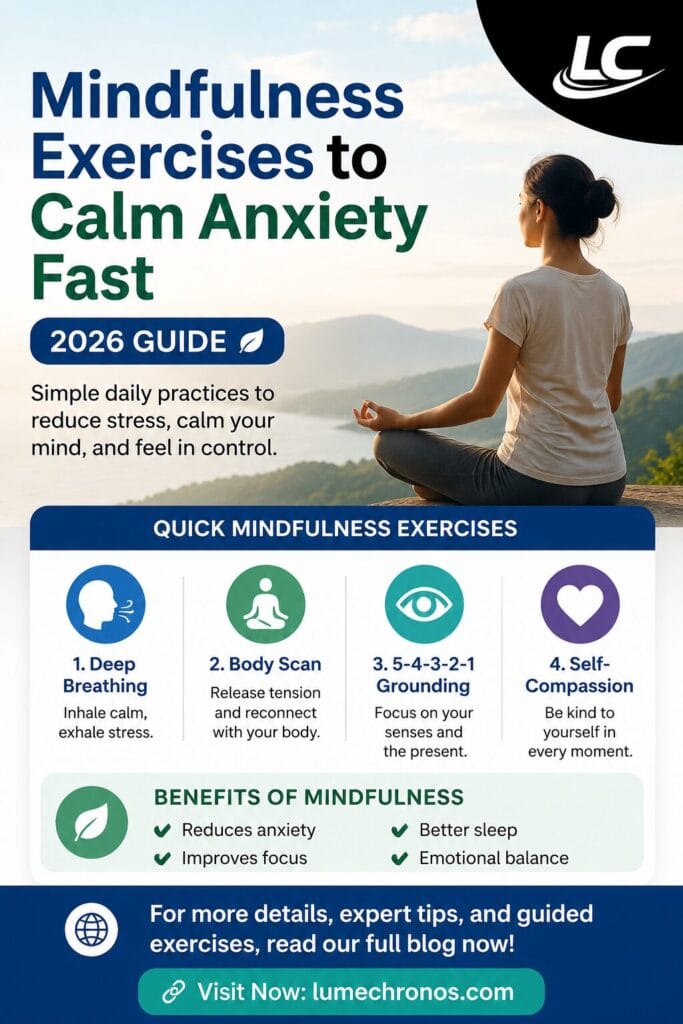
In this guide, you will learn four specific, step-by-step exercises — each one backed by behavioral science and used by therapists, military veterans, athletes, and everyday people to break the anxiety loop. Whether you have tried meditation before and hated it, or you are completely new to the idea, this guide meets you where you are.
Let’s start.
What Mindfulness Actually Does to an Anxious Brain
Before jumping into the exercises, it helps to understand why mindfulness works. Because when you understand the mechanism, you trust the method — and you actually stick with it.
The Science Behind the Calm
Anxiety is largely a problem of the prefrontal cortex losing a tug-of-war with the amygdala. The amygdala is your brain’s alarm system — ancient, fast, and aggressive. When it fires, it floods your body with cortisol and adrenaline. Your heart rate climbs. Your thoughts race. Your muscles tighten. Evolutionarily, this was brilliant — it helped your ancestors outrun predators. In 2026, it mostly just ruins your sleep and makes meetings feel like emergencies.
Mindfulness exercises work by activating the parasympathetic nervous system, often called the “rest and digest” system. When you consciously slow your breath, anchor attention to physical sensations, or guide your awareness through your body, you signal safety to your nervous system. The amygdala quiets. The prefrontal cortex — responsible for rational thought and decision-making — regains control.
Research published in peer-reviewed journals including Behaviour Research and Therapy and JAMA Internal Medicine has consistently shown that regular mindfulness practice reduces self-reported anxiety, lowers physiological stress markers, and improves emotional regulation — often within just eight weeks of consistent practice.
Why Most People Give Up Too Early
Here is what most articles will not tell you: the first week of mindfulness often feels worse, not better. Why? Because you are, for the first time, sitting with thoughts you have been running from. The discomfort you feel early on is not failure. It is the process working.
In practice, most people who “tried meditation and hated it” never got past day three. The people who benefit most are those who commit to five minutes daily for two weeks before judging results.
📌 Explore more on building sustainable mental wellness habits at LumeChronos – Wellness Guides
Helpful YouTube reference: What Is Mindfulness? — Headspace on YouTube
Mindfulness Exercise 1: The 4-7-8 Breathing Technique
If you could only learn one mindfulness exercise for anxiety, this might be it. The 4-7-8 breathing method is simple, fast, and requires nothing except your lungs.
How It Works
The 4-7-8 technique was popularized by integrative medicine physician Dr. Andrew Weil and is rooted in the ancient yogic practice of pranayama. The specific ratio — inhale for 4 counts, hold for 7, exhale for 8 — is designed to create a pronounced shift in your autonomic nervous system. The extended exhale, in particular, is the key. When your exhale is significantly longer than your inhale, your vagus nerve responds by lowering your heart rate and blood pressure almost immediately.
Step-by-Step Guide
Step 1: Sit comfortably or lie down. Rest the tip of your tongue gently against the ridge of tissue just above your upper front teeth — this position stays throughout the exercise.
Step 2: Exhale completely through your mouth, making a quiet whoosh sound.
Step 3: Close your mouth and inhale quietly through your nose for 4 counts.
Step 4: Hold your breath for 7 counts. Do not strain. If 7 feels too long at first, scale down proportionally.
Step 5: Exhale completely through your mouth for 8 counts, making the same soft whoosh.
Step 6: That is one cycle. Repeat for a total of 4 cycles to start. Over time, you can work up to 8 cycles.
When to Use It
The 4-7-8 technique is ideal before high-stress situations — presentations, difficult conversations, or sleepless nights. Many anxiety sufferers use it as an immediate intervention when they feel a panic spiral beginning.
Mistake to avoid: Counting too fast. The counts should be slow, deliberate, and consistent — roughly one second per count is a good baseline.
| Breathing Phase | Duration | Purpose |
|---|---|---|
| Inhale | 4 counts | Draws in calming oxygen |
| Hold | 7 counts | Builds internal CO2 balance |
| Exhale | 8 counts | Activates vagal nerve / calms heart rate |
📺 Video Guide: 4-7-8 Breathing Tutorial — YouTube
🐦 Viral Post: Search X (Twitter) for
#478breathing— real-time community sharing their experiences, tips, and streaks.
Mindfulness Exercise 2: The Body Scan Meditation
Anxiety does not only live in your thoughts. It lives in your shoulders. In your clenched jaw. In the tightness across your chest that you stopped noticing three years ago because it just became normal. The body scan is how you find it — and release it.
What Is a Body Scan?
A body scan is a guided attention exercise where you slowly and deliberately move your awareness through different regions of your body, noticing sensations without trying to change or judge them. It was central to Dr. Jon Kabat-Zinn’s Mindfulness-Based Stress Reduction (MBSR) program — one of the most rigorously studied mindfulness protocols in clinical history, developed at the University of Massachusetts in the late 1970s and still used worldwide.
Step-by-Step Guide
Step 1: Lie down flat on your back — on a bed, yoga mat, or even the floor. Close your eyes if that feels comfortable.
Step 2: Take three slow, natural breaths. Just settle in. There is nowhere to be for the next ten minutes.
Step 3: Bring your attention to the top of your head. Notice any sensation — warmth, tingling, tightness, or even just the absence of sensation. Stay here for ten to fifteen seconds.
Step 4: Slowly drift your attention downward — forehead, eyes, jaw (one of the biggest tension stores in anxious people), neck, and shoulders. As you notice tightness, breathe gently into it. You are not forcing relaxation; you are inviting it.
Step 5: Continue moving down through your chest, abdomen, lower back, hips, thighs, knees, calves, and finally your feet and toes.
Step 6: Once you reach your feet, take a long breath and let your awareness expand to your whole body at once. Sit in that expansiveness for thirty seconds before slowly opening your eyes.
Why This Works Especially Well for Anxiety
Anxiety keeps you in your head. The body scan forces a re-anchoring to physical experience — which is immediate, concrete, and real, unlike the hypothetical catastrophes that anxiety manufactures. Many people are surprised to discover that they hold enormous tension in areas like the stomach, inner thighs, and scalp — tension they were completely unaware of until they stopped to look.
Expert tip: Record yourself reading the instructions in a slow, calm voice, then play it back. Having a gentle audio guide removes the mental effort of remembering steps, making the exercise far more effective.
📺 Recommended Video: 10-Minute Body Scan Meditation — The Honest Guys (YouTube)
🔗 Find guided body scan audio tools and relaxation resources at LumeChronos Shop
Mindfulness Exercise 3: The 5-4-3-2-1 Grounding Technique
The 5-4-3-2-1 method is not just a mindfulness exercise — it is an anxiety emergency tool. When your thoughts are spiraling and you need to return to the present right now, this technique works faster than almost anything else.
The Core Idea: Sensory Interruption
Anxiety thrives in abstraction. It lives in the future (“what if this goes wrong?”) or the past (“why did I say that?”). It cannot survive contact with the present moment. The 5-4-3-2-1 technique works by systematically engaging each of your five senses, forcing your brain to process real, immediate sensory data rather than manufactured fear.
This approach is frequently used in trauma-informed therapy and is recommended by the American Psychological Association as a grounding strategy for acute anxiety.
Step-by-Step Guide
5 — Things You Can SEE: Look around and name five things you can see right now. Not from memory — actually look. The texture of the wall. A shadow on the floor. The shape of a coffee cup. Narrate them silently or out loud.
4 — Things You Can TOUCH: Notice four things you can physically feel. The fabric of your clothing. The temperature of the air. The pressure of the chair beneath you. The smooth surface of your phone.
3 — Things You Can HEAR: Close your eyes and listen for three sounds. Perhaps the hum of a fan. Distant traffic. Your own quiet breathing.
2 — Things You Can SMELL: Notice two scents — even faint ones. Coffee, shampoo, fresh air, paper. If you cannot identify one easily, hold something with a mild scent near your face.
1 — Thing You Can TASTE: Notice one taste — even the subtle, neutral taste that is always present in your mouth.
After the Sequence
Take one slow, deep breath. Notice how your mind feels compared to sixty seconds ago. Most people report a significant drop in acute anxiety intensity after a single round. If it does not fully work on the first pass, do the sequence again — many practitioners run it two or three times in a row.
Mistake to avoid: Rushing through the items like a checklist. Each step should take ten to fifteen seconds of genuine sensory focus. The slower you go, the more effective it is.
Comparison Table: Grounding vs. Distraction
| Approach | What It Does | Long-Term Effect |
|---|---|---|
| Grounding (5-4-3-2-1) | Anchors attention to present reality | Trains the brain to self-regulate |
| Distraction (scrolling, TV) | Masks anxiety temporarily | Does not build regulatory skills |
| Suppression (ignoring it) | Increases rebound anxiety | Often worsens over time |
📺 Video Reference: 5-4-3-2-1 Grounding Technique Explained — YouTube
🔗 For a global perspective on grounding practices across cultures, see LumeChronos DE
Mindfulness Exercise 4: Walking Meditation
Most people think mindfulness means sitting still in silence. But one of the most accessible and underrated mindfulness exercises for anxiety is simply walking — with intentionality.
Why Walking Works
Walking meditation combines the anxiety-reducing neurological benefits of rhythmic movement (which releases serotonin and GABA, two key neurotransmitters involved in mood regulation) with the present-moment anchoring of mindfulness practice. Unlike a brisk walk with headphones in, mindful walking deliberately slows your pace and focuses your full sensory attention on the experience of movement itself.
Several studies, including research from Stanford University’s psychology department, have found that walking in natural environments reduces activity in the brain’s subgenual prefrontal cortex — the region associated with rumination and repetitive negative thinking that is so characteristic of anxiety.
Step-by-Step Guide
Step 1: Choose a path — a park, a quiet street, even a hallway. You do not need nature, though it helps. You need about ten to fifteen minutes of uninterrupted time.
Step 2: Leave your phone on silent. Put it in your pocket or bag. For the next ten minutes, it does not exist.
Step 3: Begin walking at about half your normal pace. There is no destination. The walk is the destination.
Step 4: Direct your attention to the physical sensations of walking. Notice your foot lifting, swinging forward, and making contact with the ground. Notice the slight shift in your weight. Notice the rhythm.
Step 5: Expand your attention to your surroundings. What colors do you see? What do you smell? Is there a breeze? What sounds reach you without you seeking them?
Step 6: When your mind wanders — and it will — simply notice where it went (“planning,” “worrying,” “memory”) and gently return your attention to the sensation of your feet on the ground. No judgment. No frustration. This returning is the practice.
Real-World Application
Many anxiety sufferers find walking meditation easier to start with than sitting meditation because movement itself creates a gentle, natural anchor for attention. If sitting still makes you feel more anxious (which is common — it can amplify awareness of racing thoughts), walking meditation is a perfect entry point.
Expert tip: Pair your walking meditation with a consistent time — right after work, first thing in the morning, or after lunch. Routine reduces the mental energy required to start, and starting is always the hardest part.
📺 Video Reference: Guided Walking Meditation for Anxiety — YouTube
🐦 Community inspiration: Search
#walkingmeditationon Instagram or X to find thousands of real people documenting their daily practice and sharing results.
Recommended Tools and Resources to Go Deeper
You do not need an app to practice mindfulness — but the right tools can make consistency dramatically easier. Here are some that are genuinely worth your time.
Apps Worth Trying
Headspace — One of the most beginner-friendly mindfulness apps available, with structured courses specifically designed for anxiety, sleep, and stress. Their animated explainer videos are especially good for visual learners. headspace.com
Insight Timer — A free-first platform with thousands of guided meditations, body scans, and breathing exercises from teachers around the world. For people who want variety without a subscription, this is the best starting point. insighttimer.com
Calm — Particularly strong for sleep anxiety and nighttime racing thoughts. Their “Daily Calm” feature is a genuinely beautiful ten-minute daily practice. calm.com
Reference Reading
For those who want to go deeper into the science, Jon Kabat-Zinn’s Full Catastrophe Living remains the definitive guide to mindfulness-based stress reduction. It is not a quick read, but it is one of the most evidence-grounded books on anxiety and mindfulness available.
🔗 Discover curated mindfulness resources, journals, and wellness tools at LumeChronos Shop
❓ FAQ: Mindfulness Exercises for Anxiety
1. How do mindfulness exercises help with anxiety?
Mindfulness exercises work by shifting your nervous system from a state of high alert (the sympathetic “fight or flight” response) into a calmer, more regulated state (the parasympathetic “rest and digest” response). When you consciously direct your attention to your breath, body, or senses, you interrupt the cycle of anxious thoughts and give your prefrontal cortex — the rational thinking part of your brain — a chance to re-engage. Over time, regular practice actually changes brain structure, reducing the reactivity of the amygdala and building stronger emotional regulation pathways.
2. How long does it take for mindfulness to reduce anxiety?
Research suggests that noticeable changes in anxiety symptoms can occur within two to eight weeks of consistent daily practice, even with just ten to fifteen minutes per day. However, many people report feeling calmer within the first session, particularly with breathing exercises like 4-7-8. The key word here is consistent — occasional practice helps, but daily practice creates lasting neurological change.
3. Can mindfulness help with panic attacks?
Yes, and it is particularly effective as an early-intervention tool. The 5-4-3-2-1 grounding technique and 4-7-8 breathing are both well-suited for the acute phase of a panic attack, helping to interrupt the physical escalation before it peaks. That said, if you experience frequent or severe panic attacks, working with a licensed therapist alongside a mindfulness practice is strongly recommended.
4. Do I need to meditate every day to see results?
Daily practice produces the best outcomes, but that does not mean hour-long sessions. Research consistently supports “microdosing” mindfulness — five to ten minutes daily — as highly effective, particularly for beginners. Missing a day is not failure. Missing weeks at a time is what interrupts progress. Think of it less like a medication schedule and more like a fitness routine: some weeks are imperfect, and that is fine.
5. Is mindfulness a replacement for therapy or medication?
No, and it should not be positioned that way. Mindfulness exercises are a powerful complement to professional mental health care, not a substitute for it. For mild to moderate anxiety, mindfulness alone may be sufficient. For more severe anxiety disorders, PTSD, or co-occurring depression, professional support — therapy, medication, or both — is important. Always consult a qualified healthcare provider if your anxiety is significantly disrupting your daily life.
6. What if I can’t stop my thoughts during meditation?
This is the most common beginner concern — and the most important misunderstanding to correct. The goal of mindfulness is not to stop thinking. It is to notice that you are thinking and choose where to direct your attention. Every time your mind wanders and you bring it back — that moment of return is the exercise. Over time, those returns become quicker and gentler. In other words, getting distracted and coming back is not a bug. It is the whole feature.
7. Can children or teenagers use these exercises?
Absolutely. The body scan, 5-4-3-2-1 grounding, and slow breathing techniques are all used in school-based mindfulness programs around the world, including the popular MindUP curriculum. Teenagers especially often respond well to the grounding technique because it is fast, discrete, and does not require them to sit still or close their eyes. For younger children, simplified breathing exercises using visual cues (like “smell the flowers, blow out the candles”) tend to work best.
8. Is there any science I can read on this myself?
Yes — here are some excellent starting points. The American Psychological Association’s website (apa.org) has a section dedicated to mindfulness and anxiety research. The Greater Good Science Center at UC Berkeley (greatergood.berkeley.edu) publishes accessible summaries of mindfulness studies. And the peer-reviewed journal Mindfulness (Springer) publishes ongoing research if you want to go deeper into the clinical data.
🧾 Key Takeaways
Here is what matters most from everything covered in this guide.
Mindfulness is evidence-based, not esoteric. Its effects on anxiety are supported by decades of clinical research and are neurologically measurable.
You do not need hours or silence to start. Five minutes of 4-7-8 breathing before bed tonight is a legitimate, meaningful start.
Each exercise serves a different context. Use 4-7-8 breathing for immediate calm, the body scan for deep release, 5-4-3-2-1 for acute panic moments, and walking meditation when sitting still feels impossible.
Consistency beats intensity. Ten minutes daily for a month will change your baseline anxiety more than an hour-long session once a week.
Mindfulness and professional care are teammates, not competitors. If your anxiety is severe, keep your therapist or doctor in the loop and share that you are adding these practices.
The discomfort early on is part of the process. Sitting with anxiety to learn how to regulate it is not the same as suffering through it — it is training.
Start small. Measure nothing. Return often. Progress with mindfulness is rarely dramatic. It tends to feel like one day you realize the spiral started and you caught it sooner than before.
Final Thoughts: Five Minutes Is Enough to Begin
If this guide has done its job, you are leaving with at least one exercise you can try tonight — not someday, not when you “have more time,” but tonight. Because the honest truth about anxiety relief is that there is no perfect moment to start, and waiting for one is itself a form of anxiety.
You do not need to overhaul your life. You do not need to become a monk or download three apps or buy anything at all. You need five minutes and a willingness to pay attention to your own experience. That is it. That is the whole starting point.
Try the 4-7-8 technique before you fall asleep tonight. See how you feel. Then try the body scan tomorrow. Build from there. Celebrate the small wins — not because they are small, but because they are evidence that you are choosing yourself over your anxiety, one breath at a time.
Found this helpful? Share it with someone you know who struggles with stress or anxiety — they may not know these tools exist. Drop a comment below and tell us which technique you are going to try first. And if you want to explore more practical guides on wellness, productivity, and mental clarity, visit LumeChronos — we publish resources like this regularly.
🔗 Explore anxiety-support tools, mindfulness journals, and guided resources at LumeChronos Shop 🌍 For globally-sourced wellness perspectives and cross-cultural comparisons, visit LumeChronos DE
This article is based on insights from real-time trends and verified sources including trusted industry platforms.
References & Further Reading:
- World Health Organization: Mental Health – Anxiety Disorders
- JAMA Internal Medicine – Mindfulness Meditation Programs for Psychological Stress: jamanetwork.com
- Greater Good Science Center, UC Berkeley: greatergood.berkeley.edu/topic/mindfulness
- Jon Kabat-Zinn, Full Catastrophe Living — Bantam Books
- American Psychological Association – Mindfulness: apa.org/topics/mindfulness
- Headspace Research Library: headspace.com/science
- YouTube – Headspace: What Is Mindfulness?
- YouTube – 4-7-8 Breathing Tutorial: youtube.com/watch?v=YRPh_GaiL8s
- YouTube – 10-Minute Body Scan Meditation: The Honest Guys
- YouTube – 5-4-3-2-1 Grounding Technique: youtube.com/watch?v=30VMIEmA114
- YouTube – Guided Walking Meditation for Anxiety: youtube.com/watch?v=8rNqfL0Kyp0