



Introduction: You Don’t Need an Hour — You Need a Plan
Here’s an uncomfortable truth: most people who say they “don’t have time to exercise” actually have ten minutes. They just haven’t decided to use those ten minutes well.
If you’re a working professional — juggling deadlines, back-to-back calls, family responsibilities, and maybe a commute on top of all that — the idea of hitting the gym every day probably sounds laughable. And honestly? It should. Most fitness content is written for people with a lot of free time. That’s not you.
But here’s what the research and real-world experience consistently show: 10-minute home workouts for busy professionals aren’t just a compromise. Done with structure and consistency, they’re genuinely effective. Your cardiovascular system doesn’t check your schedule before deciding whether to improve. Your muscles don’t ask how long you trained before deciding whether to strengthen.
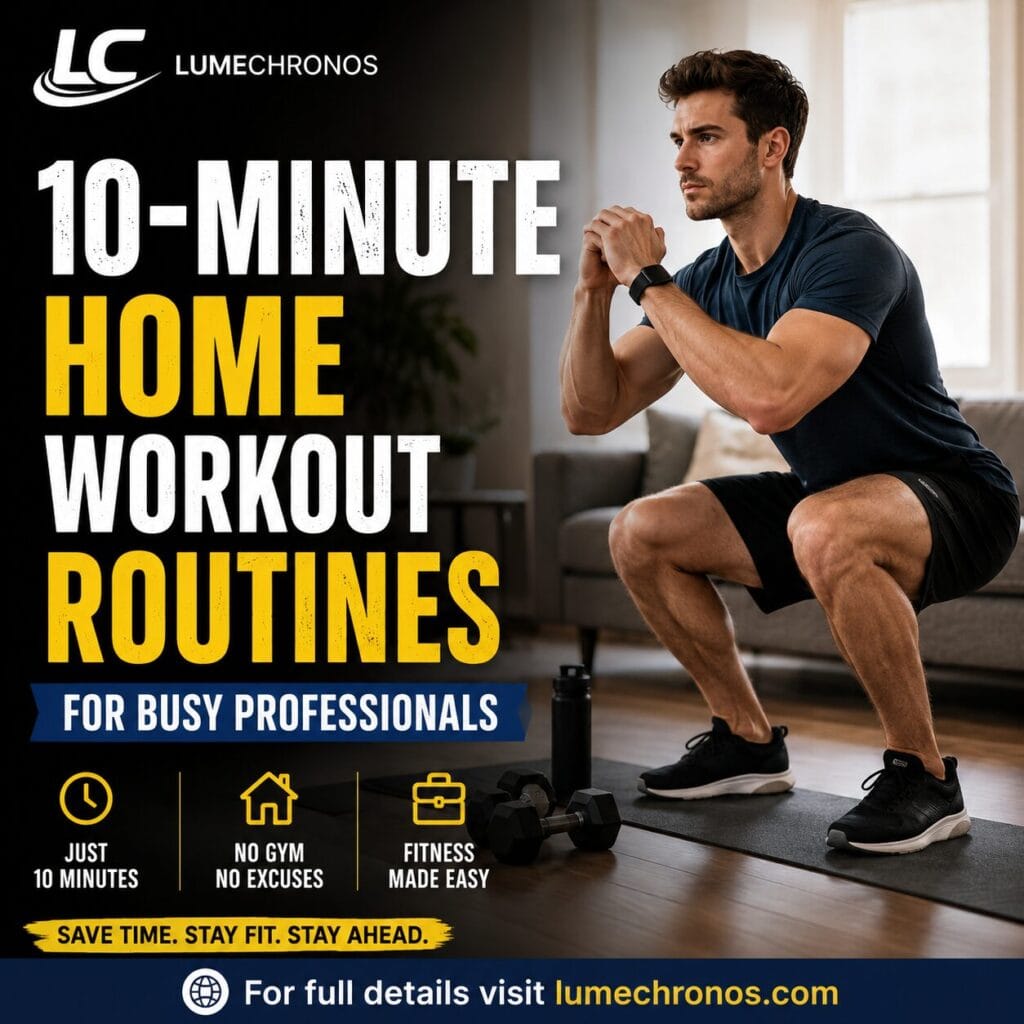
This guide isn’t about selling you on some magical shortcut. It’s about giving you three focused, science-backed workout routines — one full-body circuit, one core-focused session, and one cardio burst — that you can actually do in your living room, before your first meeting, during a lunch break, or right after the kids go to bed. No gym. No equipment required (though optional dumbbells help). Just ten minutes, intentionally spent.
Let’s cut through the confusion and get you moving.
Why 10 Minutes Is More Powerful Than You Think
Most people massively underestimate what ten focused minutes can do — and that’s partly because the fitness industry has conditioned us to believe that “real” workouts are 45–60 minutes with a warm-up, cool-down, and Instagram photo in between.
That thinking isn’t just wrong — it’s actively keeping people sedentary.
The Science Behind Short, High-Effort Workouts
A growing body of research has shifted the conversation around minimum effective dose in exercise. Studies published in journals like PLOS ONE and reports from the American College of Sports Medicine (ACSM) have confirmed that short bouts of high-intensity exercise — when structured correctly — can improve cardiorespiratory fitness, muscular endurance, and even metabolic health markers in time-compressed individuals.
The key variable isn’t duration. It’s effort density — how much useful work you pack into the time you have.
When you do bodyweight squats, push-ups, and high knees back-to-back with minimal rest, your heart rate elevates, your muscles recruit multiple fibers, and your body enters a state of metabolic stress that triggers adaptation. That adaptation is what we call fitness.
In practice, a sloppy 45-minute gym session where you spend 20 minutes checking your phone delivers far less than a focused, structured 10-minute routine where you’re actually working.
The Mental Barrier Is Bigger Than the Physical One
Most people don’t skip workouts because they’re tired. They skip because starting feels overwhelming. “I only have 10 minutes — what’s even the point?” is the thought that kills more fitness habits than any injury ever has.
The answer is simple: the point is that you did it. Consistency compounds. Three 10-minute sessions a week, done faithfully over six months, will reshape your body and your discipline more meaningfully than a January gym membership you abandon by February 15th.
For a deeper look at how building small, consistent habits leads to long-term health transformation, the guides at lumechronos.com offer excellent frameworks rooted in behavioral science and real-world experience.
Helpful Reference: Watch this concise breakdown on why short workouts work scientifically — YouTube: Science of Short Workouts Explained
Workout 1: The Full-Body Circuit (10 Minutes Flat)
This is your bread-and-butter routine. It works every major muscle group — legs, chest, back, shoulders, arms, and core — using nothing but your bodyweight. It’s designed around compound movements, meaning each exercise recruits multiple muscles simultaneously, giving you maximum return on every rep.
The Routine
Structure: 4 exercises × 3 rounds, 45 seconds work / 15 seconds rest between exercises, minimal rest between rounds.
| Exercise | Duration | Muscles Targeted |
|---|---|---|
| Jumping Jacks | 45 sec | Full body, warm-up effect |
| Push-Ups | 45 sec | Chest, triceps, shoulders, core |
| Bodyweight Squats | 45 sec | Quads, glutes, hamstrings |
| Plank Hold | 45 sec | Core, shoulders, back |
How to Do Each Exercise Correctly
Jumping Jacks — Start with feet together and arms at your sides. Jump both feet out while raising arms overhead, then return to starting position. Keep a slight bend in your knees to protect joints. This doubles as a warm-up, spiking your heart rate in the first 30–45 seconds so the rest of the circuit lands harder.
Push-Ups — Place hands slightly wider than shoulder-width. Lower your chest to about an inch from the floor while keeping your body in a straight line from heels to head. Push back up. If full push-ups are too challenging right now, do them on your knees — that’s not cheating, it’s training intelligently. Beginners often make the mistake of letting their hips sag, which shifts load off the chest and strains the lower back.
Bodyweight Squats — Feet shoulder-width apart, toes slightly turned out. Sit back and down as if lowering into a chair, keeping your chest upright and knees tracking over your toes. Drive through your heels to stand. One common mistake: letting your knees cave inward on the way up. Focus on pressing your knees out throughout the movement.
Plank Hold — Forearms on the floor, elbows under shoulders. Body forms a straight line. Don’t let your hips rise or drop. Breathe steadily. If 45 seconds feels easy, you’re not bracing your core hard enough — squeeze it like you’re about to take a punch.
Pro Tip
After two weeks of this routine, add one push-up per session or hold your plank five seconds longer. Progressive overload — adding challenge over time — is what separates people who plateau from people who genuinely progress.
Watch: Full Body 10-Minute Workout — No Equipment (YouTube)
Workout 2: Core Focus (10 Minutes, Deep Burn)
Your core isn’t just your abs. It’s the entire muscular corset around your midsection — the rectus abdominis (the “six-pack” muscle), obliques, transverse abdominis, and lower back. For professionals who sit at desks for hours, a weak core isn’t just a cosmetic issue. It’s a posture problem, a back pain problem, and eventually an injury problem.
This ten-minute core routine targets all of those layers.
The Routine
Structure: 3 exercises × 3 rounds, 40 seconds work / 20 seconds rest.
| Exercise | Duration | Primary Target |
|---|---|---|
| Plank | 40 sec | Deep core, stability |
| Bicycle Crunches | 40 sec | Obliques, rectus abdominis |
| Mountain Climbers | 40 sec | Core, hip flexors, cardio |
How to Do Each Exercise
Plank — Covered in Workout 1, but in this core-focused context, concentrate specifically on the brace. Pull your navel toward your spine. Squeeze your glutes. Don’t forget to breathe. Most people hold their breath during planks and tire out faster than necessary.
Bicycle Crunches — Lie flat on your back with hands lightly behind your head (not pulling on your neck). Bring your right elbow toward your left knee while extending your right leg. Alternate sides in a cycling motion. The mistake most people make is rushing — slow, controlled reps where you feel the rotation in your obliques are worth twice as many sloppy, fast reps.
Mountain Climbers — Start in a high plank (hands on floor, arms straight). Drive one knee toward your chest, then quickly switch legs as if running horizontally. The faster you go, the more cardiovascular demand this adds. The slower you go, the more core control it demands. Both are valid — adjust based on what you’re training for that day.
Why This Matters for Desk Workers
Sitting for 6–8 hours a day shortens your hip flexors and gradually shuts off your glutes and deep core muscles. This is sometimes called “gluteal amnesia” in physiotherapy — your body literally forgets how to properly activate those muscles. A 10-minute core routine done consistently reactivates those muscles, improves posture, and dramatically reduces the risk of lower back pain that plagues so many office workers over 35.
For professionals looking for tools that support active recovery and posture improvement beyond workouts, lumechronos.shop has resources worth exploring.
Watch: 10-Minute Core Workout for Beginners (YouTube)
Workout 3: Cardio Burst (10 Minutes, Maximum Burn)
Some days, you don’t want slow and controlled. You want to sweat, elevate your heart rate, feel like you did something. That’s what this cardio burst routine is for.
This is structured as a simple HIIT (High-Intensity Interval Training) format — 30 seconds of maximum effort, 15 seconds rest, repeat. In 10 minutes, you’ll complete multiple rounds that keep your metabolism elevated for hours after you finish. That post-exercise oxygen consumption effect — the “afterburn” — is one of the legitimate benefits of HIIT that research has validated repeatedly.
The Routine
Structure: 2 exercises alternated for 10 minutes. 30 sec work / 15 sec rest.
| Exercise | Duration | Intensity |
|---|---|---|
| High Knees | 30 sec | High |
| Burpees | 30 sec | Very High |
Repeat this alternating cycle until the 10 minutes are complete. You’ll get approximately 13–14 sets total.
How to Do Each Exercise
High Knees — Stand in place and run, but drive your knees up to hip height with each stride. Pump your arms actively. Keep your core engaged — don’t lean backward. This is more demanding than it looks when done at full effort. The moment you allow your knees to drop, you’ve turned a cardio exercise into a shuffle. Drive those knees up.
Burpees — Here’s the one everyone loves to hate. Stand tall. Drop your hands to the floor. Jump or step your feet back into a plank. Perform a push-up (optional but recommended). Jump or step feet forward. Explode up with arms overhead. Land softly. That’s one rep. If burpees are too intense at first, remove the push-up and replace the jump with a step. Build up over time.
Cardio Tip for Beginners
If you haven’t exercised in a while, start with high knees alternated with rest (no burpees) for the first two weeks. Let your cardiovascular system adapt before layering in the burpees. There’s no medal for injuring yourself in week one.
Watch: 10-Minute HIIT Cardio Workout — No Equipment (YouTube)
How to Schedule These Workouts Into a Real Week
Here’s where most fitness guides fail busy professionals: they give you the exercises but ignore the logistics of actually fitting them into your life.
A Realistic Weekly Template
| Day | Routine | When |
|---|---|---|
| Monday | Full-Body Circuit | Morning (before shower) |
| Tuesday | Rest | — |
| Wednesday | Core Focus | Lunch break |
| Thursday | Rest | — |
| Friday | Cardio Burst | Evening (after work) |
| Saturday | Any of the three | Flexible |
| Sunday | Rest | — |
This is a 3–4x per week structure, which aligns with what exercise physiologists recommend for general fitness and health maintenance in adults. You’re not training for the Olympics — you’re training to feel strong, energetic, and healthy while running a demanding professional life.
The Best Time to Work Out (Honest Answer)
The best time to work out is when you’ll actually do it. Full stop.
That said, morning workouts have a practical edge for busy people: your schedule can’t hijack them. A 7:00 AM workout happens before the day derails you. An “I’ll do it tonight” workout competes with dinner, emails, family, and fatigue.
In practice, experiment with both. Some people feel energized by morning sessions; others find that lunch-break workouts break up cognitive fatigue and reset their afternoon productivity. The routine that works is the one you stick with.
For global perspectives on work-life-fitness balance and how professionals in different cultures approach health habits, the insights at lumechronos.de are worth a read.
Viral Post Reference: Twitter/X thread on morning workout habits of high-performing professionals
Equipment: What You Actually Need (Honest Breakdown)
These three routines require absolutely nothing except a flat surface and about six feet of space. But if you want to layer in some optional equipment as you progress, here’s a practical guide.
Bodyweight Only (All Three Routines)
You don’t need anything. A yoga mat is a nice comfort addition for planks and core work — your elbows will thank you — but it’s not required. If you have hardwood floors, fold a towel.
Optional: Light Dumbbells (5–15 lbs)
Once the bodyweight circuit feels manageable, adding dumbbells to squats and push-up variations dramatically increases the challenge without increasing time. A pair of adjustable dumbbells is one of the most cost-effective fitness purchases available, and unlike gym memberships, they don’t expire.
What You Don’t Need
You don’t need a pull-up bar, resistance bands, a jump rope, or any piece of equipment that requires installation or commitment. Those are additions for later, once you’ve built the habit. Right now, the habit is the investment.
Common Mistakes Busy Professionals Make With Short Workouts
Mistake 1: Treating Every Session Like a Light Warm-Up. Ten minutes only works if you push. Halfway effort produces halfway results. If you can hold a full conversation during your high knees, you’re not working hard enough.
Mistake 2: Skipping Rest Days. More is not always better. Your body adapts during rest, not during exercise. Three to four sessions per week with recovery days is superior to seven sloppy sessions.
Mistake 3: Expecting Instant Results. The first two weeks of any new routine feel hard and produce little visible change. This is normal. The adaptation curve takes four to six weeks to show meaningfully. Most people quit at week two. Don’t.
Mistake 4: Ignoring Nutrition. Ten minutes of exercise won’t outwork a diet of processed food and caloric surplus. These workouts support health — they’re most effective when paired with reasonable eating habits, adequate sleep, and hydration.
Mistake 5: Never Progressing. If you’ve been doing the same routine for three months and it feels easy, that’s your signal to add reps, reduce rest, or increase intensity. Comfort is not progress.
FAQ: 10-Minute Home Workouts for Busy Professionals
Can you actually get fit with only 10 minutes of exercise a day? Yes — with an important condition. “Fit” relative to what? If the baseline is sedentary, then ten focused minutes three to four times per week will meaningfully improve cardiovascular health, muscular endurance, and energy levels. Research consistently shows that any structured physical activity is dramatically better than none. For advanced athletic performance, you’ll eventually need more volume. But for the average desk-bound professional trying to feel strong and healthy, ten high-quality minutes is genuinely sufficient to build and maintain baseline fitness.
What is the best short workout for someone with absolutely no time? The Full-Body Circuit in this guide — jumping jacks, push-ups, squats, and a plank hold — is arguably the most efficient option available for time-pressed adults. It hits every major muscle group, elevates the heart rate, and requires zero equipment. If you can only do one workout from this entire guide, that’s the one.
Is a 10-minute workout enough to lose weight? It can support weight loss as part of a broader approach. Exercise burns calories and improves metabolic health, but weight loss is primarily driven by overall caloric balance (calories consumed vs. calories burned over time). Ten minutes of intense bodyweight exercise burns roughly 80–140 calories depending on body size and effort. That’s not a dramatic number, but combined with consistent eating habits, it contributes meaningfully. The more honest benefit for weight management is the metabolic improvement and habit formation that come from regular exercise.
Do I need to warm up before a 10-minute workout? For most healthy adults doing bodyweight routines, the first exercise — like jumping jacks — functions as a dynamic warm-up. If you’re exercising first thing in the morning or if you’re over 45, spend 60–90 seconds doing gentle arm circles, hip rotations, and light marching in place before diving into the main set. Cold muscles are more injury-prone.
Can I do these workouts every single day? You can, but you probably shouldn’t — at least not at full intensity. Three to four sessions per week with rest days allows your muscles, connective tissue, and nervous system to recover. If you want to do something daily, alternate between a harder session and a lighter session (like just the core routine at moderate effort). Active recovery — light walking, stretching — on rest days is also beneficial.
How long before I see results from 10-minute home workouts? Most people begin to feel results — better energy, reduced stiffness, improved mood — within two to three weeks. Visible physical changes (muscle tone, posture improvement) typically become noticeable around the six-week mark when combined with reasonable nutrition. The timeline varies based on starting fitness level, consistency, sleep quality, and diet. Patience and consistency are non-negotiable.
Are these workouts safe for beginners with no fitness background? Yes, with appropriate modifications. Beginners should start with knee push-ups instead of full push-ups, remove burpees from the cardio routine initially, and take extra rest between exercises. Listen to your body — sharp joint pain (not muscle fatigue) is a signal to stop and reassess form or intensity. If you have any pre-existing medical conditions, consult a physician before starting any new exercise program.
What if I miss a session? Miss it and move on. One skipped session means nothing. The pattern of skipping — where one missed day becomes three, then a week, then the end of the habit — is what matters. If you miss a session, schedule the next one immediately. Don’t try to “make up” for it by doubling the intensity next time. Just resume the normal plan.
Key Takeaways
Here’s what matters most from everything covered in this guide:
- Ten focused minutes beats zero minutes every single time. The size of your commitment matters less than the consistency of it. Done imperfectly three times a week for a year beats the perfect plan you abandoned after two weeks.
- The three routines cover everything: Full-Body Circuit for overall strength and conditioning, Core Focus for posture and back health, Cardio Burst for fat burning and cardiovascular fitness. Rotating between them prevents boredom and ensures balanced development.
- Effort density is the key variable. Short workouts only work when you actually push. If the 10 minutes feel easy, you’re not doing them right. Heart rate should be elevated. You should finish slightly breathless.
- Schedule workouts like meetings. Block the time in your calendar. Give it a location (your living room, hotel room, office break room). Treat it as non-negotiable. The professionals who stay fit aren’t more motivated — they’re just more systematic.
- Avoid the “all or nothing” trap. Missing one session doesn’t ruin anything. Three months of “mostly consistent” training beats one month of perfect training followed by complete abandonment. The middle path — regular, imperfect effort — is where long-term results live.
- Nutrition and sleep amplify everything. Workouts are one pillar. You’re building on unstable ground if you’re sleeping five hours and eating poorly. The workouts in this guide work best as part of a broader commitment to health, not a substitute for it.
- Progress gradually. Add one rep, subtract five seconds of rest, or increase the number of rounds every two weeks. Small progressive challenges are what prevent plateaus and keep the body adapting.
Final Thoughts: Your Ten Minutes Start Now
There’s a version of you six months from now who stayed consistent with these workouts. That version is leaner, has less back pain, sleeps better, thinks more clearly, and manages stress with noticeably more resilience. The only difference between where you are now and that version is a decision — made today, and then remade every morning or lunch break for the next six months.
You don’t need a gym membership, a personal trainer, or a two-hour window in your calendar. You need a clear space, ten minutes, and the discipline to take this seriously enough to start.
Start with the Full-Body Circuit. Do it three times this week. That’s it. Don’t overthink the plan — the plan works when you work it.
If you found this guide useful, share it with a colleague who keeps saying they “don’t have time to exercise.” Send it to your work group chat. Leave a comment below with which routine you’re starting with — Full-Body Circuit, Core Focus, or Cardio Burst? We read every reply.
For more in-depth health and lifestyle guides built for real people with real schedules, explore lumechronos.com. For practical tools and resources that support an active professional lifestyle, check out lumechronos.shop. And for a global lens on work-life balance and fitness culture, visit lumechronos.de.
Reference Resources:
- American College of Sports Medicine — Exercise is Medicine
- Harvard Health Publishing — The Case for Exercise
- YouTube: Jeff Nippard — Minimum Effective Dose for Fitness
- YouTube: Athlean-X — 10 Minute Full Body Workout
- Twitter/X: Fitness habit threads for busy people
This article is based on insights from real-time trends and verified sources including trusted industry platforms.