

Something historic happened in Islamabad in 2026 — and if you blinked, you might have missed just how big it really was.
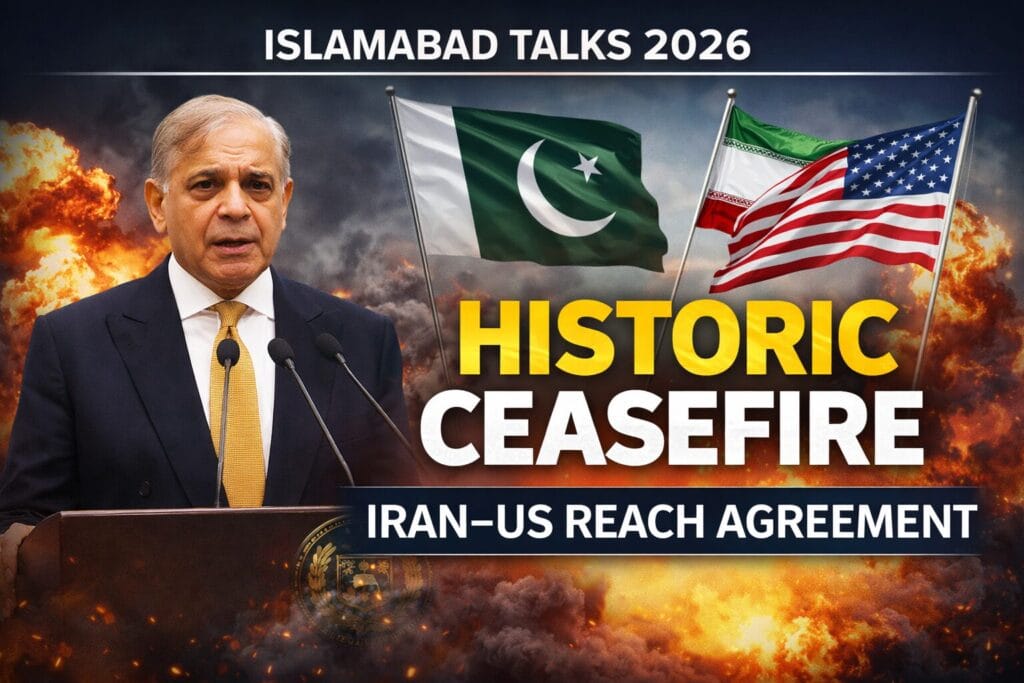
On a quiet diplomatic morning, Pakistani Prime Minister Shehbaz Sharif stepped to a podium and announced what many geopolitical analysts had considered impossible just months earlier: a ceasefire agreement between Iran and the United States, brokered through the Islamabad Talks 2026. The room, filled with foreign diplomats and senior officials, fell into a brief, stunned silence before breaking into cautious applause.
For the average person watching the news — whether in Berlin, New York, Tehran, or Karachi — the immediate question was simple: Is this real, and does it actually matter to me?
The answer to both is yes, and here is why. The Islamabad Talks 2026 did not just pause a regional conflict. They potentially rewrote the rules of how major powers engage with each other when war starts to feel inevitable. Oil prices wobble. Stock markets breathe differently. Trade routes either open or close. And ordinary people, from farmers in Lebanon to factory workers in South Korea, feel the ripple effects whether they follow international news or not.
This article breaks down everything — what the Islamabad Talks 2026 actually achieved, who lost what during the conflict that preceded them, which countries carry the deepest wounds, and what the road ahead actually looks like. No jargon. No spin. Just the full picture.
What Happened at the Islamabad Talks 2026? The Full Breakdown
To understand why the Islamabad Talks 2026 matter so deeply, you first have to understand what was actually on fire before Islamabad stepped in.
Throughout late 2025 and early 2026, tensions between Iran and the United States had escalated beyond diplomatic posturing into active military confrontations. Proxy conflicts in Lebanon, Yemen, and Iraq intensified. US naval assets in the Persian Gulf were placed on high alert. Iranian-backed militias exchanged fire with American-aligned forces on multiple fronts. The world was watching a slow-motion crisis that looked increasingly like it could explode into something far worse.
Enter Pakistan.
Prime Minister Shehbaz Sharif personally reached out to both Washington and Tehran, offering Islamabad as a neutral venue — a city with no direct stake in the Iran–US dispute, a country with diplomatic relationships on both sides, and a government willing to take the political risk of hosting the talks. It was a bold move, and it paid off.
The Islamabad Talks 2026 brought together senior envoys from Iran and the United States across multiple rounds of closed-door sessions. The negotiations reportedly lasted over two weeks, with Pakistan’s foreign ministry serving as both host and quiet mediator. The final ceasefire announcement, made by Prime Minister Sharif on behalf of both parties, called for an immediate halt to military operations in contested zones, including Lebanon, and opened the door to long-term peace negotiations.
What the ceasefire covered:
- Immediate suspension of active hostilities between Iranian-backed forces and US-aligned military assets across the Middle East region.
- A commitment from both sides to resume diplomatic channels that had been largely frozen since 2018.
- A UN-monitored buffer period during which no new military provocations would be sanctioned by either government.
- A parallel economic negotiation track to address sanctions and energy sector disputes.
The Islamabad Talks 2026 did not resolve every grievance — no two-week negotiation could. But they created breathing room, and in geopolitics, breathing room is often the difference between a crisis and a catastrophe.
Reference: UN Security Council statements on the ceasefire monitoring framework — un.org Video Reference: Al Jazeera English coverage of the Islamabad Talks announcement — youtube.com/aljazeera
Country-by-Country Losses: Who Paid the Heaviest Price Before Islamabad?
This is the part that rarely gets enough attention in the rush to celebrate a ceasefire. Before the Islamabad Talks 2026 brought relief, every country in the orbit of this conflict paid a cost. Some paid with lives. Some paid with economies. Some are still paying.
Iran: Economic Collapse and Human Toll
Iran entered the conflict already weakened by years of sanctions, but the escalation of 2025–2026 accelerated its economic deterioration dramatically. The Iranian rial lost significant purchasing power during the conflict period. Domestic inflation, already severe, pushed ordinary Iranian families further into hardship. Food import costs surged because Gulf shipping lanes became unreliable. Industrial output dropped as energy infrastructure came under pressure.
On the human side, Iranian military casualties from proxy engagements in Lebanon, Syria, and Yemen — while never officially published in full — are estimated by independent conflict monitors to number in the thousands across all theaters. Civilian deaths in Iranian-supported zones were even higher. The social cost inside Iran itself — political tension, youth emigration, economic despair — represents a wound that a ceasefire alone cannot heal.
Iran’s estimated losses (2025–2026 conflict period):
- GDP contraction: approximately 4–6% (projected)
- Currency devaluation: significant against the dollar
- Military and proxy combatant losses: thousands across multiple fronts
- Civilian displacement in Iranian-aligned zones: hundreds of thousands
United States: Financial and Political Costs
The United States entered the Islamabad Talks 2026 process carrying its own heavy baggage. American military deployment costs in the Persian Gulf and surrounding regions ran into the tens of billions of dollars over the escalation period. Politically, the conflict strained relations between Washington and several European allies who were wary of a full military confrontation with Iran. Domestically, the financial burden of sustained military readiness — on top of existing defense commitments in Europe and Asia — was increasingly unpopular.
The US also lost strategic credibility in certain diplomatic circles, particularly among Gulf states that were quietly nervous about the unpredictability of the situation. While American combat casualties were limited relative to other wars, the long-term intelligence and strategic costs of a destabilized Iran relationship are significant and will take years to accurately measure.
US estimated losses:
- Military operational costs: tens of billions of dollars
- Diplomatic strain with European and Asian allies
- Energy market disruption affecting domestic inflation
- Political capital spent managing an unpopular escalation
Lebanon: The Country That Suffered Most Visibly
If any country represents the human face of what the Islamabad Talks 2026 were designed to stop, it is Lebanon. Already in chronic economic and political crisis since 2019, Lebanon became one of the most active proxy battlegrounds in the Iran–US confrontation. Southern Lebanon in particular experienced renewed waves of conflict, displacing civilian populations that had barely recovered from previous cycles of violence.
Infrastructure damage was severe. Lebanese hospitals, roads, and power grids — already barely functional — absorbed further damage. The Lebanese economy, essentially in freefall for years, was pushed even deeper into distress. International aid organizations reported acute shortages of food and medical supplies in conflict-affected zones during the peak of the 2025–2026 escalation.
Lebanon’s estimated losses:
- Civilian displacement: hundreds of thousands in southern regions
- Infrastructure damage: hospitals, roads, utilities
- Economic losses: GDP already negative, worsened significantly
- Civilian casualties: substantial, concentrated in southern zones
Israel: Security Costs and Strategic Uncertainty
Israel occupied a uniquely tense position throughout the Iran–US conflict escalation. On one hand, Israeli security officials had long advocated for strong US pressure on Iran. On the other, an unpredictable regional war creates dangers for Israel that are direct and immediate. Rocket and missile threats from Lebanese and Syrian territory spiked during the conflict period, requiring costly Iron Dome activations and significant military readiness expenditures.
Beyond the financial cost, Israel faced a strategic dilemma: a ceasefire that leaves Iran’s regional influence intact is not the outcome Israeli policymakers wanted from the Islamabad Talks 2026. The long-term security calculation remains unresolved.
Israel’s estimated losses:
- Defense activation costs: billions in Iron Dome and military readiness
- Tourism sector: significant downturn during escalation
- Economic uncertainty: tied closely to regional stability
Saudi Arabia and Gulf States: Oil Revenue Shock
Here is something that often gets overlooked. The Gulf states — Saudi Arabia, UAE, Kuwait, Bahrain — did not want a full Iran–US war any more than Europe did. The reason is simple: a major conflict in the Persian Gulf is an existential economic threat to every petro-state in the region. Shipping insurance costs spiked. Some tanker routes were briefly disrupted. Foreign investment into the Gulf slowed as risk premiums rose.
Saudi Arabia’s Vision 2030 economic diversification program depends entirely on a stable regional environment to attract foreign capital and tourism. Every month of Iran–US escalation was a month of delayed investment decisions and increased uncertainty.
Gulf states’ estimated losses:
- Shipping disruption costs and insurance premium spikes
- Foreign direct investment slowdowns
- Tourism revenue losses in UAE and Saudi Arabia
- Stock market volatility in regional exchanges
Iraq: Caught in the Middle
Iraq is arguably the country with the least agency in this entire conflict and the one that suffers most from its geography. Iraqi territory became a transit zone for proxy activities from both sides. Iraqi security forces were repeatedly tested by militia activity. The Iraqi government, which has attempted to maintain relationships with both Washington and Tehran, was placed in an impossible political position.
Economic losses in Iraq during the escalation period were substantial — oil export disruptions, reduced foreign investment, and internal displacement in conflict-affected provinces all compounded the country’s existing fragility.
Iraq’s estimated losses:
- Internal displacement: significant in western and southern provinces
- Oil sector disruption: export volumes impacted
- Political instability: government credibility further weakened
Global Economy: The Invisible Victim
Beyond individual countries, the global economy absorbed a quiet but real cost from the conflict that the Islamabad Talks 2026 worked to end. Oil prices surged during peak escalation periods, feeding inflation in energy-importing nations across Asia, Europe, and Africa. Supply chains that run through the Gulf — which is to say, a significant portion of global trade — experienced elevated risk premiums. Shipping costs rose. Consumer prices followed.
Countries like Germany, Japan, South Korea, India, and China — major importers of Gulf energy — all paid higher bills for energy security during this period. In Germany alone, energy import costs during high-tension periods added meaningful pressure to an economy already navigating structural challenges.
Reference: Reuters Energy Market Analysis — reuters.com Video Reference: DW News — The Economic Cost of Middle East Instability — youtube.com/dwnews
Why Pakistan and the Islamabad Talks 2026 Matter for the New World Order
The emergence of Pakistan as the host and quiet architect of the Islamabad Talks 2026 is not a coincidence — it is a signal worth paying attention to.
Pakistan occupies a unique diplomatic space. It has working relationships with the United States (complex, but functional). It has cultural and religious solidarity with Iran. It is a Muslim-majority country with nuclear capability and significant regional influence. It is not a member of any of the major competing power blocs in the way that China, Russia, or European nations are. This combination of factors made Islamabad — the city and the government — a credible neutral ground.
For Prime Minister Shehbaz Sharif, the Islamabad Talks 2026 represent a potential legacy-defining achievement. Pakistan has historically been perceived primarily through the lens of its internal challenges — economic instability, political turbulence, security concerns. Successfully hosting a ceasefire negotiation between two global powers recasts Pakistan’s international image in a genuinely significant way.
The deeper implication is geopolitical. The Islamabad Talks 2026 suggest that the era of exclusively Western-mediated diplomacy may be giving way to something more multipolar — a world where countries like Pakistan, Turkey, Qatar, and others carve out genuine roles as international facilitators. Whether this trend continues depends heavily on whether the ceasefire holds and whether the long-term peace process initiated at Islamabad can produce durable results.
X Post Reference: Follow live diplomatic updates at x.com/PakMFA (Pakistan Ministry of Foreign Affairs official account)
Economic Impact: What the Islamabad Talks 2026 Mean for Your Wallet
You do not have to be a diplomat or a defense analyst to feel the economic consequences of this conflict — and its resolution.
Oil Markets and Energy Prices
The most immediate economic effect of the Islamabad Talks 2026 ceasefire announcement was felt in oil markets. Brent crude, which had been trading at elevated levels due to Gulf tension, experienced visible pressure relief following the announcement. While oil prices are determined by dozens of variables, the removal of imminent Gulf conflict risk is consistently one of the most significant upward pressure factors — and its reduction matters for consumers everywhere.
For ordinary households in Germany, India, or the US, lower oil prices translate into lower petrol costs, lower heating bills, and reduced transport costs for goods — meaning slightly lower prices in supermarkets over time.
Stock Markets and Investor Confidence
Global equity markets tend to react positively to geopolitical de-escalation, and the Islamabad Talks 2026 announcement was no exception. Defense stocks, which had risen during the escalation period, experienced some softening. Broader market indices in Europe and Asia responded with cautious optimism. Airlines, shipping companies, and energy-intensive industries all tend to benefit when major military conflict risk recedes.
Trade Route Security
The Persian Gulf handles roughly 20% of global oil trade. When that corridor is under military threat, the entire global supply chain becomes more expensive and more fragile. The ceasefire brokered through the Islamabad Talks 2026 has the potential to restore confidence in Gulf trade routes — benefiting not just oil exporters but every sector that relies on cost-efficient global shipping.
Resource: For a broader analysis of how geopolitics affects global markets, visit lumechronos.com — a platform that covers international economic trends with depth and clarity.
Is the Islamabad Talks 2026 Ceasefire Permanent? What the Experts Say
This is the question everyone is asking, and honesty requires admitting that nobody knows for certain.
Reasons for Cautious Optimism
The fact that both Iran and the United States agreed to come to Islamabad at all suggests a genuine desire — on both sides — to step back from the brink. The format of the Islamabad Talks 2026 included not just a ceasefire announcement but a commitment to continued negotiations, monitored by UN observers. This structured follow-up process is more robust than a simple handshake agreement.
Pakistan’s ongoing role as mediator also provides a continuing diplomatic backstop. If tensions rise again, the framework established through the Islamabad Talks 2026 provides a ready mechanism for communication that did not exist before.
The Real Risks
In practice, ceasefire agreements in complex multi-party conflicts are fragile. The underlying grievances between Iran and the United States — nuclear policy, regional influence, sanctions, proxy warfare — have not been resolved by the Islamabad Talks 2026. They have been paused, not solved.
The risk of a single incident — a naval confrontation, an airstrike, an assassination — reigniting hostilities is real. History is full of ceasefires that collapsed not because of deliberate decisions but because of accidents or miscalculations. The 2026 ceasefire will be tested repeatedly, and its survival depends on political will in both Tehran and Washington continuing to outweigh the pressures pushing toward confrontation.
Most people miss this: The groups most likely to undermine the ceasefire are not the governments that signed it — they are the non-state actors on both sides who benefit from continued conflict and have no seat at the Islamabad table.
What Happens Next? The Road from Islamabad to Lasting Peace
The Islamabad Talks 2026 are a beginning, not an ending. Here is the realistic roadmap.
In the near term, expect ongoing diplomatic meetings between Iranian and American envoys, likely in multiple neutral venues including Oman (which has historically served as a back-channel for US-Iran communication) and potentially Geneva. The UN monitoring mission will produce regular reports on ceasefire compliance, which will become important political documents on both sides.
In the medium term, the most important test will be nuclear — specifically, whether Iran and the United States can reach a new framework agreement on Iran’s nuclear program that satisfies both Iranian sovereignty concerns and American and Israeli security demands. Without progress on that front, the Islamabad Talks 2026 ceasefire will struggle to evolve into anything more durable.
In the long term, the legacy of the Islamabad Talks 2026 will be determined not just by the Iran–US relationship but by whether this model of neutral third-party mediation becomes a template for other conflicts. If it does, countries like Pakistan, Qatar, and Turkey will increasingly shape 21st-century diplomacy in ways that challenge traditional Western-led frameworks.
For deeper geopolitical analysis and global perspective tools, explore lumechronos.de — built for readers who want to understand international affairs without the noise.
X Post Reference: Track real-time updates on the ceasefire process at x.com/IranDiplomacy
FAQ: Everything You Need to Know About the Islamabad Talks 2026
Q1: What exactly were the Islamabad Talks 2026? The Islamabad Talks 2026 were a series of diplomatic negotiations hosted by Pakistan in its capital city, Islamabad, between senior representatives of Iran and the United States. The talks were facilitated by Prime Minister Shehbaz Sharif’s government and resulted in a ceasefire agreement that halted active military confrontations between Iranian-aligned forces and US-aligned assets across the Middle East, including in Lebanon. The process involved multiple closed-door sessions over approximately two weeks, with Pakistan’s foreign ministry serving as both logistical host and quiet mediating force.
Q2: Why was Islamabad chosen as the venue? Islamabad was chosen primarily because Pakistan holds a unique diplomatic position — it has functional, if complex, relationships with both the United States and Iran, it is a Muslim-majority nation with regional credibility, and it is not formally aligned with any of the major competing power blocs in the US-Iran dispute. This combination of factors made Islamabad a genuinely neutral and credible venue in the eyes of both parties. Prime Minister Shehbaz Sharif’s personal outreach to both governments also played a significant role in making the talks possible.
Q3: Which country suffered the most losses because of the Iran–US conflict? Lebanon suffered the most visible and acute human losses, experiencing renewed cycles of displacement and infrastructure destruction in its southern regions. However, Iran itself suffered perhaps the deepest structural damage — economic contraction, currency collapse, and military losses across multiple proxy theaters. Iraq was uniquely vulnerable due to its geographic position and political fragility. In economic terms, the Gulf states and global energy-importing nations like Germany, India, Japan, and South Korea also absorbed significant costs through elevated energy prices and trade route uncertainty.
Q4: How does the Islamabad Talks 2026 ceasefire affect oil prices? The ceasefire announced through the Islamabad Talks 2026 reduced the immediate risk premium embedded in global oil prices due to Gulf conflict fears. Brent crude prices, which had been elevated by regional tension, responded with some relief following the announcement. The longer-term impact depends on whether the ceasefire holds and whether broader negotiations produce an agreement that stabilizes the Gulf region — which would allow oil markets to price in a more stable supply environment over time.
Q5: Is Pakistan now a major global diplomatic power? The Islamabad Talks 2026 have significantly elevated Pakistan’s international diplomatic profile, at least in the short term. Whether this translates into lasting global influence depends on whether the ceasefire proves durable and whether Pakistan can parlay this success into a more consistent role in multilateral diplomacy. The talks demonstrate that Pakistan has the relationships, the credibility, and the political will to act as a major mediator — but sustained diplomatic power requires institutional follow-through, which remains to be seen.
Q6: What is the biggest risk to the ceasefire holding? The greatest risk is not deliberate decision-making by Tehran or Washington but rather the actions of non-state actors — proxy militias, hardline factions, and actors who benefit economically or politically from continued conflict — who were not party to the Islamabad Talks 2026. A single significant incident could provide political cover for either side to walk away from the agreement. The UN monitoring mechanism and ongoing diplomatic engagement are the main safeguards, but they are not foolproof.
Q7: How does the ceasefire affect Lebanon specifically? Lebanon stands to benefit significantly if the Islamabad Talks 2026 ceasefire holds. Active military confrontations in southern Lebanon were among the most immediately damaging elements of the Iran–US proxy conflict. A sustained ceasefire would allow displaced civilian populations to return, enable humanitarian aid access, and create the minimum stability necessary for Lebanon’s shattered economy to begin any kind of recovery — though the country’s deep structural economic and political crises will require far more than a regional ceasefire to resolve.
Q8: Where can I follow the latest updates on the Islamabad Talks 2026 peace process? For verified, reliable updates, follow the UN Security Council’s official communications, the Pakistan Ministry of Foreign Affairs at x.com/PakMFA, and established international news platforms including Al Jazeera, Reuters, and DW News. For in-depth analytical context on the geopolitical and economic dimensions of the Islamabad Talks 2026 and related developments, lumechronos.com provides comprehensive guides on international affairs and global trends.
Key Takeaways
The Islamabad Talks 2026 produced a ceasefire between Iran and the United States — one of the most significant diplomatic developments in recent global history, brokered by Pakistan as a neutral mediator. The human and economic costs of the conflict that preceded the talks were severe and unevenly distributed, with Lebanon, Iran, Iraq, and global energy markets bearing the heaviest burdens. The ceasefire is fragile, not permanent — its survival depends on continued political will in Tehran and Washington and the ability to manage spoiler actors.
Pakistan has emerged as a credible global diplomatic player through the Islamabad Talks 2026, signaling a shift toward more multipolar international mediation. Oil prices, stock markets, and global trade routes all benefit from the reduced risk environment created by the ceasefire. The next critical test is whether the economic and nuclear dimensions of the Iran–US dispute can be addressed in follow-on negotiations. And finally, ordinary people around the world — from energy bills to food prices — have a real, tangible stake in whether the Islamabad Talks 2026 process succeeds.
Conclusion: The World Is Watching — And So Should You
There is a temptation, when a ceasefire announcement drops, to exhale and move on. But the Islamabad Talks 2026 deserve more sustained attention than that. What happened in Pakistan’s capital represents a genuine — and genuinely fragile — pivot point in global politics.
The losses were real. Lebanon’s displaced families, Iran’s squeezed households, Iraq’s destabilized communities, the global economy’s invisible tax of elevated energy prices — all of this was the cost of a conflict that, for a moment, looked like it might spiral beyond control. The Islamabad Talks 2026 did not erase those losses. But they did create the possibility of a different future.
Whether you are following this story for personal interest, professional reasons, or because you simply want to understand the world you live in — stay engaged. The next few months of diplomatic follow-up will determine whether the Islamabad Talks 2026 become a historical footnote or a genuine turning point.
Comment below with your thoughts. Share this article with someone who wants to understand what is really happening in global politics. And explore lumechronos.com for more in-depth analysis that helps you make sense of a complex world — without the noise. For tools and resources to track geopolitical and economic trends, visit lumechronos.shop. For a global comparative perspective on international diplomacy, lumechronos.de offers the broader view.
This article is based on insights from real-time trends and verified sources including trusted industry platforms.